Artwork
Akbar and Abdu'r Rahim
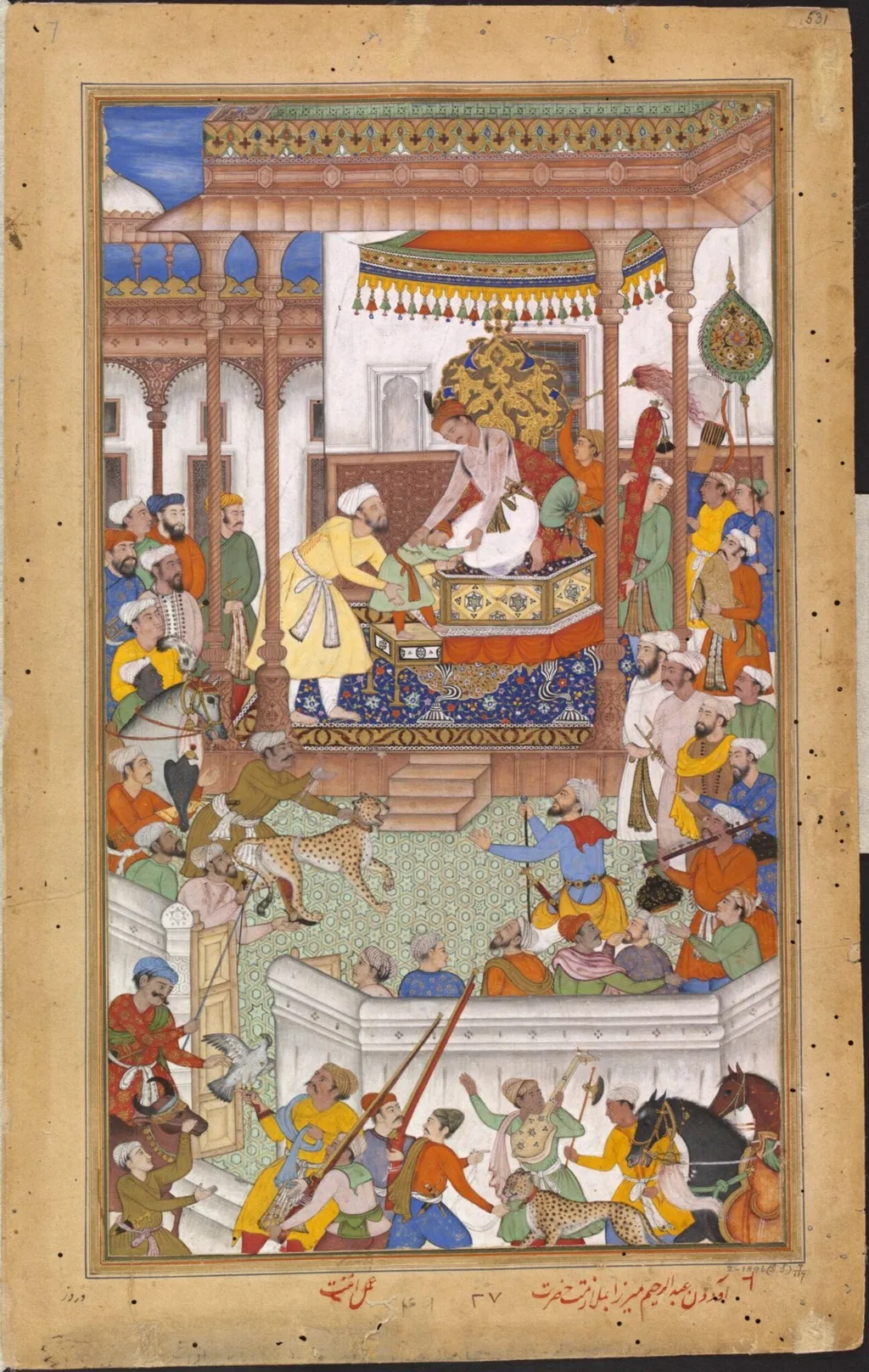
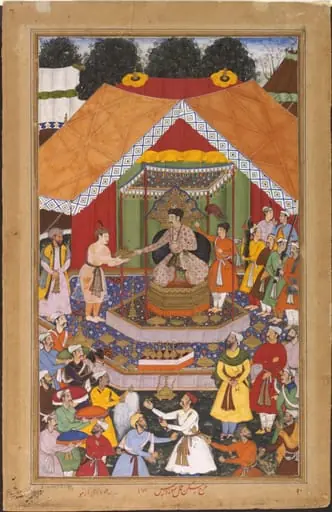
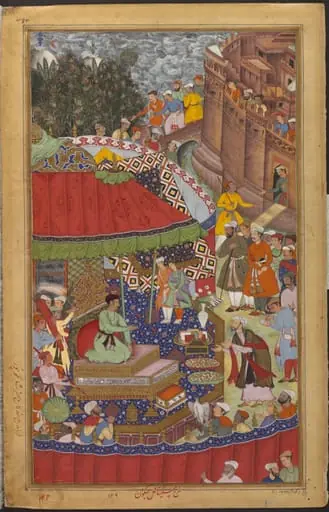
Akbar and Abdu'r Rahim is a paint painting by the Mughal Painting artist Anant. It dates from 1592 and is held in the collection of the Victoria and Albert Museum.
About this work
Overview
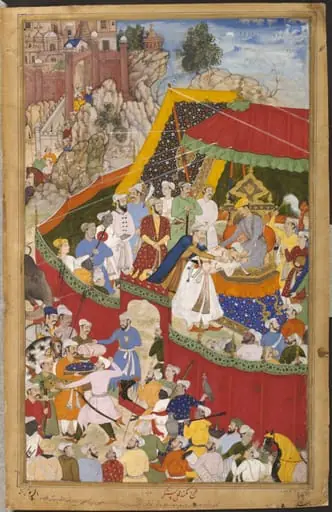
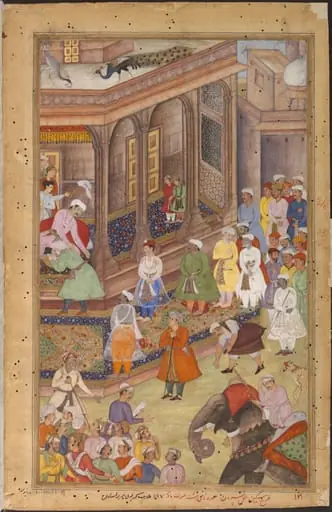
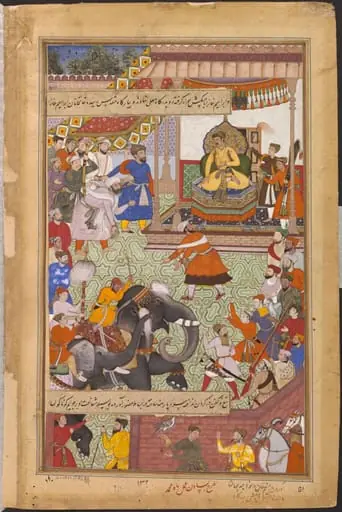
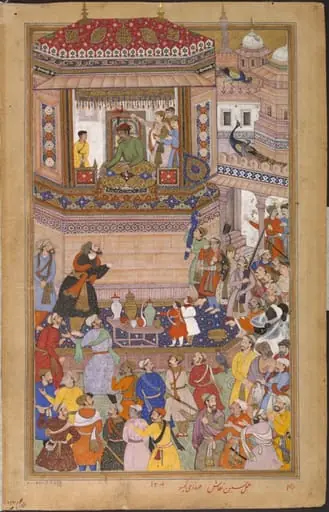
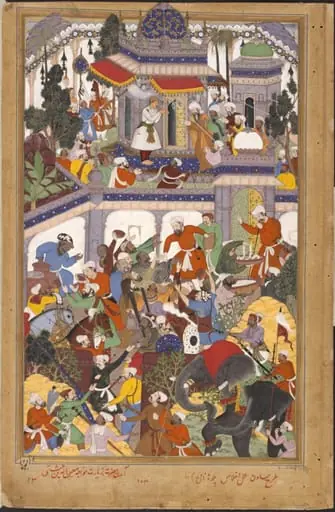
The miniature, executed in the Mughal court workshop, records a 1561 ceremony in which Emperor Akbar receives the four‑year‑old Abdu’r Rahim. The child, whose father Bairam Khan—Akbar’s chief general—had been assassinated, is assisted onto the raised platform by a second figure, possibly Ataga Khan. The scene is set within a formal audience hall surrounded by courtiers and guards.
Subject & Meaning
The composition emphasizes Akbar’s authority and magnanimity, portraying the young heir of a fallen commander being welcomed into the imperial presence. By publicly acknowledging the boy, the emperor signals continuity of governance and his capacity to integrate former rivals into the royal fold, reinforcing the stability of his reign after a violent loss.
Technique & Style
Rendered as a detailed miniature, the work employs the fine brushwork and rich pigments characteristic of late‑16th‑century Mughal painting. Figures are delineated with precise line, while the use of gold leaf and subtle shading creates depth in the throne and garments, reflecting the sophisticated synthesis of Persian artistic conventions with Indian courtly motifs.
History & Provenance
The image forms part of the Akbarnama, the official chronicle commissioned by Akbar and authored by his historian Abu’l‑Fazl between 1590 and 1596.
The image forms part of the Akbarnama, the official chronicle commissioned by Akbar and authored by his historian Abu’l‑Fazl between 1590 and 1596. Illustrated circa 1592‑94 by a team of at least forty‑nine court artists, the manuscript remained in the royal libraries of Akbar’s successors Jahangir and Shah Jahan. The Victoria and Albert Museum acquired the volume in 1896 from the estate of Major General Clarke, former Commissioner of Oudh.
Context
The Akbarnama served both as a historical record and a visual assertion of imperial legitimacy. This particular miniature underscores the political narrative that Akbar could maintain order and patronage even after the death of his chief military advisor, reinforcing the image of a unified and enduring empire.
Artist & collection
Artist
Anant made delicate Mughal drawings that bring old Persian tales to life. The king in *The king forgives his hungry chamberlain* sits draped in gold while Akbar and Abdu'r Rahim stand in a garden scene, their robes…