Artwork
Portrait of Gadadhar Prasad
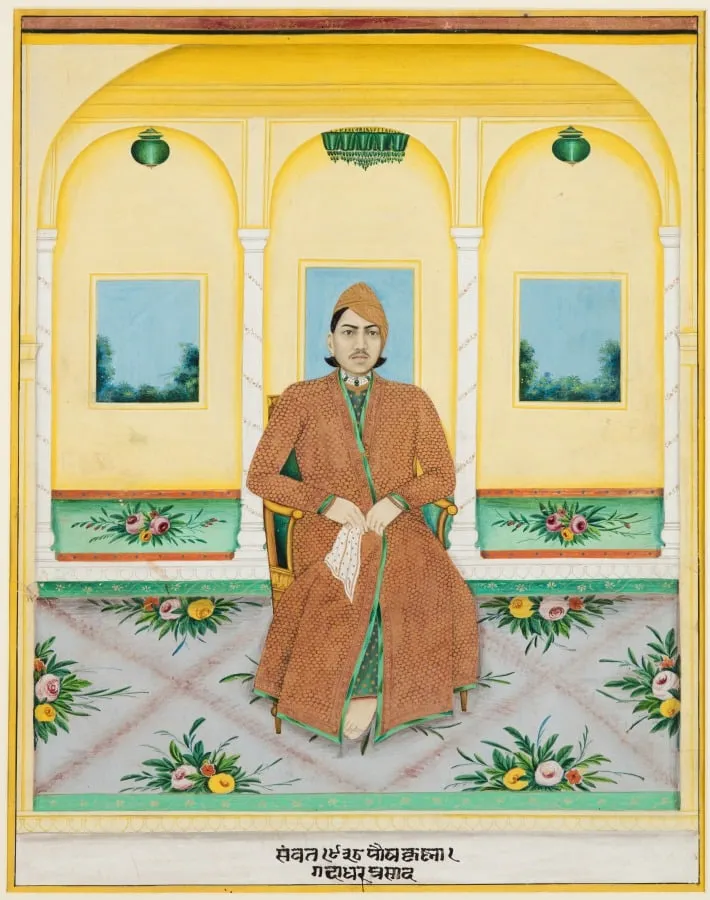
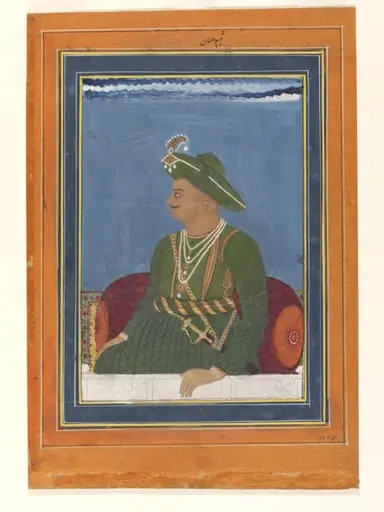
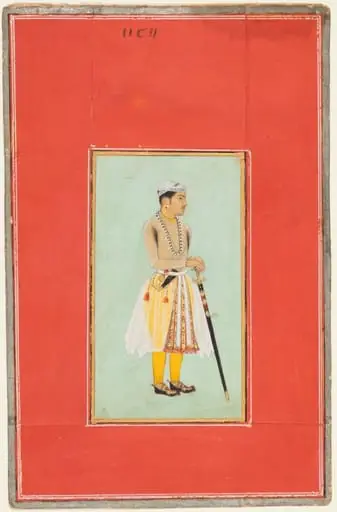
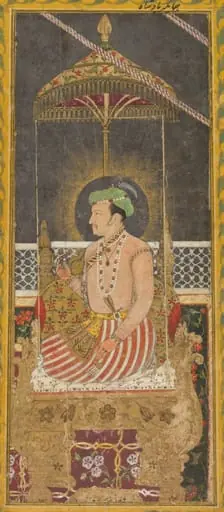
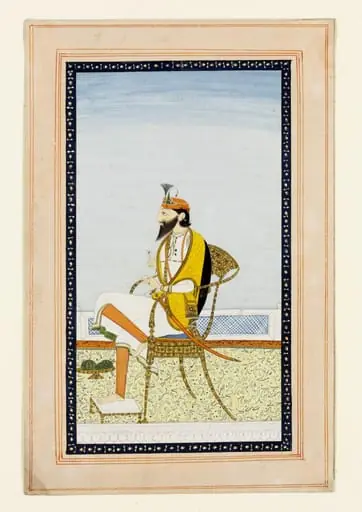
Portrait of Gadadhar Prasad is an unspecified painting by the Patna School of Painting artist Unknown. It dates from 1881 and is held in the collection of the Cleveland Museum of Art. This oil painting depicts a man from the Rajput nobility of Alwar, seated in a richly furnished interior.
About this work
Overview
The composition departs from traditional Rajasthani profile views, adopting a direct frontal pose uncommon in regional portraiture.
This oil painting depicts a man from the Rajput nobility of Alwar, seated in a richly furnished interior. He wears elaborate jewelry and a layered robe of gold and maroon silk, seated on a carved wooden chair atop an ornate carpet. The setting includes hanging green glass lamps, suggesting a blend of local craftsmanship and imported materials. The composition departs from traditional Rajasthani profile views, adopting a direct frontal pose uncommon in regional portraiture.
Subject & Meaning
The sitter is likely a local ruler or high-ranking noble, identified by his regal attire and adornments. The pearls and emeralds signify wealth and status, while the frontal gaze conveys authority and presence. Unlike conventional Rajasthani portraits that emphasize lineage and ritual, this image projects individual dignity and self-awareness, possibly reflecting the subject’s engagement with evolving cultural norms during the 19th century.
Technique & Style
The artist combines Indian miniature traditions with European naturalism. Facial features are rendered with subtle modeling, avoiding flatness typical of earlier Rajput styles. The drapery of the robe shows attention to volume and light, while the background lamps and carpet retain decorative patterning. This synthesis suggests the artist was trained in local workshops but exposed to Western portraiture through colonial contacts or printed sources.
History & Provenance
The portrait originated in the princely state of Alwar, Rajasthan, likely commissioned in the early to mid-1800s. It remained within the royal family until the 20th century, when it entered a private collection. Its survival reflects the continued patronage of traditional arts even as political power waned under British influence. No documented exhibition history exists prior to its modern acquisition.
Context
During the 19th century, Rajput courts navigated cultural change under British colonial rule. Alwar’s rulers maintained local customs while adopting European aesthetics to assert modernity. This portrait mirrors a broader trend: regional elites using visual language to negotiate identity. Similar works appear in other princely states, where traditional iconography merged with Western compositional norms to project both heritage and adaptability.
Legacy
The painting stands as a quiet testament to cultural hybridity in colonial India. It influenced later regional artists who experimented with perspective and realism without abandoning indigenous motifs. Today, it is studied as an example of how local elites selectively integrated foreign forms to reinforce their status, offering insight into the complex dynamics of power, identity, and artistic choice in 19th-century North India.
Artist & collection

 Domestic Scene
 Giacomo and Cardinal Marco, investing Andrea, Abbot of San Zeno, with his Benefice
 The Nymph of Fontainebleau
 Portrait of a Woman
 Madonna and Child with Saints in the Enclosed Garden
 Venus and Minerva
 Family Group of Four on Sofa
 Wall painting from Room H of the Villa of P. Fannius Synistor at Boscoreale