Artwork
Sawers
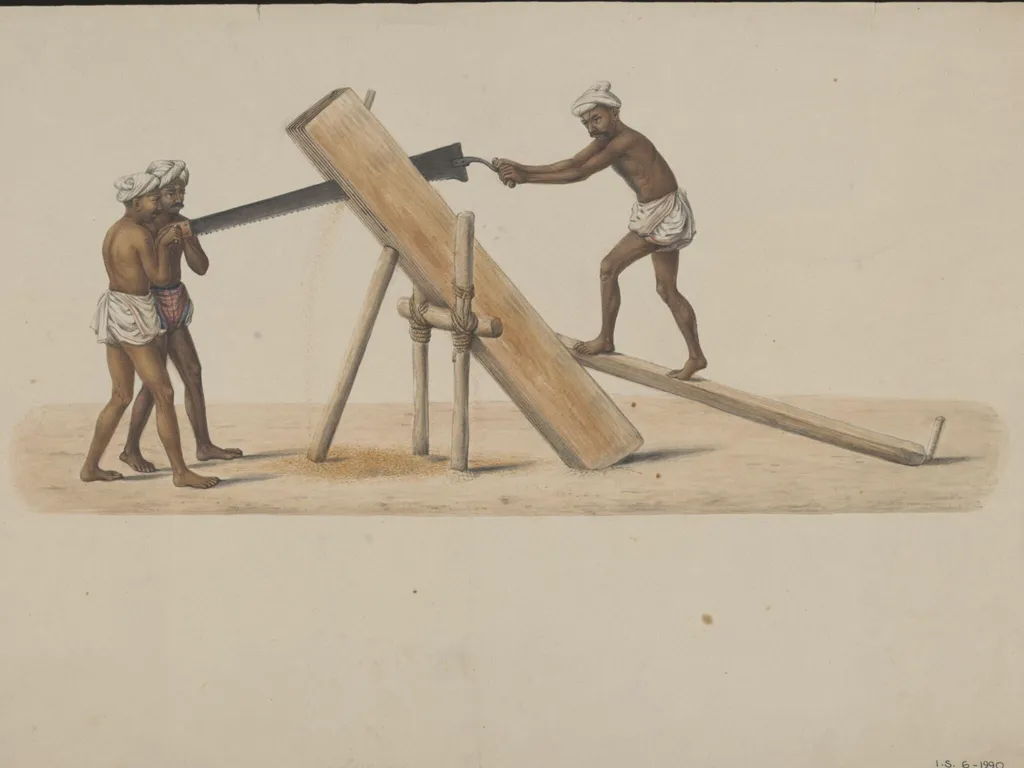
Sawers is a paint painting by the Realist artist Unknown. It dates from 1840 and is held in the collection of the Victoria and Albert Museum.
About this work
Overview
Sawers is one of sixteen paintings completed in 1840, each depicting a distinct trade or labor activity. This work captures two laborers engaged in the physical task of cutting a large wooden beam. The composition emphasizes collaboration and precision, with both figures positioned to show their roles in the process: one on the ground, the other elevated on a supporting plank.
Subject & Meaning
The painting portrays a moment of synchronized labor, highlighting the coordination required in manual craftsmanship. The absence of elaborate clothing or tools suggests a focus on the act itself rather than the status of the workers. Their bare feet and simple wraps imply a working-class context, grounding the scene in everyday rural or artisanal life.
Technique & Style
The artist uses restrained brushwork to convey texture and motion—wood grain, sweat-slicked skin, and the tension in limbs are rendered with quiet realism. Light falls evenly across the scene, avoiding dramatic contrast, which reinforces the ordinary nature of the labor. The saw’s frame is depicted with structural clarity, underscoring its function as a stabilizing tool.
History & Provenance
Created in 1840, Sawers belongs to a documented series commissioned to record occupational practices of the period. It remained in private collections until entering a public institution’s holdings in the late 19th century. The Victoria and Albert Museum acquired it in the early 20th century, where it has been preserved as part of a broader ethnographic study of labor.
Context
During the 1840s, industrialization was reshaping labor, yet many trades still relied on hand tools and human coordination. This painting reflects a transitional moment, documenting techniques that would soon be replaced by machinery. The series as a whole served as a visual archive, preserving skills deemed at risk of obsolescence.
Legacy
Sawers contributes to a historical record of pre-industrial craftsmanship, offering insight into the physicality and rhythm of manual labor. Its value lies not in aesthetic flourish but in its unembellished documentation of collective work. It remains a reference for studies in labor history and material culture.
Artist & collection

 Domestic Scene
 Giacomo and Cardinal Marco, investing Andrea, Abbot of San Zeno, with his Benefice
 The Nymph of Fontainebleau
 Portrait of a Woman
 Madonna and Child with Saints in the Enclosed Garden
 Venus and Minerva
 Family Group of Four on Sofa
 Wall painting from Room H of the Villa of P. Fannius Synistor at Boscoreale