Artwork
Sfântul Mare Mucenic Haralambie
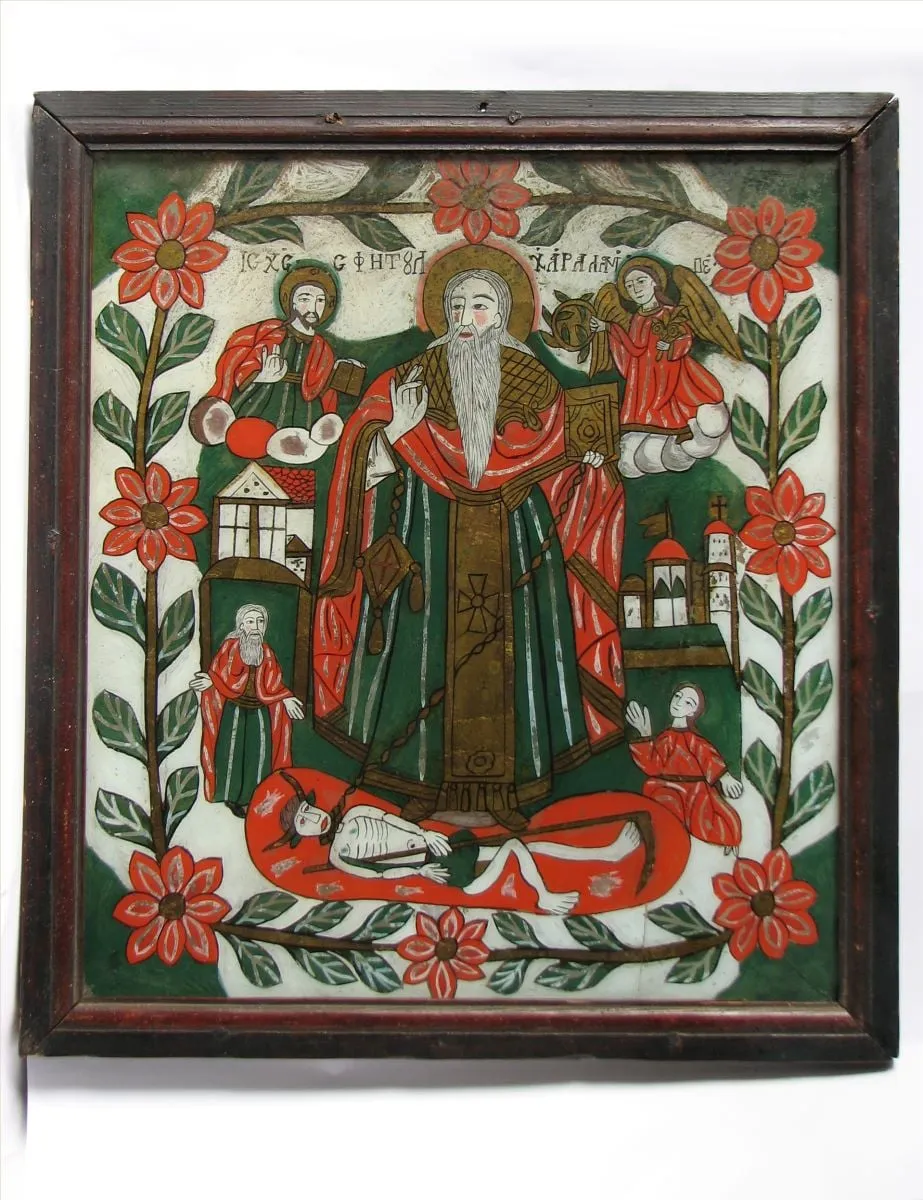
Sfântul Mare Mucenic Haralambie is a drawing by Unknown. It dates from 1850 and is held in the collection of the ASTRA National Museum Complex. This religious panel depicts Saint Haralambie, a Christian martyr revered for miraculous healings.
About this work
Overview
This religious panel depicts Saint Haralambie, a Christian martyr revered for miraculous healings.
This religious panel depicts Saint Haralambie, a Christian martyr revered for miraculous healings. He stands tall in vivid red robes, gripping a long staff, while a sick figure lies at his feet. Surrounding him are witnesses—some holding books, one with wings—suggesting divine presence. The background includes modest architecture and foliage, rendered without perspective or shadow. Colors are unmodulated, emphasizing symbolic clarity over naturalism.
Subject & Meaning
The scene illustrates Saint Haralambie’s traditional role as a healer of the afflicted, a common theme in Eastern Orthodox hagiography. The winged figure likely represents an angel, affirming divine sanction of his act. Books held by onlookers may signify scripture or learning, reinforcing the spiritual authority of the moment. The inscription above his head, in liturgical script, confirms his identity and sanctity, anchoring the image in devotional practice.
Technique & Style
The painting employs flat, bold color fields with no shading or modeling, characteristic of medieval iconographic traditions. Forms are outlined clearly, and spatial depth is suggested only by overlapping elements, not perspective. The absence of cross-hatching or chiaroscuro reflects a deliberate rejection of naturalism in favor of spiritual symbolism. Decorative floral borders frame the scene, enhancing its ritual function rather than its realism.
History & Provenance
The work originates from a region within the Eastern Orthodox sphere, likely produced in a monastic or workshop setting during the late medieval or early modern period. Such panels were often commissioned for private devotion or church altars. Its preservation suggests continued veneration, though its exact origin and early ownership remain undocumented in public records.
Context
This image aligns with a broader tradition of saintly healing scenes in Byzantine and Slavic iconography, where saints were depicted as conduits of divine power. The stylized figures and symbolic setting reflect theological priorities over anatomical accuracy. Similar compositions appear in manuscripts and wall paintings across the Balkans and Romania, indicating shared visual language among Orthodox communities.
Legacy
The painting exemplifies enduring iconographic conventions that persisted in Eastern Christian art well into the 18th century. While later styles embraced realism, this work preserves an earlier aesthetic rooted in liturgical function. It remains a reference point for understanding how religious identity and healing were visually encoded in pre-modern Orthodox culture.
Artist & collection

 Domestic Scene
 Giacomo and Cardinal Marco, investing Andrea, Abbot of San Zeno, with his Benefice
 The Nymph of Fontainebleau
 Portrait of a Woman
 Madonna and Child with Saints in the Enclosed Garden
 Venus and Minerva
 Family Group of Four on Sofa
 Wall painting from Room H of the Villa of P. Fannius Synistor at Boscoreale
 Icoală,
 Comp în
 Prăznicar – Botezul lui IS HS
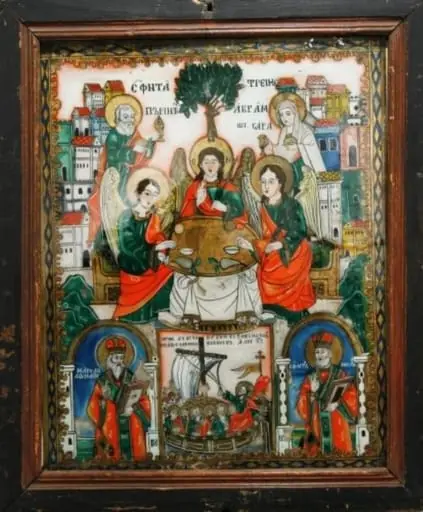 Sfânta Treime (Sfânta Troiță, Filoxenia, Cina de la Mamvri)
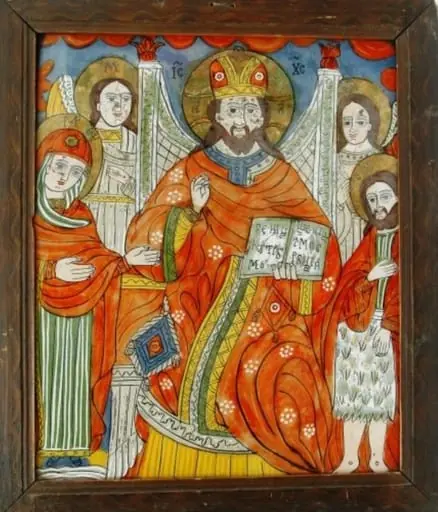 Iisus Hristos pe tron
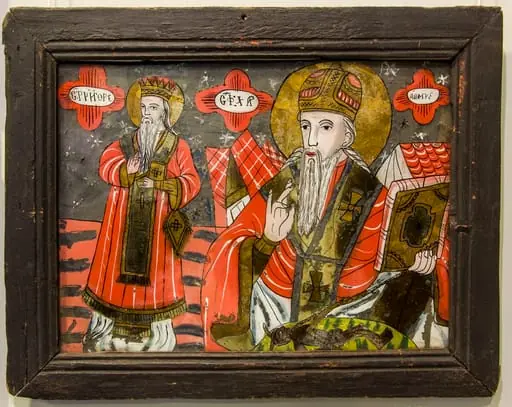 Sf. Grigore și Haralambie
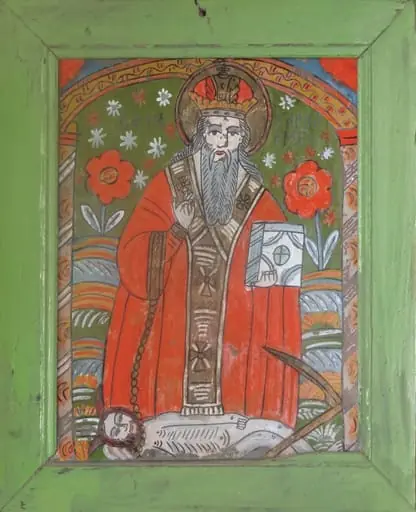 Sf. Haralambie
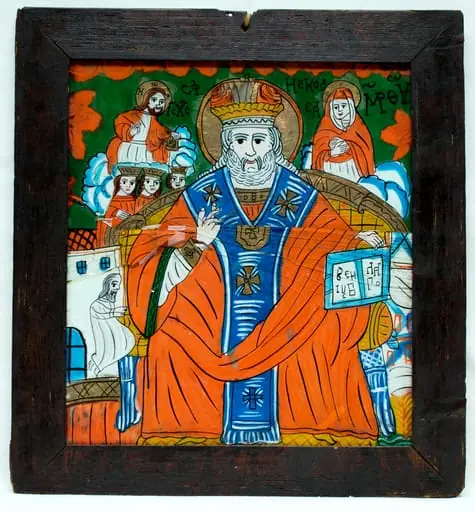
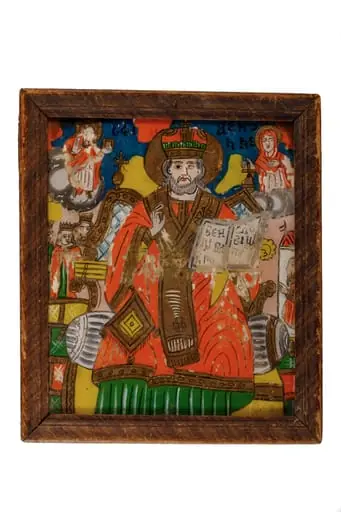 Icoană pictată pe sticlă reprezentând pe Sf. Nicolae. Sfântul este prezentat pe tron, față, bărbat tânăr, plete, barbă scurtă, cu dreapta binecuvântând, iar în stânga ține Evanghelia. Sus este încadrat de Iisus și Maria care îi oferă Evanghelia și omoforul. Stânga, la nivelul brațului, trei personaje în picioare și în dreapta o clădire și o mână (?) întinsă. Omoforul auriu cu cruci se evidențiază pe haina roșie cu linii ce marchează anatomia corpului. Icoana este înrămată.
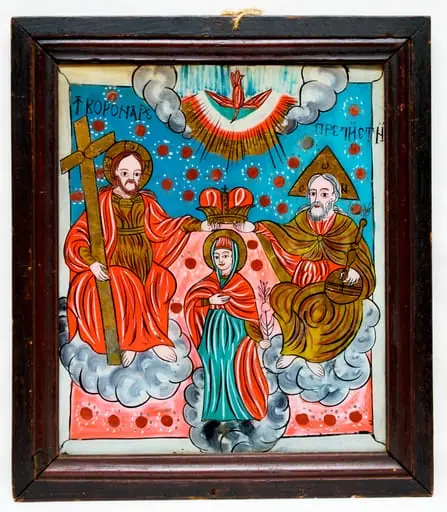 Icoa pal
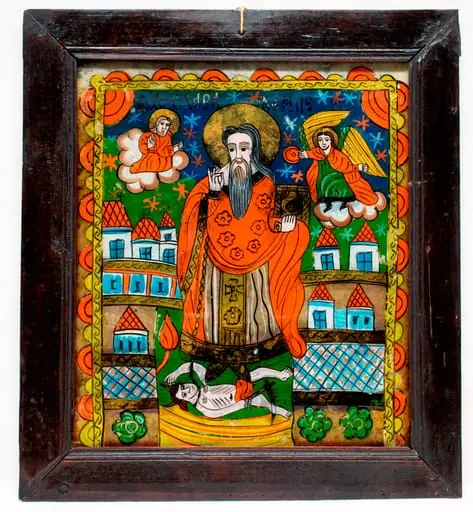
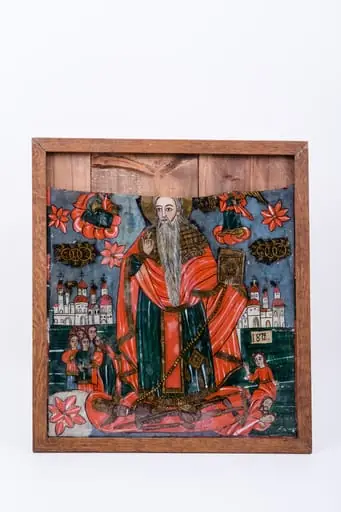 Sfântul Mare Mucenic Haralambie, făcător-de-minuni și vindecător de boli, este cel mai bătrân mucenic din cei prăznuiți de creștini. Este cunoscut ca și făcător-de-minuni, vindecător de boli și ocrotitor al caselor familiilor creștine. Central este pictat Sfântul, îmbrăcat cu veșminte liturgice, arhierești, cu sacos verde-turcoaz, mantie și epitrahil roșu vermillon, omofor cu broderie bronzie, cu mithră și aureolă. Cu mâna dreaptă binecuvântează și cu mâna stângă ține în lanț ciuma, reprezentată antropomorfic și zoomorfic - un animal cu solzi, labe cu gheare și cap de diavol, cu trăsături umane. Ciuma, simbolizând boala incurabilă și moartea, are coarne de diavol, fiind, totodată și păcatul, patima, aducătoare de moartea duhovnicească. Sfântul Haralambie este încadrat de elemente arhitectonice, ziduri de cetate, biserici, case, coloane cu boltă. Icoana se înscrie, ca și realizare artistică în Țara Făgărașului, fiind pictată de Matei Țimforea, datată 1872. În registrul inferior, sunt mai multe personaje: 8 în partea dreaptă a sfântului și 3 în stânga, ieșind vindecați, prin minunile sfântului, de sub puterea diabolică a bolii.Cromatica este armonioasă; roșu vermillon, bronziu, verde turcoaz, gri albăstrui. În registrul superior, este Dumnezeu-Tatăl binecuvântând și un înger punând cununa de mucenicie pe capul sfântului vindecător. Fondul este în registrul superior gri-violaceu-albăstrui, iar în cel inferior verde-turcoaz. Icoana este spartă în registrul superior.