Artwork
Shakyamuni Triad: Buddha Attended by Manjushri and Samantabhadra (Buddha)
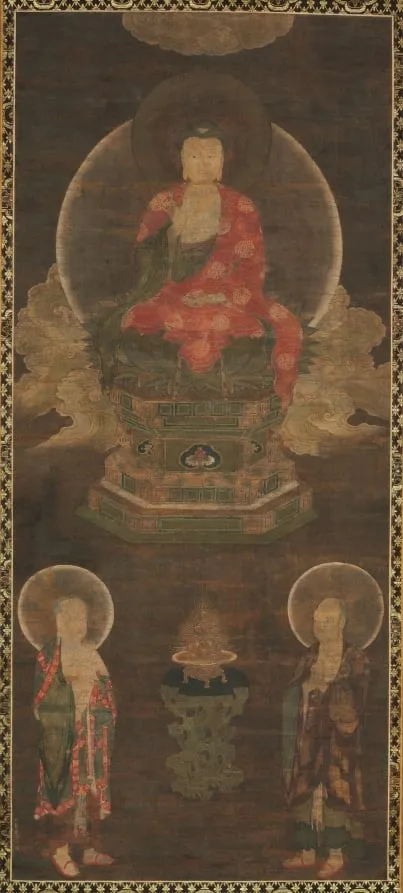
Shakyamuni Triad: Buddha Attended by Manjushri and Samantabhadra (Buddha) is an unspecified painting by the Ming dynasty painting artist Unknown. It dates from 1304 and is held in the collection of the Cleveland Museum of Art.
About this work
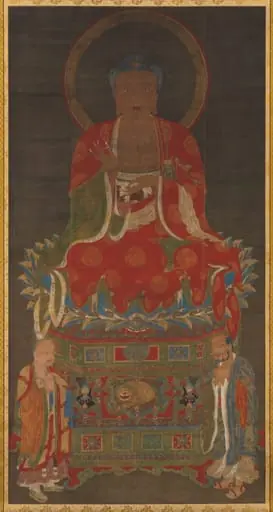
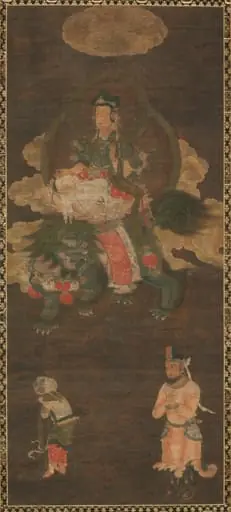
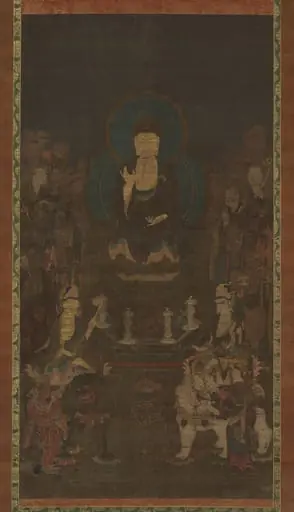
You see a tall, gold-leaf painting of Buddha sitting on a lotus, flanked by two holy figures—one on a lion, one on an elephant.
You see a tall, gold-leaf painting of Buddha sitting on a lotus, flanked by two holy figures—one on a lion, one on an elephant. Below them, smaller figures kneel or stand, hands folded in prayer.
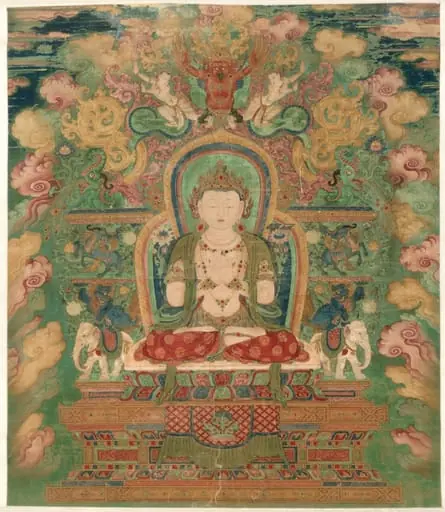
This painting is from Yuan-dynasty China, a time when Buddhist art was rare. The clouds around the figures aren’t just decoration; they’re shaped like dragons and swirls, almost alive. The artist used thin, glowing lines to make the gold shine in dim temple light.
To see more like this, look up *yuan dynasty (1271-1368)*.
Overview
The work is a three‑panel painting from China’s Yuan period that presents the historical Buddha Shakyamuni at the centre, accompanied by two bodhisattvas. The central figure sits upon a lotus blossom, while the flanking deities are shown riding a lion and an elephant respectively. The composition is rendered on a tall surface coated with gold leaf, giving the scene a luminous quality in low light.
Subject & Meaning
Shakyamuni is portrayed delivering a sermon from the Lotus Sutra, a text that underpins Mahayana Buddhist doctrine across East Asia. To his right, Manjushri, the embodiment of wisdom, is mounted on a lion; to his left, Samantabhadra, representing universal virtue, rides an elephant. Beneath them, a group of devotees—including two of the Buddha’s principal disciples, two foreign figures, a boy with topknots, and a female worshipper—are depicted in prayerful postures, symbolising the spread of enlightenment.
Technique & Style
The artist employed delicate, luminous lines of gold leaf against a dark background, allowing the figures to glow when illuminated by temple candles. Cloud motifs surrounding the divine trio are rendered as dynamic, dragon‑like swirls, integrating decorative and narrative functions. The use of gold and the stylised rendering of animals and clouds reflect a synthesis of Chinese painting conventions with Buddhist iconography typical of the Yuan era.
History & Provenance
Painted during the Yuan dynasty (1271–1368), the piece belongs to a limited corpus of Buddhist paintings from a period when such works were comparatively uncommon in China. Its survival suggests it was likely commissioned for a temple setting, where its gold surface would have enhanced devotional ambience.
Context
The Lotus Sutra, central to Mahayana practice, provided the theological framework for the scene, emphasizing the Buddha’s universal teaching. The inclusion of both Chinese and non‑Chinese figures illustrates the sutra’s claim to universal relevance, while the presence of the two chief disciples underscores the transmission of doctrine.
Artist & collection

 Domestic Scene
 Giacomo and Cardinal Marco, investing Andrea, Abbot of San Zeno, with his Benefice
 The Nymph of Fontainebleau
 Portrait of a Woman
 Madonna and Child with Saints in the Enclosed Garden
 Venus and Minerva
 Family Group of Four on Sofa
 Wall painting from Room H of the Villa of P. Fannius Synistor at Boscoreale
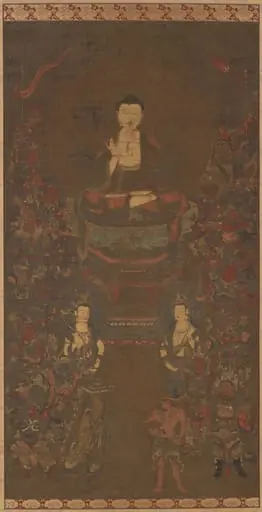 Shakyamuni with the Sixteen Benevolent Deities
 Shakyamuni Triad: Buddha Attended by Manjushri and Samantabhadra
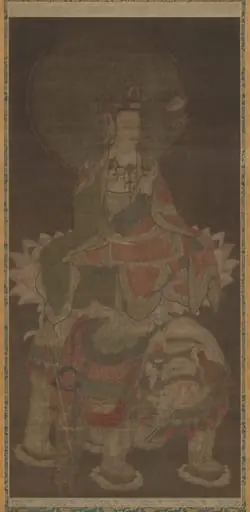 Samantabhadra
 Shakyamuni with two attendants
 Shakyamuni Triad: Buddha Attended by Manjushri and Samantabhadra (Bodhisattva with Lion)
 Manjushri
 釈迦三尊十大弟子像|Shaka (Shakyamuni), the Historical Buddha, with Two Attendant Bodhisattvas and the Ten Great Disciples
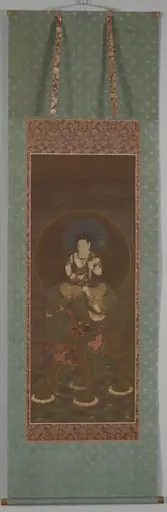 Monju with Five Hair Knots
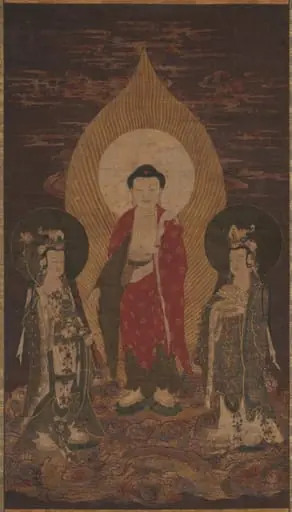 Amitābha Triad
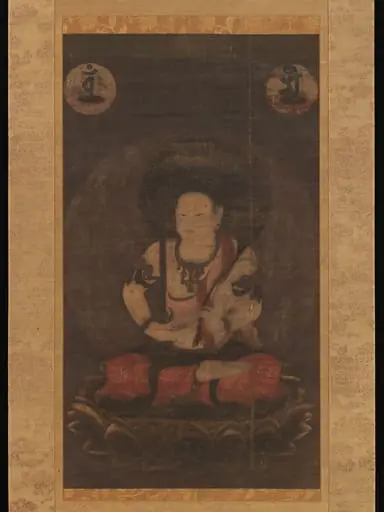 五髻文殊菩薩像|The Bodhisattva Monju (Manjushri) with Five Topknots