Artwork
Shakyamuni with two attendants
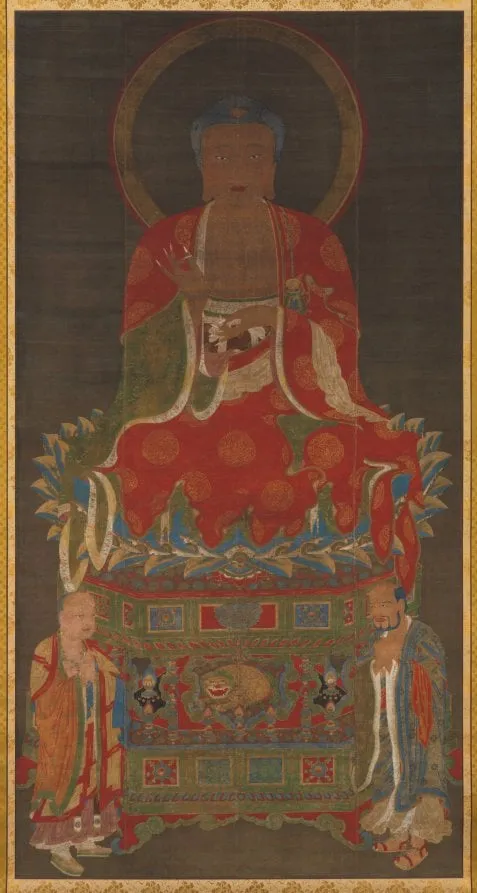
Shakyamuni with two attendants is an unspecified painting by the Ming dynasty painting artist Unknown. It dates from 1304 and is held in the collection of the Cleveland Museum of Art. The work portrays the historic Buddha Shakyamuni seated upon an ornate pedestal, accompanied by two attendant figures who bow in reverence.
About this work
No one knows who painted it, but the careful details suggest a monk or a workshop artist.
A golden Buddha sits on a jeweled throne, two attendants bowing beside him. His red robe glows with dragons and clouds, painted in rich colors and gold.
This was made for a temple, not a palace. The silk borders—gold on cream—were added later to protect it. No one knows who painted it, but the careful details suggest a monk or a workshop artist.
To see more like this, look up china, yuan (1271-1368) or early ming dynasty (1368-1644).
Overview
The work portrays the historic Buddha Shakyamuni seated upon an ornate pedestal, accompanied by two attendant figures who bow in reverence. The composition is framed by two layers of silk borders, the inner one of gold brocade on a cream field and an outer yellow silk strip with hanging decorative tassels.
Subject & Meaning
Shakyamuni is depicted in his traditional red monastic robe, embellished with motifs of dragons and clouds that symbolize spiritual power and celestial realms. The attendant figures, positioned on either side, convey devotion and the transmission of Buddhist teachings.
Technique & Style
The artist employed gold leaf and richly saturated pigments to render the luxurious textiles, especially the golden medallions that swirl across the Buddha’s robe. The painting’s surface is executed on a silk support, typical of Yuan and early Ming religious art, and the later addition of silk borders served both protective and decorative purposes.
History & Provenance
Created for a Buddhist temple rather than a secular palace, the piece’s creator remains unidentified, though the precision of the details suggests a monk or a workshop associated with monastic commissions. The silk borders were affixed after the painting’s initial completion to safeguard the work.
Context
The visual vocabulary of dragons, clouds, and sumptuous fabrics aligns with artistic conventions of the Yuan dynasty (1271–1368) and early Ming period (1368–1644), when Buddhist iconography often incorporated imperial motifs to convey the Buddha’s supreme authority.
Artist & collection

 Domestic Scene
 Giacomo and Cardinal Marco, investing Andrea, Abbot of San Zeno, with his Benefice
 The Nymph of Fontainebleau
 Portrait of a Woman
 Madonna and Child with Saints in the Enclosed Garden
 Venus and Minerva
 Family Group of Four on Sofa
 Wall painting from Room H of the Villa of P. Fannius Synistor at Boscoreale
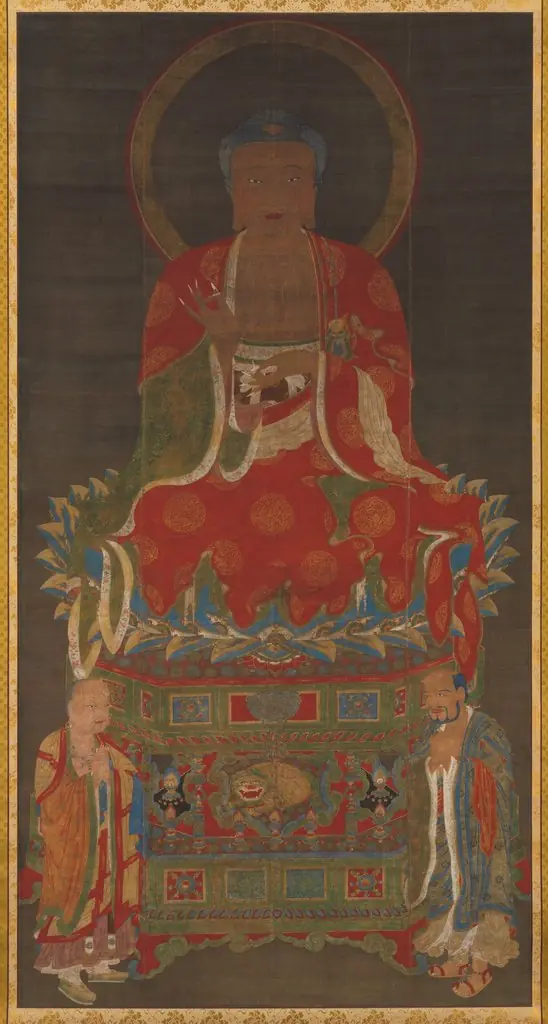 Shakyamuni with two attendants
 Shakyamuni Triad: Buddha Attended by Manjushri and Samantabhadra (Buddha)
 Shakyamuni with the Sixteen Benevolent Deities
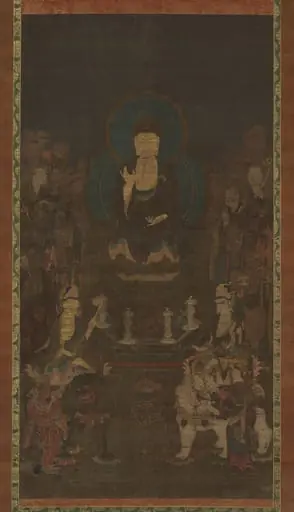 釈迦三尊十大弟子像|Shaka (Shakyamuni), the Historical Buddha, with Two Attendant Bodhisattvas and the Ten Great Disciples
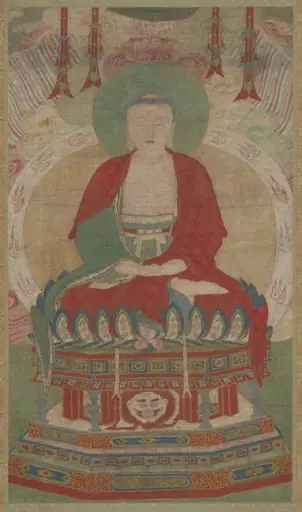 Seated Amitābha
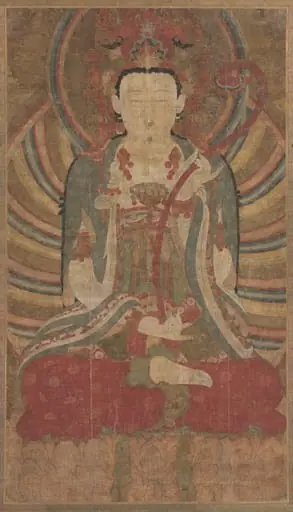 Seated Manjusri
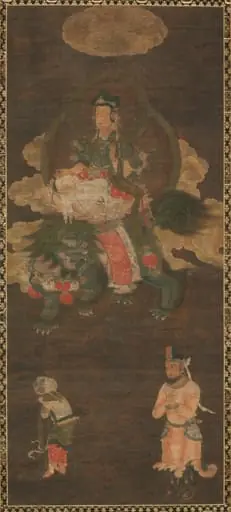 Shakyamuni Triad: Buddha Attended by Manjushri and Samantabhadra (Bodhisattva with Lion)
 Assembly of Buddhist Deities
 Amitābha Triad