Artwork
St. Jerome
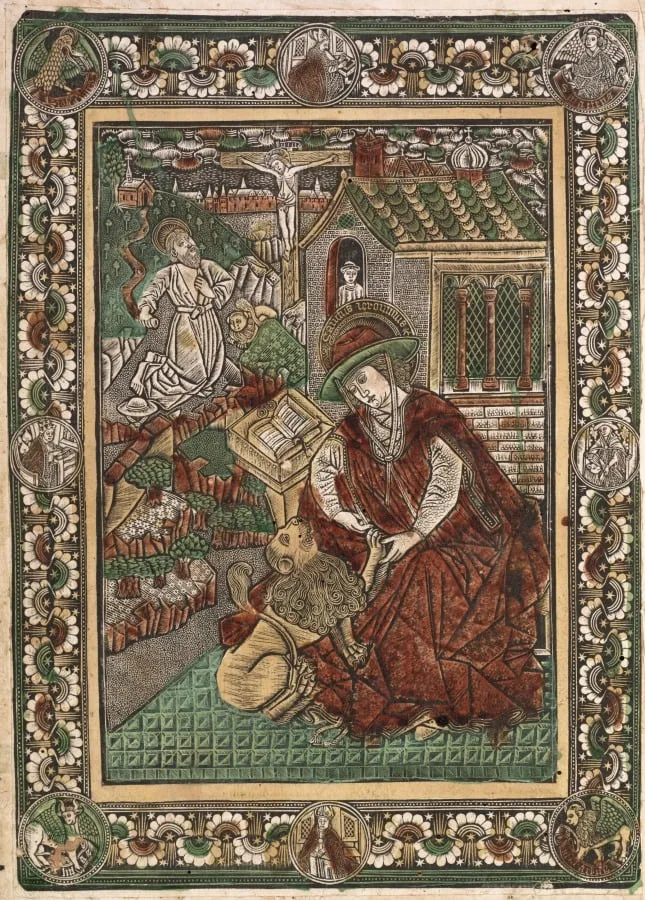
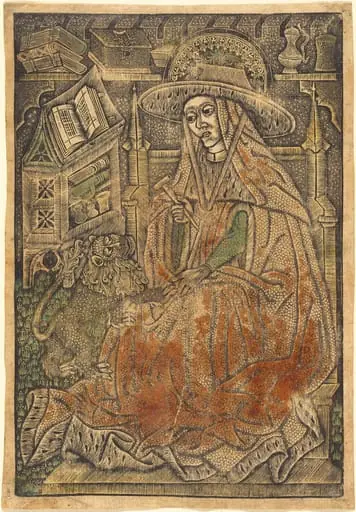
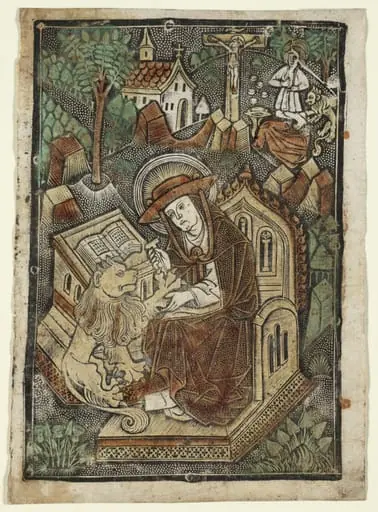
St. Jerome is a print by the Renaissance artist Unknown. It dates from 1465 and is held in the collection of the Cleveland Museum of Art. This print of St.
About this work
Overview
Only three known impressions survive, and this one is uniquely preserved as part of a bound manuscript, offering rare insight into its original context and use.
This print of St. Jerome, made in the latter half of the 15th century, originates from a German or French workshop using the metalcut technique. Unlike woodcuts, it was produced by engraving lines into a metal plate and then texturing large black areas with punched and stamped motifs. Only three known impressions survive, and this one is uniquely preserved as part of a bound manuscript, offering rare insight into its original context and use.
Subject & Meaning
The image depicts St. Jerome, the scholar-saint who translated the Bible into Latin, seated at a desk surrounded by books and writing tools. A lion rests at his feet, referencing the legend that he removed a thorn from its paw. The intimate, cluttered interior suggests a monastic study, reinforcing his identity as a learned ascetic. The inclusion of the print in a liturgical manual underscores its devotional purpose, linking scholarly piety with ritual practice.
Technique & Style
The print was made using a metal plate engraved with fine lines and then textured with punches and stamps to create intricate patterns in the dark areas. This method replaced flat black with delicate, lace-like networks of ink, producing a subtle tonal variation without relying on shading. The result is a graphic, almost textile-like surface that contrasts with the smooth outlines of the figures, distinguishing it from contemporary woodcuts and later chiaroscuro prints.
History & Provenance
The print was bound into a copy of William Durandus’s Rationale divinorum officiorum, a 13th-century guide to liturgical rites, printed in Basel before 1477. It was glued into the volume during the late 1400s, likely as a devotional illustration. This physical attachment to a liturgical text is exceptional, as most metalcuts were circulated as standalone images. Its survival within the binding has preserved its original context and limited its exposure to other collectors.
Context
Metalcuts emerged in the decades before the widespread adoption of movable type, serving as affordable, repeatable images for religious texts and devotional objects. This print reflects the transition from manuscript illumination to printed imagery, where visual clarity and symbolic economy were prioritized. Its presence in a liturgical manual highlights how religious imagery was integrated into daily worship, bridging the gap between textual authority and visual devotion.
Legacy
As one of only three surviving impressions, this print offers a rare example of early metalcut technique and its integration into bookbinding. It illustrates how printed images were not merely decorative but functionally embedded in religious practice. While metalcuts were soon eclipsed by woodcuts and engravings, this artifact preserves a moment when the boundaries between manuscript, print, and ritual were still fluid.
Artist & collection

 Domestic Scene
 Giacomo and Cardinal Marco, investing Andrea, Abbot of San Zeno, with his Benefice
 The Nymph of Fontainebleau
 Portrait of a Woman
 Madonna and Child with Saints in the Enclosed Garden
 Venus and Minerva
 Family Group of Four on Sofa
 Wall painting from Room H of the Villa of P. Fannius Synistor at Boscoreale