Artwork
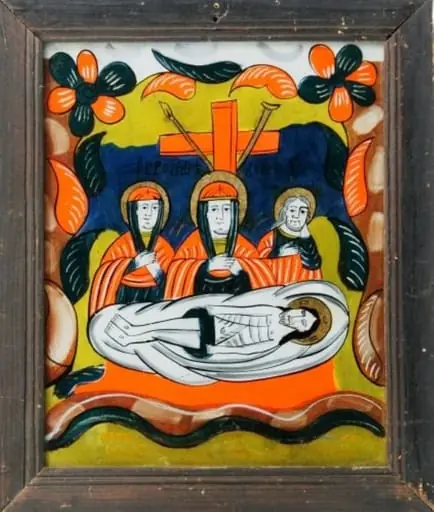
Tema icoanei face parte din ciclul Patimilor Mântuitorului și înfățișează Prohodul Domnului. Alături de Hristos așezat pe piatră sunt reprezentate doar trei personaje. Maica Domnului, în centru, cu mâinile împreunate la piept, are de-o parte un apostol, iar de cealaltă parte una dintre femeile mironosițe, probabil Maria Magdalena. În spate se profilează crucea lui Hristos și însemnele patimilor - sulița și buretele. Un șirag de rozete ornamentează fondul icoanei. Cromatica icoanei se compune din tonuri de roșu vermillon, ocru galben, alb, verde, albastru, negru și gri. Rama icoanei e profilată, băițuită și e formată din îmbinarea a patru baghete de lemn.
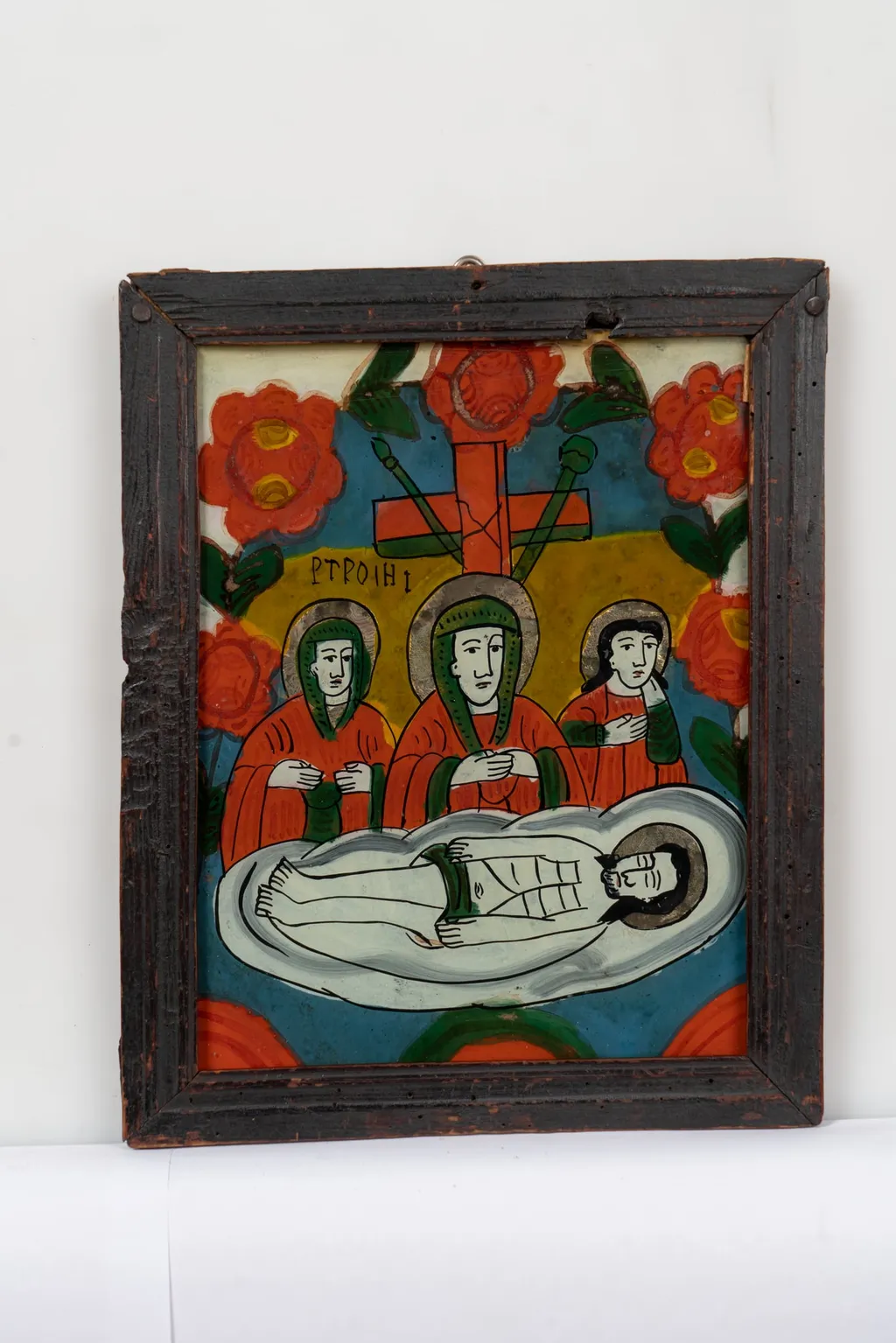
Tema icoanei face parte din ciclul Patimilor Mântuitorului și înfățișează Prohodul Domnului. Alături de Hristos așezat pe piatră sunt reprezentate doar trei personaje. Maica Domnului, în centru, cu mâinile împreunate la piept, are de-o parte un apostol, iar de cealaltă parte una dintre femeile mironosițe, probabil Maria Magdalena. În spate se profilează crucea lui Hristos și însemnele patimilor - sulița și buretele. Un șirag de rozete ornamentează fondul icoanei. Cromatica icoanei se compune din tonuri de roșu vermillon, ocru galben, alb, verde, albastru, negru și gri. Rama icoanei e profilată, băițuită și e formată din îmbinarea a patru baghete de lemn. is a drawing by Unknown. It dates from 1850 and is held in the collection of the Ethnographical Museum of Transylvania. This icon belongs to the Passion Cycle of the Savior, depicting the Lamentation over Christ’s body.
About this work
Overview
The composition is sparse, focusing on three figures gathered around the deceased Christ, who lies on a stone.
This icon belongs to the Passion Cycle of the Savior, depicting the Lamentation over Christ’s body. The composition is sparse, focusing on three figures gathered around the deceased Christ, who lies on a stone. Above them, the cross and instruments of the Passion—spear and sponge—are subtly rendered. The background is adorned with a continuous band of red rosettes, contrasting with a muted sky. The entire scene is framed in a carved wooden border, reinforcing its liturgical function.
Subject & Meaning
The icon captures the moment of mourning after Christ’s deposition from the cross. The Virgin Mary, centrally placed with hands clasped in grief, is flanked by an apostle and a myrrh-bearer, likely Mary Magdalene. Their postures convey solemn reverence rather than theatrical sorrow. The presence of the cross and Passion symbols above the body anchors the scene in theological narrative, emphasizing Christ’s sacrifice and the faithful’s witness to his death.
Technique & Style
Executed in traditional iconographic style, the figures are rendered with flat planes and strong outlines, avoiding naturalistic depth. Colors are bold and symbolic: vermilion red, ochre, white, blue, black, and gray define forms without shading. The background’s rosettes and cloudy sky are painted with uniform pigment, enhancing the spiritual rather than physical realism. The black outlines unify the composition, a hallmark of Byzantine-derived icon painting.
History & Provenance
The icon’s wooden frame, composed of four joined staves and decorated with carved and gilded details, suggests a regional workshop, likely from the Balkans or Eastern Europe. Its stylistic features align with late medieval or early modern Orthodox traditions. While specific origins are unrecorded, its form and iconography reflect liturgical practices common in monastic or parish settings where such images served as focal points for prayer and remembrance.
Context
This icon would have been displayed in a church or private chapel during Holy Week, particularly on Good Friday or Holy Saturday. Its limited figures and symbolic elements reflect the devotional need for clarity and contemplation. The rosettes may allude to heavenly joy or the Garden of Eden, contrasting the sorrow below. The inclusion of the Passion instruments situates the Lamentation within the broader narrative of redemption.
Legacy
The icon preserves a canonical composition common in Orthodox traditions, transmitting theological themes through visual economy. Its enduring structure—central Virgin, flanking mourners, and elevated symbols—remains a model in later iconography. Though not attributed to a known master, its craftsmanship and adherence to liturgical norms ensure its place within the continuum of sacred art in Eastern Christianity.
Artist & collection
Museum
Ethnographical Museum of Transylvania
Continue through works from the same source collection.
 Domestic Scene
 Giacomo and Cardinal Marco, investing Andrea, Abbot of San Zeno, with his Benefice
 The Nymph of Fontainebleau
 Portrait of a Woman
 Madonna and Child with Saints in the Enclosed Garden
 Venus and Minerva
 Family Group of Four on Sofa
 Wall painting from Room H of the Villa of P. Fannius Synistor at Boscoreale
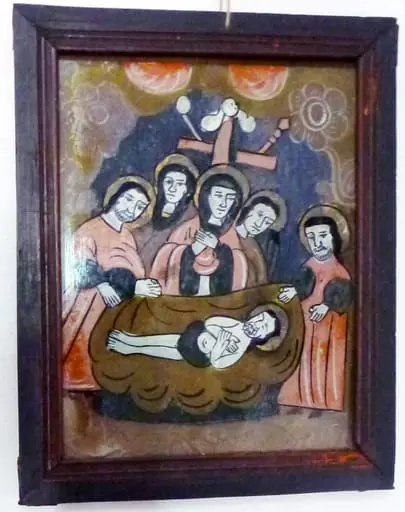
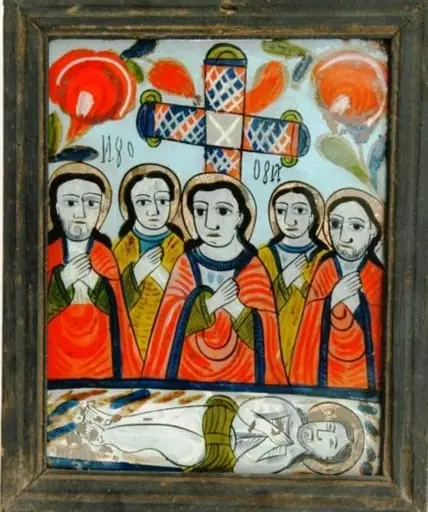
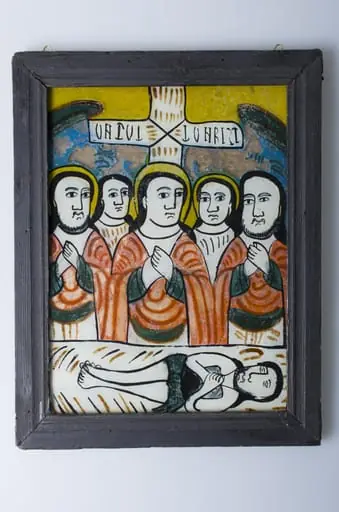 Icoana este pictată pe sticlă, având tema "Plângerea lui Iisus"; în registrul secund este ilustrat Iisus întins pe lințoliu, în jurul lui aflându-se un grup de cinci persoane, în mijlocul lor fiind reprezentată Sfânta Fecioară. Pe verso, de rama din lemn, pentru a proteja icoana, sunt prinse câteva scânduri. Rama este realizată din lemn de brad cu elemente profilate pe latura interioară, grunduită. Cromatica: alb; negru; roșu; galben; albastru; culoarea patinată a lemnului (rama).
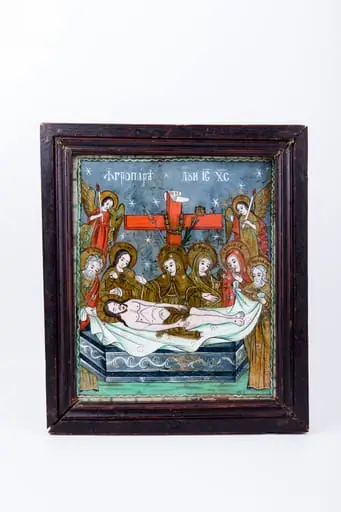
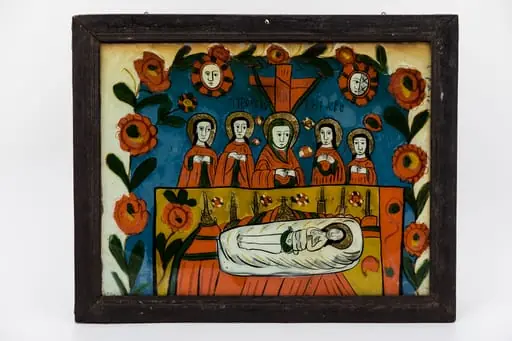 Icoana reprezintă Punerea în mormânt a Mântuitorului Iisus Hristos. Prohodul Domnului. Trupul Mântuitorului Iisus Hristos, fiind coborât de pe cruce, este învelit în țesătura giulgiului alb-gri, cu fire diafane galbene de lumină, amintind de Lumina Învierii. Maica Domnului împreună cu Sfinții Iosif din Arimateea, Nicodim și două femei mironosițe aducătoare de mir țin în brațe trupul Mântuitorului. Compozițional se creează astfel o imagine concentrică de corabie, cu Crucea Răstignirii ca și catarg, corabia prefigurând Biserica. Giulgiul și îmbrățișarea celor apropiați, uniți întru dragoste și suferință, reprezintă axa orizontală perpendiculară pe Cruce. Compoziția este echilibrată, simetrică și circulară. Maica Domnului este îmbrăcată în veșmânt cu maforiom roșu vermillon, cu sacos roșu vermillon și interiorul căptușit cu verde văratic. Fondul icoanei este cerul albastru ceruleum-cobalt, în registrul superior și de mijloc și un spațiu de galben-chihlmbar, în registrul inferior, în jurul mormântului Mântuitorului Iisus Hristos. Întreaga compoziție iconografică este încadrată de un chenar decorativ geometrizant alb, dublat de un chenar fitomorf, format dintr-o ghirlandă de 10-12 ruje roșii vermillon, cu interiorul galben-verde. În ghirlanda de ruje, sunt intercalate cele două elemente astrale martore: Soarele și Luna. Simetric și armonios, sunt 6 sfeșnice cu lumânări arzânde, lângă Trupul Mântuitorului Iisus Hristos, învăluit în giulgiu. Cromatica este armonioasă și luminos-pastelată: roșu vermillon, albastru cobalt, ceruleum, verde văratic-forest, galben chihlimbar, alb și negru. Inscripția din româno-chirilică se traduce Îngroparea Lui IC XC Iisus Hristos. Icoana este din Țara Oltului, Șcheii Brașovului.
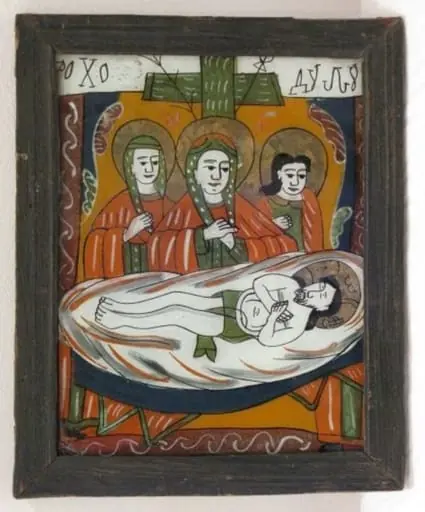 Plângerea lui Iisus
 Plângerea lui Iisus (Prohodul)
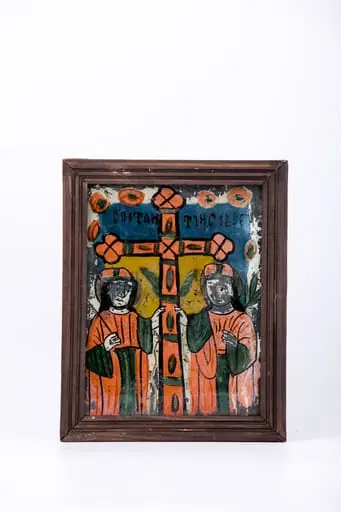 În centrul icoanei este Crucea pictată cu roșu vermillon și ornamentată cu 7 elemente ovoidale gri antracit și brațele au terminații trilobate. În dreapta crucii este Sfântul Împărat Constantin, și în stânga este Împărăteasa Elena, mama sa. Deasupra fiecăruia este inscripționat numele. În spatele Crucii, lipit de cruce, sunt două aripi ca de înger, stilizate sub formă de elemente vegetale. Veșmintele Sfinților Constantin și Elena sunt într-o combinație de roșu vermillon și gri antracit. Spațiul galben de lumină din spatele crucii duce gândul la Crucea de lumină apărută pe cer In hoc signo vinces - prin acest semn vei învinge. Icoana este bogat ornamentată de culoare, lumină și detalii semnificative, elemente decorative geometrizante și fitomorfe. Fondul icoanei este cerul de noapte, albastru ultramarin bleumarin întunecat. Întreaga compoziție este încadrată armonios de un chenar decorativ fitomorf-geometrizant, format din ruje roșii. Cromatica este armonioasă și bogată: roșu vermillon, galben-chihlimbar, albastru ultramarin bleumarin, gri antracit, alb, negru. Icoana este de Nicula. Inscripția din româno-chirilică se traduce Constantin Elena. Icoana este deteriorată, având absențe cromatice.
 Prohodul Domnului
 Trup
Trup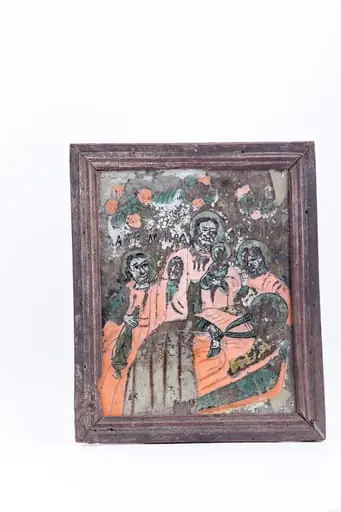 Icoana reprezintă Nașterea Maicii Domnului, 8 septembrie. Sfânta Maică Ana este redată întinsă pe un pat și lângă ea este Sfântul Părinte Ioachim, cu Pruncuța Maria în brațe. În stânga și în drepta lor, este câte o fecioară, martore și asistente ajutoare la naștere. În registrul superior, asemenea unei arcade-bolți de biserică este o ghirlandă de 3 ruje - trandafiri mari roșii cu frunze verzi. Cromatica este armonioasă: roșu vermillon, brun, verde, negru, alb. Icoana este de Nicula. Inscripția din româno-chirilică se traduce MP Maica Domnului.
 Plângerea lui Iisus Hristos (Prohodul)