Artwork
Trup
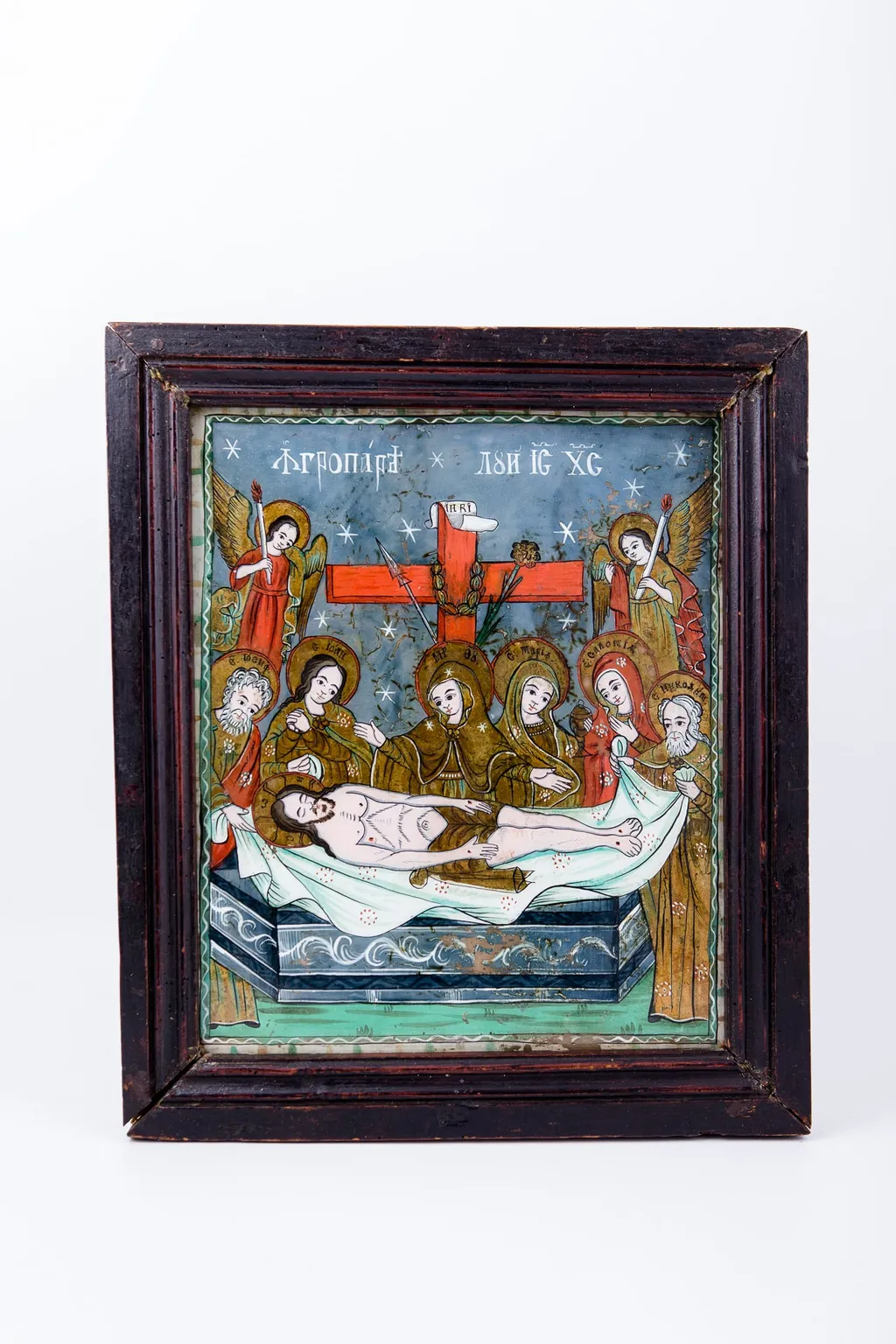
Trup is a drawing by Unknown. It dates from 1850 and is held in the collection of the ASTRA National Museum Complex. This panel depicts a religious scene centered on a recumbent figure surrounded by mourners and celestial beings.
About this work
Overview
The figures are rendered with minimal modeling, using flat planes of color and simplified forms characteristic of early Byzantine art.
This panel depicts a religious scene centered on a recumbent figure surrounded by mourners and celestial beings. Two winged angels hold a red cross adorned with a crown above the group, suggesting a sacred event. The background features a deep blue field dotted with gold stars and faint Greek inscriptions, reinforcing its liturgical context. The figures are rendered with minimal modeling, using flat planes of color and simplified forms characteristic of early Byzantine art.
Subject & Meaning
The composition likely illustrates the Dormition or Death of the Virgin, a common theme in Eastern Christian tradition. The angels bearing the cross and crown symbolize divine authority and the Virgin’s heavenly coronation. The mourners, some touching the body, express grief and reverence, while the spear may reference the lance of Longinus or symbolic instruments of Christ’s Passion, linking her passing to the salvific narrative.
Technique & Style
The painting employs a rigid, hierarchical composition typical of medieval iconography. Figures lack naturalistic perspective, and drapery is rendered in stylized folds. Colors are unmodulated, with gold stars and inscriptions adding luminosity without depth. The use of tempera or encaustic on wood suggests a devotional object, crafted for veneration rather than illusionistic realism.
History & Provenance
Though exact origins are uncertain, the Greek inscriptions and iconographic conventions point to production within the Byzantine Empire, possibly in Constantinople or a provincial center during the late medieval period. Its preservation implies continuous use in a religious setting, likely a church or private chapel, before entering modern collections.
Context
This work reflects the liturgical and theological emphasis on the Virgin’s transition from earthly life to heavenly glory, a doctrine formalized in the Eastern Church by the 7th century. Similar images adorned liturgical objects and church walls, serving as focal points for prayer and meditation. The inclusion of Greek text aligns with the linguistic and cultural norms of Byzantine religious art.
Legacy
The painting exemplifies the enduring visual language of Byzantine iconography, influencing later Orthodox traditions and early Renaissance devotional art. Its formal restraint and symbolic clarity helped standardize representations of sacred events across Eastern Christendom, preserving theological narratives through centuries of political and cultural change.
Artist & collection

 Domestic Scene
 Giacomo and Cardinal Marco, investing Andrea, Abbot of San Zeno, with his Benefice
 The Nymph of Fontainebleau
 Portrait of a Woman
 Madonna and Child with Saints in the Enclosed Garden
 Venus and Minerva
 Family Group of Four on Sofa
 Wall painting from Room H of the Villa of P. Fannius Synistor at Boscoreale
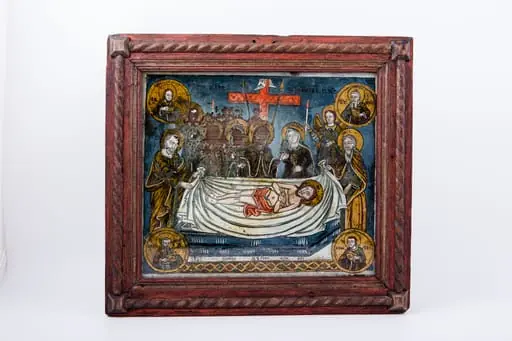 Trup și
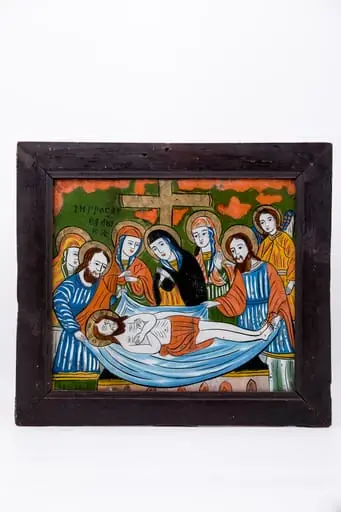 Icoana reprezintă Prohodul Domnului. Punerea în mormânt a Mântuitorului Iisus Hristos. Trupul Mântuitorului Iisus Hristos, fiind coborât de pe cruce, este învelit în țesătura giulgiului alb-albastru. Maica Domnului împreună cu Sfinții Iosif din Arimateea, Nicodim și trei femei mironosițe aducătoare de mir țin în brațe trupul Mântuitorului. Martor și aproape este Îngerul care va striga bucuria Învierii Domnului. Compozițional se creează astfel o imagine concentrică de corabie, cu Crucea Răstignirii ca și catarg, corabia prefigurând Biserica. Giulgiul și îmbrățișarea celor apropiați, uniți întru dragoste și suferință, reprezintă axa orizontală, perpendiculară pe Cruce. Compoziția este echilibrată, simetrică și circulară. Maica Domnului este îmbrăcată în veșmânt cu maforiom negru, cu sacos galben și interiorul căptușit cu albastru ceruleum. Veșmintele Sfinților și Mironosițelor sunt în combinație de roșu vermillon, albastru cu linii albe, galben solar și verde-văratic. Fondul icoanei este văzduhul verde-văratic, plin de Duhul Sfânt și un chenar decorativ sugerat ca și ancadrament, format din elemente florale stilizate - ruje roșii. Cromatica este armonioasă: roșu vermillon, albastru cobalt, ceruleum, verde văratic-forest, galben solar-chihlimbar, alb și negru. Inscripția din româno-chirilică se traduce Îngroparea Lui IC XC Iisus Hristos. Icoana este din Țara Oltului.
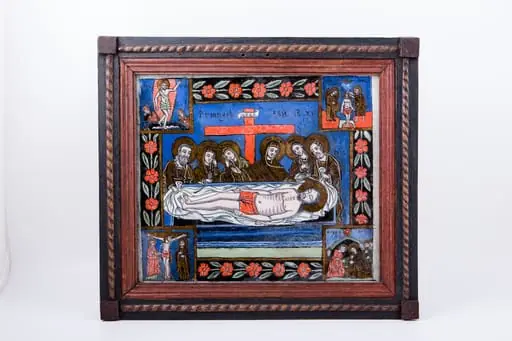 Trupățiș
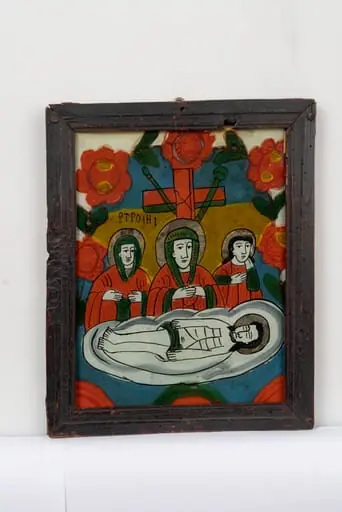 Tema icoanei face parte din ciclul Patimilor Mântuitorului și înfățișează Prohodul Domnului. Alături de Hristos așezat pe piatră sunt reprezentate doar trei personaje. Maica Domnului, în centru, cu mâinile împreunate la piept, are de-o parte un apostol, iar de cealaltă parte una dintre femeile mironosițe, probabil Maria Magdalena. În spate se profilează crucea lui Hristos și însemnele patimilor - sulița și buretele. Un șirag de rozete ornamentează fondul icoanei. Cromatica icoanei se compune din tonuri de roșu vermillon, ocru galben, alb, verde, albastru, negru și gri. Rama icoanei e profilată, băițuită și e formată din îmbinarea a patru baghete de lemn.
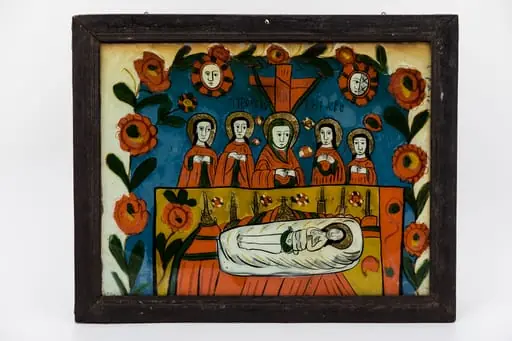 Icoana reprezintă Punerea în mormânt a Mântuitorului Iisus Hristos. Prohodul Domnului. Trupul Mântuitorului Iisus Hristos, fiind coborât de pe cruce, este învelit în țesătura giulgiului alb-gri, cu fire diafane galbene de lumină, amintind de Lumina Învierii. Maica Domnului împreună cu Sfinții Iosif din Arimateea, Nicodim și două femei mironosițe aducătoare de mir țin în brațe trupul Mântuitorului. Compozițional se creează astfel o imagine concentrică de corabie, cu Crucea Răstignirii ca și catarg, corabia prefigurând Biserica. Giulgiul și îmbrățișarea celor apropiați, uniți întru dragoste și suferință, reprezintă axa orizontală perpendiculară pe Cruce. Compoziția este echilibrată, simetrică și circulară. Maica Domnului este îmbrăcată în veșmânt cu maforiom roșu vermillon, cu sacos roșu vermillon și interiorul căptușit cu verde văratic. Fondul icoanei este cerul albastru ceruleum-cobalt, în registrul superior și de mijloc și un spațiu de galben-chihlmbar, în registrul inferior, în jurul mormântului Mântuitorului Iisus Hristos. Întreaga compoziție iconografică este încadrată de un chenar decorativ geometrizant alb, dublat de un chenar fitomorf, format dintr-o ghirlandă de 10-12 ruje roșii vermillon, cu interiorul galben-verde. În ghirlanda de ruje, sunt intercalate cele două elemente astrale martore: Soarele și Luna. Simetric și armonios, sunt 6 sfeșnice cu lumânări arzânde, lângă Trupul Mântuitorului Iisus Hristos, învăluit în giulgiu. Cromatica este armonioasă și luminos-pastelată: roșu vermillon, albastru cobalt, ceruleum, verde văratic-forest, galben chihlimbar, alb și negru. Inscripția din româno-chirilică se traduce Îngroparea Lui IC XC Iisus Hristos. Icoana este din Țara Oltului, Șcheii Brașovului.
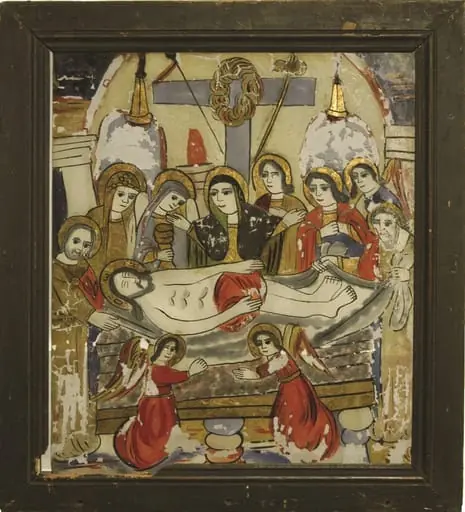 Prohodul lui Iisus
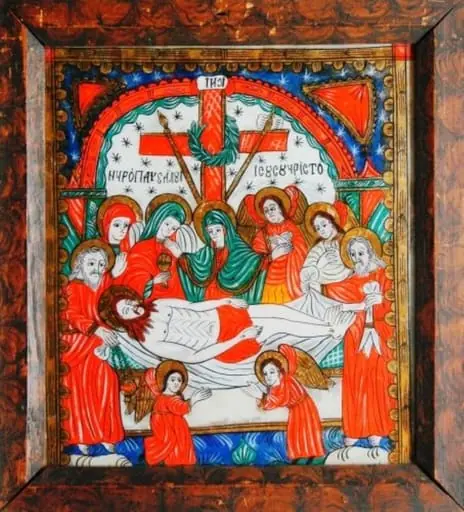 Îngroparea lui Iisus Hristos (Plângerea; Prohodul)
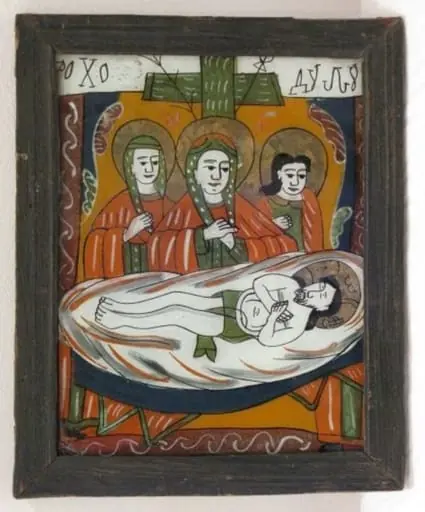 Plângerea lui Iisus
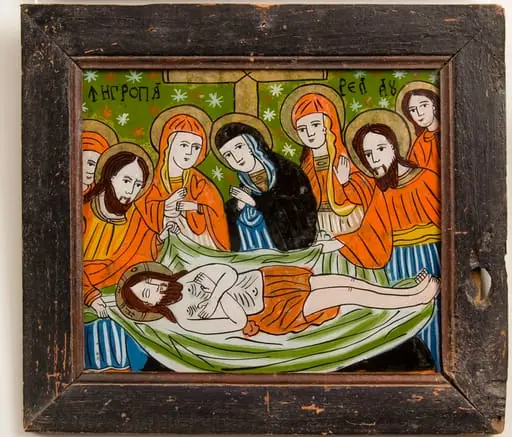 Punerea în mormânt; Îngroparea lui Iisus