Artwork
The daughter-in-law of the king of Banaras sees the jackal deprived of its food by a bird, as it unsuccessfully attempts to catch a fish, from a Tuti-nama (Tales of a Parrot): Sixteenth Night
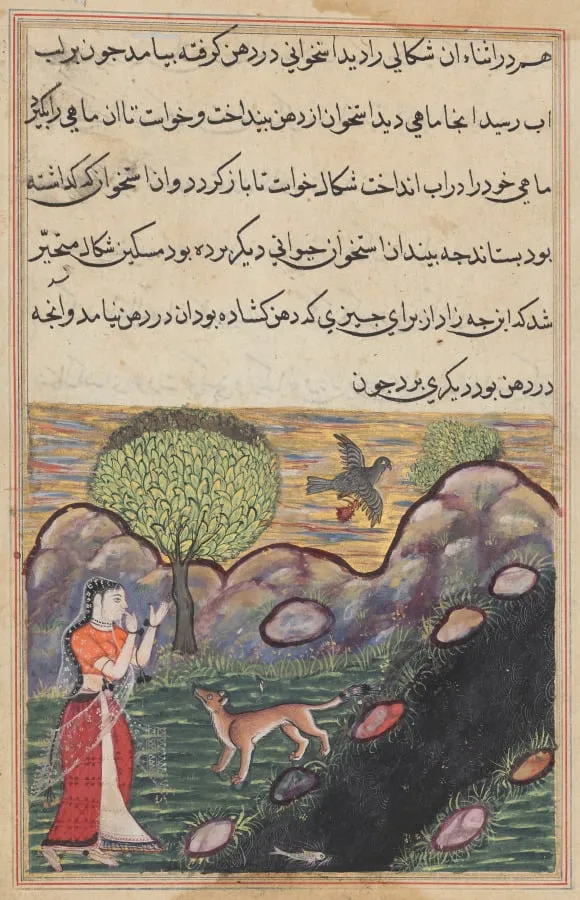
The daughter-in-law of the king of Banaras sees the jackal deprived of its food by a bird, as it unsuccessfully attempts to catch a fish, from a Tuti-nama (Tales of a Parrot): Sixteenth Night is an unspecified painting by the Mughal Painting artist Unknown. It dates from 1560 and is held in the collection of the Cleveland Museum of Art. The miniature illustrates a scene from the sixteenth night of the *Tuti‑nama*, a collection of parrot tales presented to Emperor Akbar.
About this work
The woman in the scene was left alone in the wild, and the jackal’s bad luck helps her learn to go home.
You see a woman in a red dress watching a jackal lose its fish to a big bird. The jackal stands on a rock, looking up as the bird flies off with its meal.
This painting is from a book of parrot tales told to Emperor Akbar. The story teaches a lesson: be happy with what you have. The woman in the scene was left alone in the wild, and the jackal’s bad luck helps her learn to go home.
To see more paintings like this, look up *Mughal India, court of Akbar (reigned 1556–1605)*.
Overview
The miniature illustrates a scene from the sixteenth night of the *Tuti‑nama*, a collection of parrot tales presented to Emperor Akbar. A woman in a red garment watches a jackal on a rock as a large bird swoops away with the animal’s fish. The composition captures a moment of loss and contemplation within a stylised wilderness.
Subject & Meaning
The narrative depicts the daughter‑in‑law of the Banaras king, abandoned in the forest, encountering a jackal that has just been deprived of its catch. The jackal, portrayed as a sagacious figure, advises the woman to accept her circumstances and return to her husband, embodying the tale’s moral of contentment with one’s lot.
Technique & Style
Executed in the Mughal miniature tradition, the work combines fine brushwork with delicate pigments on paper. The figures are rendered with precise outlines, while the background features a flattened landscape and a stylised bird rendered in bold, contrasting tones, typical of courtly illustrations of the late 16th century.
History & Provenance
Created during the reign of Akbar (1556–1605), the painting formed part of an illuminated manuscript commissioned for the imperial library. The *Tuti‑nama* was intended as moral entertainment for the court, and copies of its miniatures circulated among elite patrons of the Mughal empire.
Context
Mughal court art frequently employed animal allegories to convey ethical lessons. This scene aligns with the broader tradition of didactic storytelling in Persian‑influenced literature, where human characters learn virtues through encounters with the natural world.
Artist & collection

 Domestic Scene
 Giacomo and Cardinal Marco, investing Andrea, Abbot of San Zeno, with his Benefice
 The Nymph of Fontainebleau
 Portrait of a Woman
 Madonna and Child with Saints in the Enclosed Garden
 Venus and Minerva
 Family Group of Four on Sofa
 Wall painting from Room H of the Villa of P. Fannius Synistor at Boscoreale
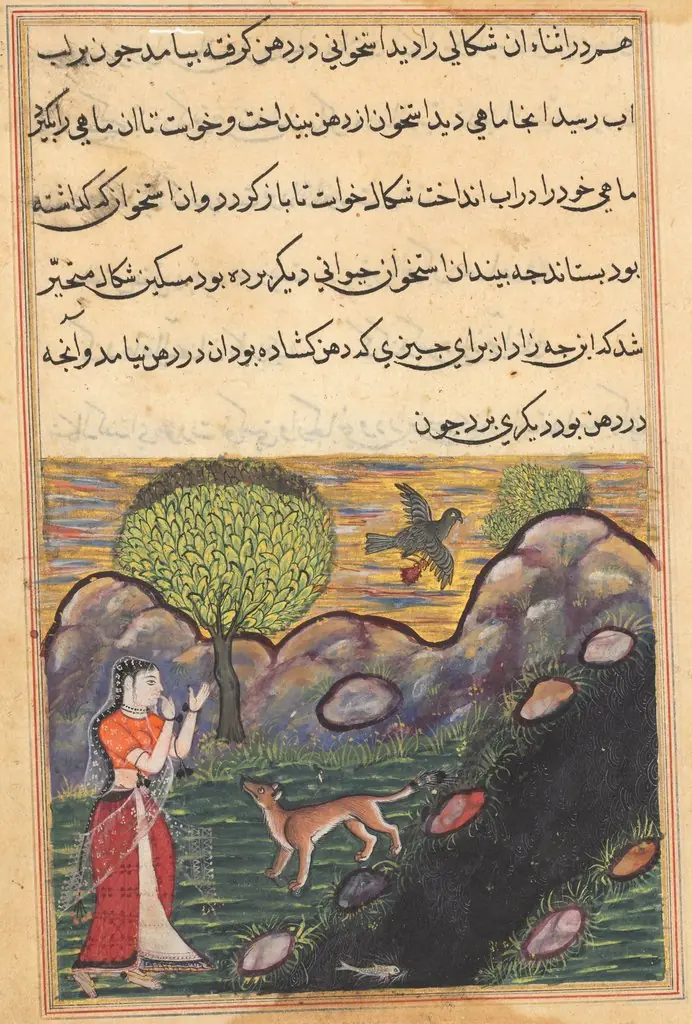 The daughter-in-law of the king of Banaras sees the jackal deprived of its food by a bird, as it unsuccessfully attempts to catch a fish, from a Tuti-nama (Tales of a Parrot): Sixteenth Night
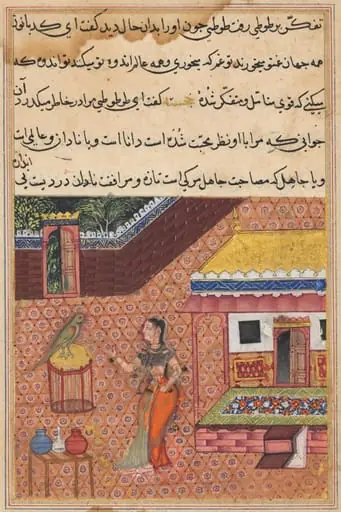 The parrot addresses Khujasta at the beginning of the thirty-fourth night, from a Tuti-nama (Tales of a Parrot)
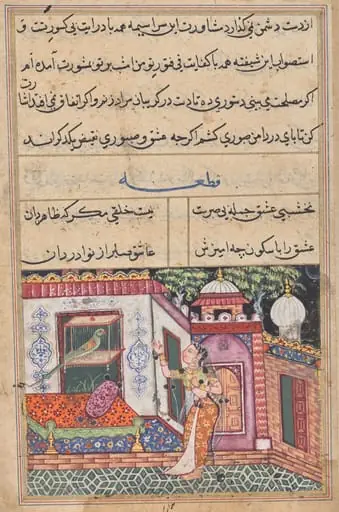 The Parrot Addresses Khujasta at the Beginning of the Eleventh Night, from a Tuti-nama (Tales of a Parrot)
 The king plucks fruit from the Tree of Life with his own hands and feeds it to a lady, from a Tuti-nama (Tales of a Parrot): Ninth Night
 The vagabond crosses a stream with the possessions of the daughter-in-law of the king of Banaras and absconds, from a Tuti-nama (Tales of a Parrot): Sixteenth Night
 The vagabond crosses a stream with the possessions of the daughter-in-law of the king of Banaras and absconds, from a Tuti-nama (Tales of a Parrot): Sixteenth Night
 The parrot addresses Khujasta at the beginning of the fiftieth night, from a Tuti-nama (Tales of a Parrot): Fiftieth Night