Artwork
The Muharram procession
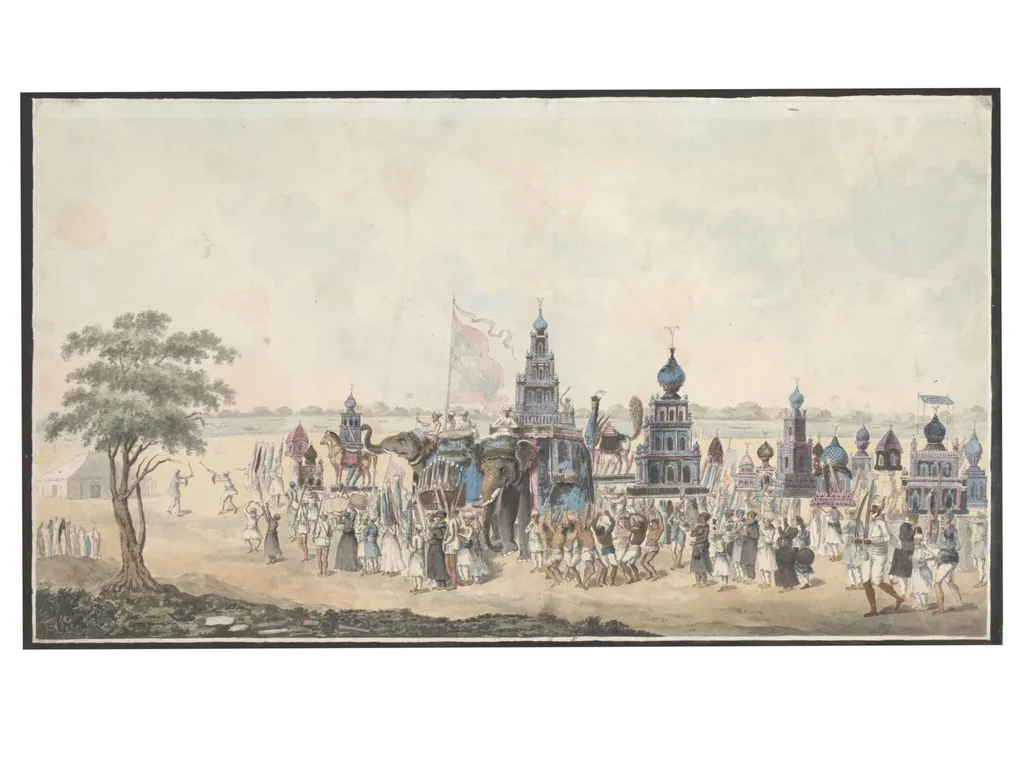
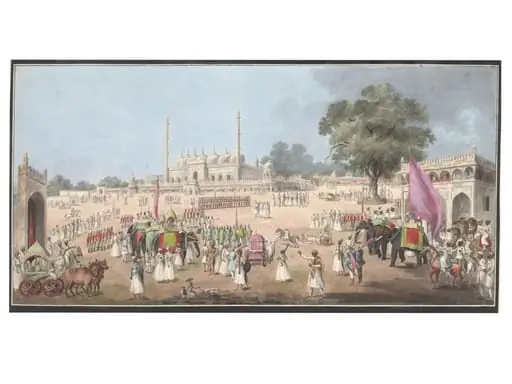
The Muharram procession is a paint painting by the Orientalist artist Unknown. It dates from 1795 and is held in the collection of the Victoria and Albert Museum.
About this work
Overview
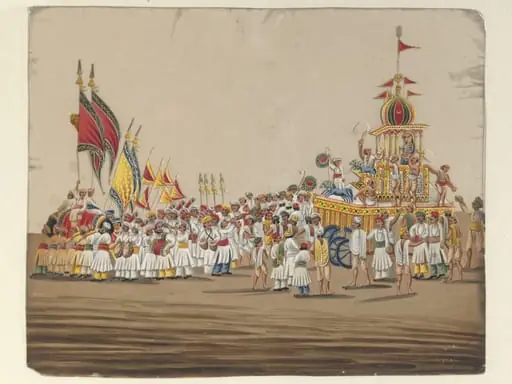
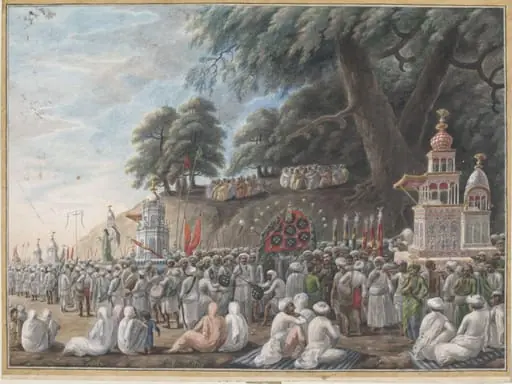
The work belongs to a series of nine paintings that document public ceremonies at the court of Murshidabad and assorted Hindu and Muslim celebrations. This particular canvas records the Muharram procession, a ritual in which participants carry miniature tombs of Hasan and Husain to be immersed in a river.
Subject & Meaning
The procession depicts Muslim devotees bearing tazias—bamboo and paper models of the martyrs’ tombs—through a bustling street. The rite commemorates the deaths of the Prophet Muhammad’s grandsons, figures revered by Shia Muslims as the legitimate successors to his leadership.
Technique & Style
Executed by a local Murshidabad artist who reproduced an earlier oil by George Farington, the painting employs softened hues to convey atmospheric perspective, a convention derived from European art that had reached India in the late eighteenth century. The gradual fading of architectural forms enhances the sense of depth.
History & Provenance
George Farington, an English artist active in India from May 1785 until his death in 1788, created the lost original oil on which this copy is based. The Murshidabad painter’s version survives as part of the series, preserving the visual record of the festival.
Context
Muharram observances were a prominent feature of the cultural life of Murshidabad, the capital of Bengal under the Nawabs. The procession’s public display of mourning blended religious devotion with communal spectacle, reflecting the city’s pluralistic traditions.
Artist & collection

 Domestic Scene
 Giacomo and Cardinal Marco, investing Andrea, Abbot of San Zeno, with his Benefice
 The Nymph of Fontainebleau
 Portrait of a Woman
 Madonna and Child with Saints in the Enclosed Garden
 Venus and Minerva
 Family Group of Four on Sofa
 Wall painting from Room H of the Villa of P. Fannius Synistor at Boscoreale