Artwork
The prince and Nikfal are joined by Khalis and the Mukhlis who are the grateful snake and frog in human form, from a Tuti-nama (Tales of a Parrot): Eighteenth Night
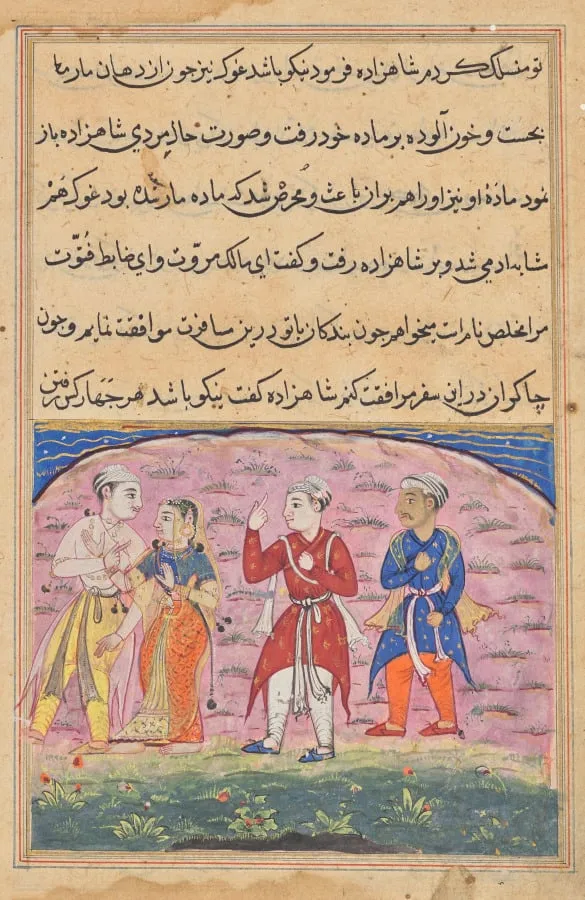
The prince and Nikfal are joined by Khalis and the Mukhlis who are the grateful snake and frog in human form, from a Tuti-nama (Tales of a Parrot): Eighteenth Night is an unspecified painting by the Mughal Painting artist Unknown. It dates from 1560 and is held in the collection of the Cleveland Museum of Art. The miniature depicts a princely figure in bright yellow trousers seated beside a woman, while two kneeling figures bow before them.
About this work
The silver pool at the bottom has darkened over time, but you can still see the poppies and grass along its edge.
A prince in yellow pants sits with a woman while two men bow before them. The men are actually a snake and a frog the prince once helped—they’ve taken human form to thank him.
This painting comes from a book of parrot tales told to Emperor Akbar. The silver pool at the bottom has darkened over time, but you can still see the poppies and grass along its edge. The story feels like a fable, but the details—like the prince’s clothes—make it feel real.
To see more paintings like this, look up Mughal India, court of Akbar (reigned 1556–1605).
Overview
The miniature depicts a princely figure in bright yellow trousers seated beside a woman, while two kneeling figures bow before them. The lower portion shows a shallow pool rendered in silver pigment that has darkened to black, its margins fringed with grass and red poppies. The surrounding terrain, though largely arid, is tinged pink and dotted with sparse tufts of vegetation.
Subject & Meaning
The scene illustrates a moment from a Tuti‑nama, a collection of parrot tales narrated to Emperor Akbar. The prince is accompanied by Nikfal, the personification of Good Fortune, and is approached by two transformed beings—a cobra and a frog—who have taken human form to repay the prince for past acts of kindness: feeding the cobra with his own flesh and rescuing the frog’s life.
Technique & Style
Executed in the Mughal miniature tradition, the work combines fine brushwork with delicate coloration. The use of metallic silver for the water surface, now oxidized, demonstrates the period’s penchant for luxurious pigments. Figures are rendered with precise linear outlines, while the landscape employs a limited palette of pink, green, and earth tones to convey an otherworldly yet recognizable setting.
History & Provenance
Created in the late sixteenth century for a manuscript compiled during the reign of Emperor Akbar (1556–1605), the painting forms part of a larger illustrated volume of moral stories. The manuscript circulated within the Mughal court, reflecting the emperor’s interest in Persian literary traditions adapted to Indian contexts.
Context
Mughal courtly art often blended Persian narrative motifs with Indian naturalistic detail. This piece exemplifies that synthesis, presenting a moral fable about gratitude and reciprocity while showcasing the court’s sophisticated aesthetic standards, including the use of costly pigments and intricate figure poses.
Legacy
The miniature remains a valuable example of Mughal narrative painting, illustrating how storytelling and visual art were integrated in imperial patronage. Its preservation of the silver pigment, despite darkening, offers insight into the material practices of the period and continues to inform studies of South Asian manuscript illumination.
Artist & collection

 Domestic Scene
 Giacomo and Cardinal Marco, investing Andrea, Abbot of San Zeno, with his Benefice
 The Nymph of Fontainebleau
 Portrait of a Woman
 Madonna and Child with Saints in the Enclosed Garden
 Venus and Minerva
 Family Group of Four on Sofa
 Wall painting from Room H of the Villa of P. Fannius Synistor at Boscoreale
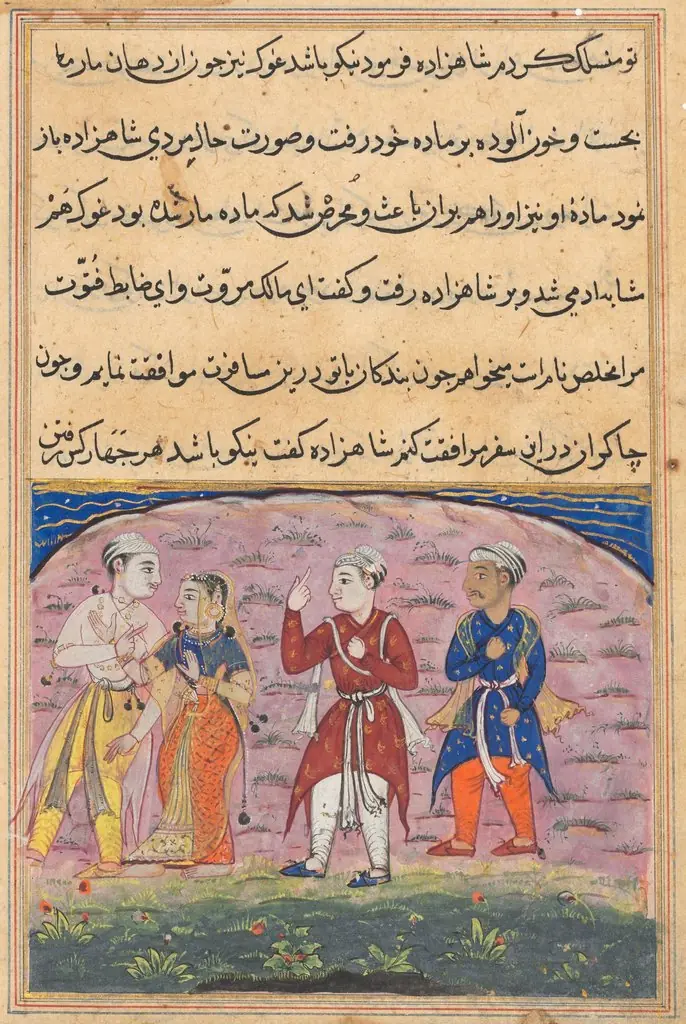 The prince and Nikfal are joined by Khalis and the Mukhlis who are the grateful snake and frog in human form, from a Tuti-nama (Tales of a Parrot): Eighteenth Night
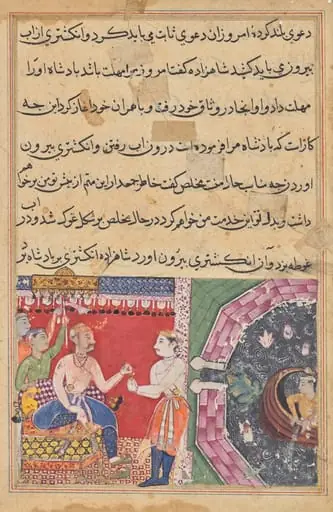 The prince, with the help of Mukhlis who changes into a frog, recovers the ring lost in the sea, and returns it to the king, from a Tuti-nama (Tales of a Parrot): Eighteenth Night
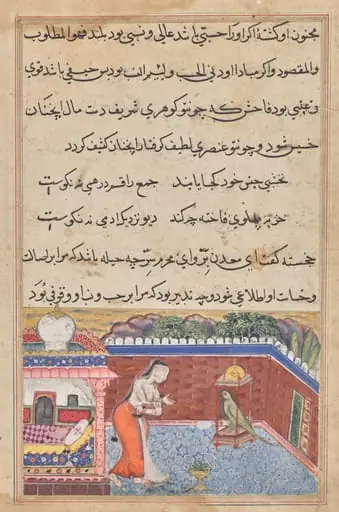 The parrot addresses Khujasta at the beginning of the thirty-first night, from a Tuti-nama (Tales of a Parrot)
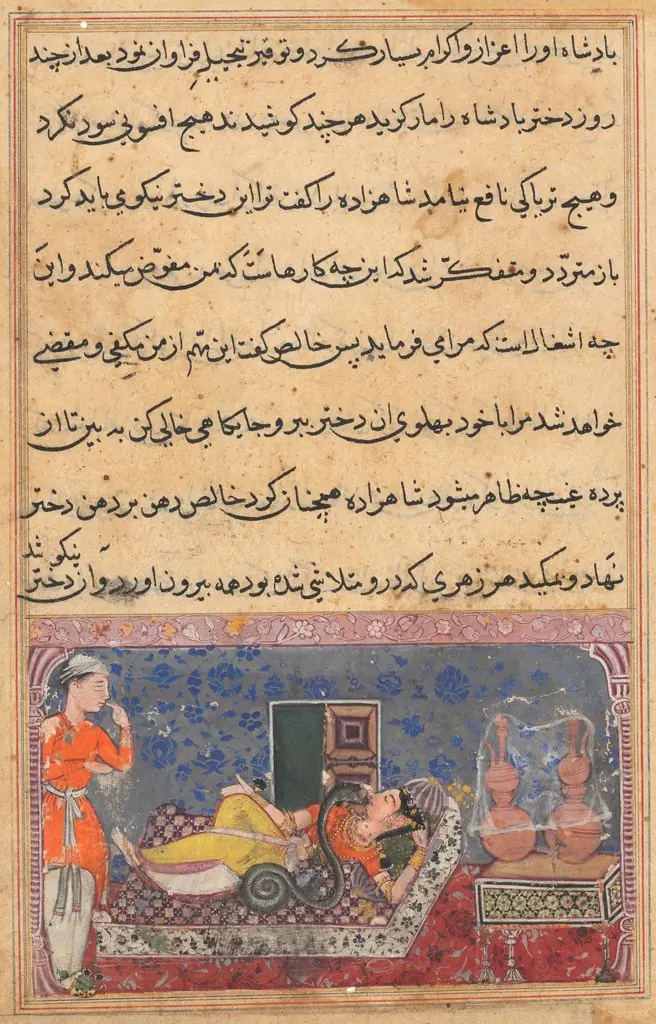 Khalis repays the prince for his kindness by changing into a snake and sucking the poison from the king’s daughter, from a Tuti-nama (Tales of a Parrot): Eighteenth Night
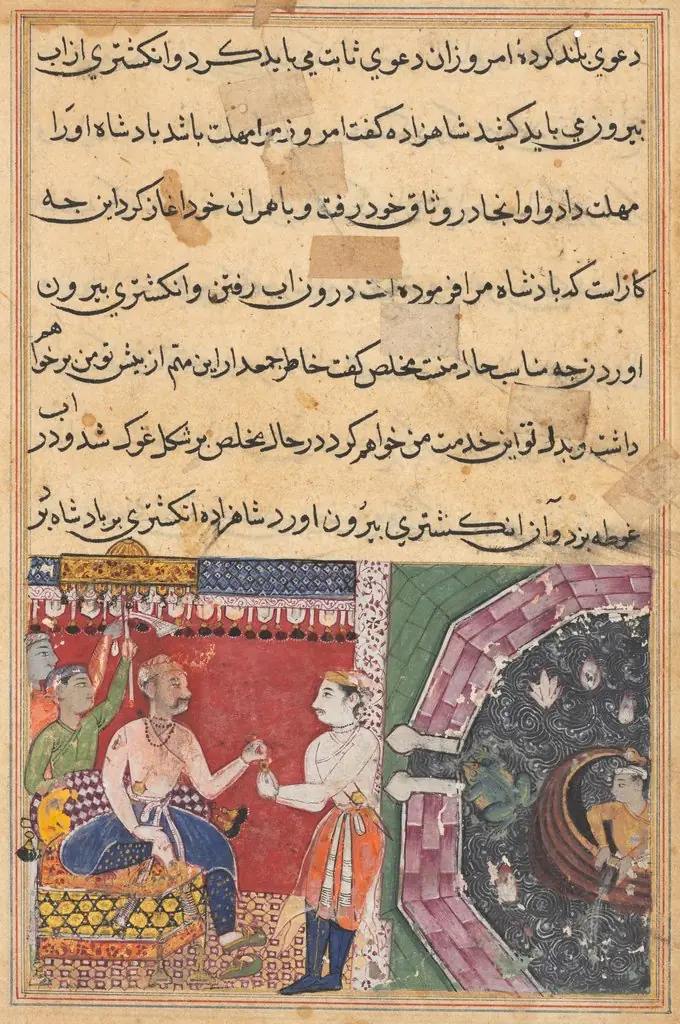 The prince, with the help of Mukhlis who changes into a frog, recovers the ring lost in the sea, and returns it to the king, from a Tuti-nama (Tales of a Parrot): Eighteenth Night
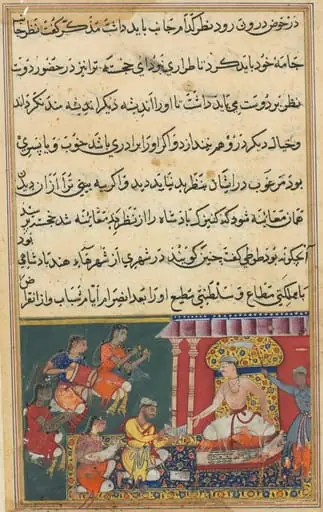 The astrologer predicts a calamity for the newly born prince in his thirteenth year, but one which he would be able to overcome, from a Tuti-nama (Tales of a Parrot): Eighth Night
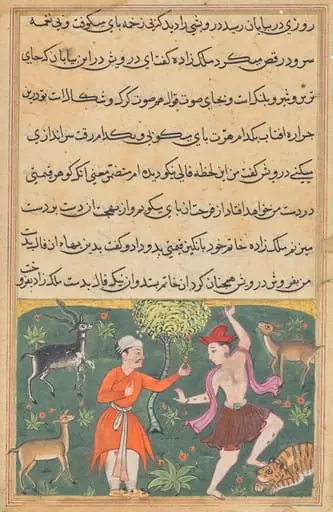 The prince meets a carefree dancing dervish whose good fortune he purchases for his ring, from a Tuti-nama (Tales of a Parrot): Eighteenth Night
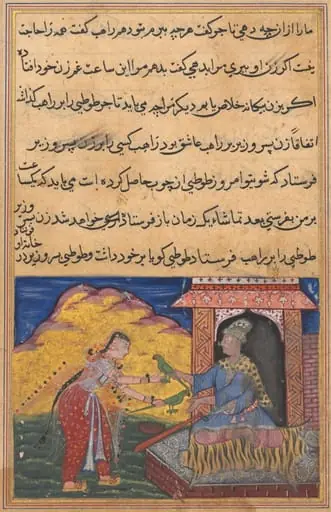 The wife of the son of the vizier brings the magic wooden parrot to her lover, the monk, who exchanges it for the replica, from a Tuti-nama (Tales of a Parrot): Tenth Night