Artwork
The astrologer predicts a calamity for the newly born prince in his thirteenth year, but one which he would be able to overcome, from a Tuti-nama (Tales of a Parrot): Eighth Night
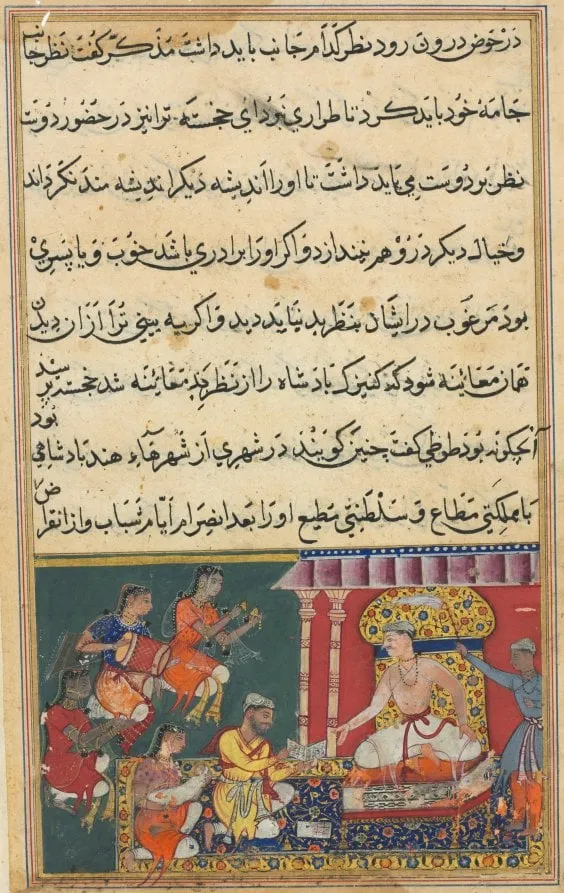
The astrologer predicts a calamity for the newly born prince in his thirteenth year, but one which he would be able to overcome, from a Tuti-nama (Tales of a Parrot): Eighth Night is an unspecified painting by the Mughal Painting artist Banavari 1. It dates from 1560 and is held in the collection of the Cleveland Museum of Art.
About this work
The red background comes from older Indian painting styles, not the more realistic shading used in Persian art at the time.
You see a king on a throne, an astrologer pointing to charts, and a woman holding a baby prince. Musicians play in the background. Everything sits against a bright red flat space.
This painting is from a book of parrot tales told over fifty-two nights. The story here warns the king that his son will face danger at thirteen—but will survive. The red background comes from older Indian painting styles, not the more realistic shading used in Persian art at the time.
To see how other artists showed royal courts, look up *Mughal India, court of Akbar (reigned 1556–1605)*.
Overview
This painting illustrates the eighth night’s tale from the Tuti-nama, a collection of stories told by a parrot to deter a queen from adultery. It captures the moment an astrologer reveals a prophecy to an Indian king: his long-awaited son will face grave peril in his thirteenth year, yet survive. The scene unfolds in a stylized royal court, where figures are arranged with symbolic clarity rather than naturalistic depth.
Subject & Meaning
The narrative centers on fate and resilience. The king, seated in authority, listens as the astrologer gestures toward celestial charts, signaling the inevitability of the prince’s trial. The infant, cradled by a woman, embodies vulnerability, while the musicians suggest celebration tinged with foreboding. The red background intensifies the emotional weight of the prophecy, framing the moment as both ceremonial and ominous.
Technique & Style
The composition employs flat, unmodulated surfaces and bold outlines, characteristic of pre-Mughal Indian manuscript painting. Figures are arranged hierarchically, with the king and astrologer dominating the space. The absence of perspective and the use of vivid, non-naturalistic color—particularly the saturated red backdrop—reflect indigenous traditions, distinguishing it from contemporary Persian techniques that favored atmospheric depth and shading.
History & Provenance
Created in the late 16th century, likely in a workshop associated with the Mughal court, this miniature was part of a manuscript commissioned for royal entertainment. The Tuti-nama, originally Persian in origin, was translated and illustrated in India under Akbar’s patronage. This folio survives as evidence of the court’s interest in moral tales framed through visual storytelling.
Context
The Tuti-nama was adapted during Akbar’s reign as part of a broader effort to synthesize Persian literary forms with Indian artistic sensibilities. Royal manuscripts like this served both as cultural artifacts and instruments of political messaging, reinforcing ideals of wisdom, destiny, and dynastic continuity. The choice of a parrot as narrator reflects a tradition of animal allegory in South Asian storytelling.
Legacy
This painting exemplifies the hybrid aesthetic of early Mughal art, blending Persian narrative structure with Indian visual conventions. Its influence can be traced in later courtly illustrations that prioritized symbolic expression over realism. As part of a larger manuscript tradition, it preserves a unique moment in the evolution of Indian miniature painting during a period of cross-cultural exchange.
Artist & collection
Artist
This hand scroll shows Mughal emperors at play in the 1500s. Banavari painted scenes from royal life in Tabriz—here, wolves are released for the prince to chase, and a fortune-teller warns of a danger the heir will…

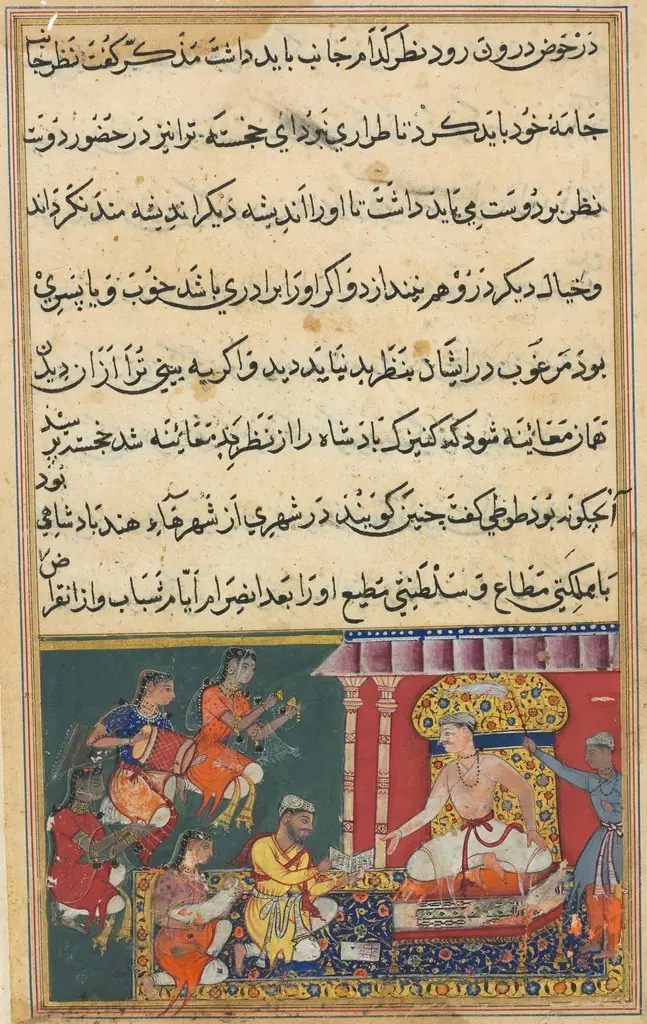 The astrologer predicts a calamity for the newly born prince in his thirteenth year, but one which he would be able to overcome, from a Tuti-nama (Tales of a Parrot): Eighth Night
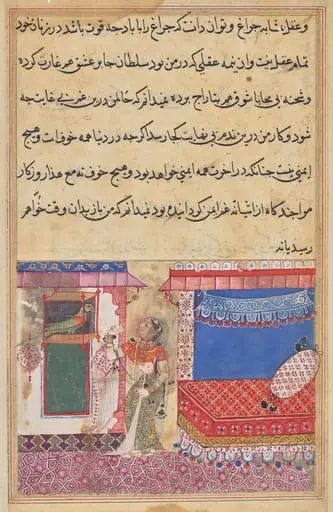 The Parrot Addresses Khujasta at the Beginning of the Eighteenth Night, from a Tuti-nama (Tales of a Parrot)
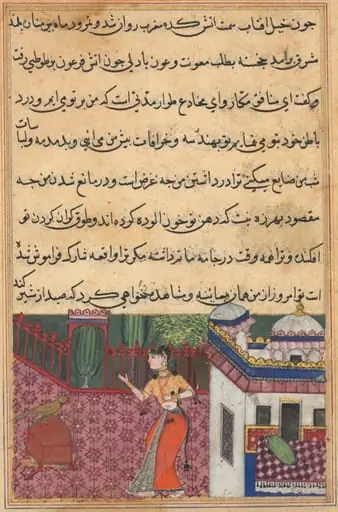 The parrot addresses Khujasta at the beginning of the thirty-third night, from a Tuti-nama (Tales of a Parrot)
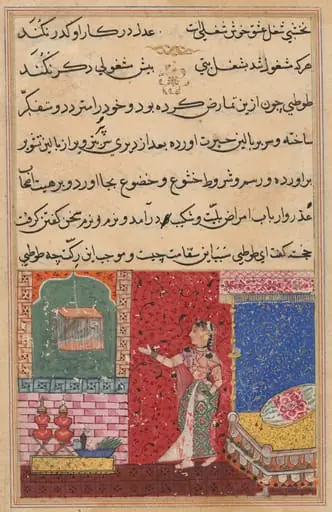 The Parrot Addresses Khujasta at the Beginning of the Fifteenth Night, from a Tuti-nama (Tales of a Parrot)
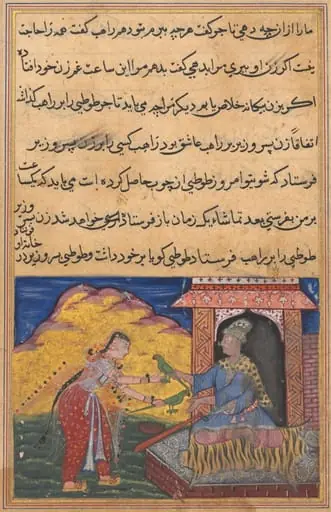 The wife of the son of the vizier brings the magic wooden parrot to her lover, the monk, who exchanges it for the replica, from a Tuti-nama (Tales of a Parrot): Tenth Night
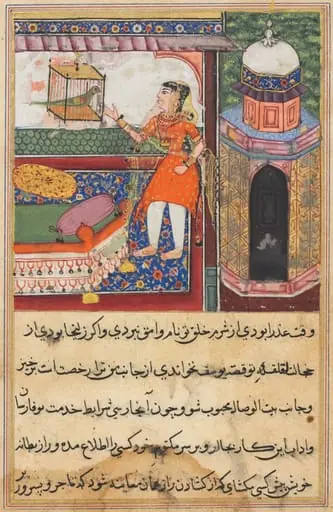 The Parrot Addresses Khujasta at the Beginning of the Tenth Night, from a Tuti-nama (Tales of a Parrot)
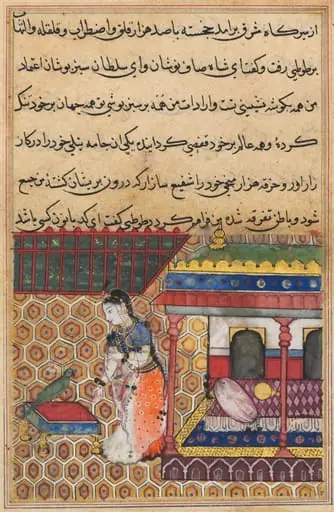 The parrot addresses Khujasta at the beginning of the thirty-eighth night, from a Tuti-nama (Tales of a Parrot)
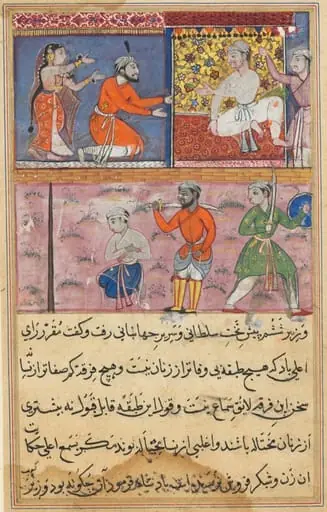 The prince sent back to the place of execution for the sixth time, from a Tuti-nama (Tales of a Parrot): Eighth Night
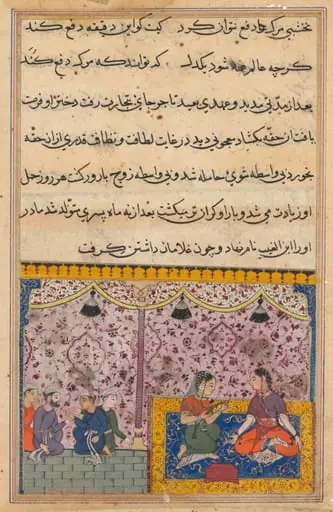 The merchant’s daughter gives birth to a son as a result of eating out of the box. The clever child recognizes the false gems from true, from a Tuti-nama (Tales of a Parrot): Twenty-third Night
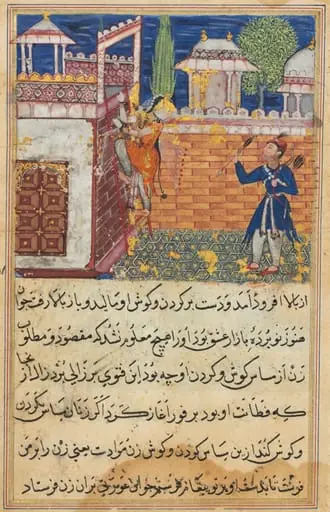 The deceitful wife returns to her terrace after caressing her lover, from a Tuti-nama (Tales of a Parrot): Eighth Night
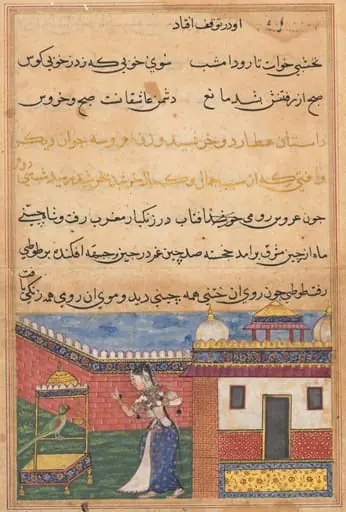 The parrot addresses Khujasta at the beginning of the thirty-second night, from a Tuti-nama (Tales of a Parrot)
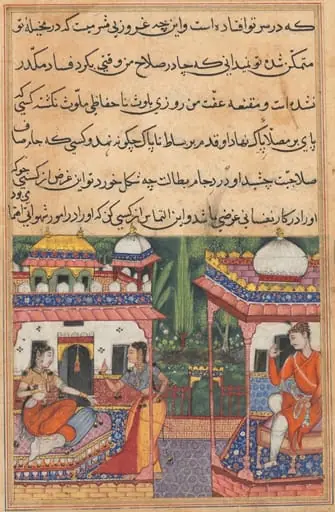 Kaiwan sends a message of love to Khurshid, wife of his brother Utarid who is away on a journey, from a Tuti-nama (Tales of a Parrot): Thirty-second Night
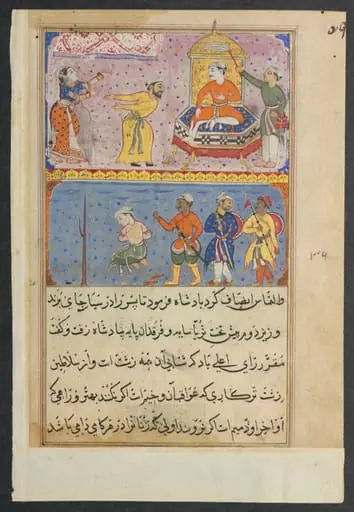 The prince, once reprieved, is returned to the palace of execution a second time on the plea of the king’s handmaiden, from a Tuti-nama (Tales of a Parrot): Eighth Night
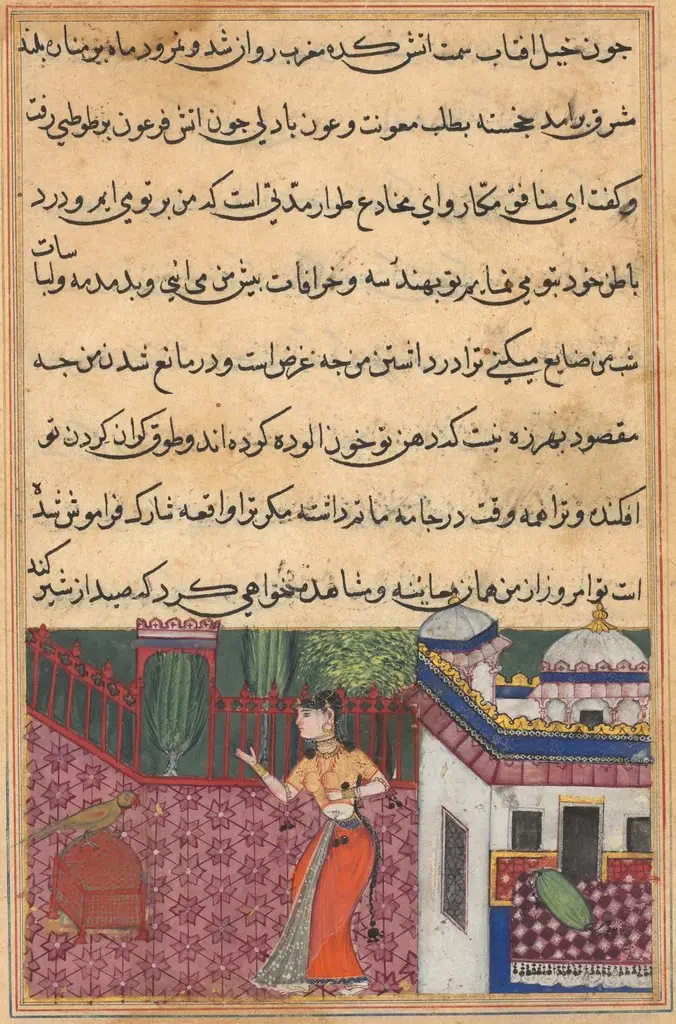 The parrot addresses Khujasta at the beginning of the thirty-third night, from a Tuti-nama (Tales of a Parrot)
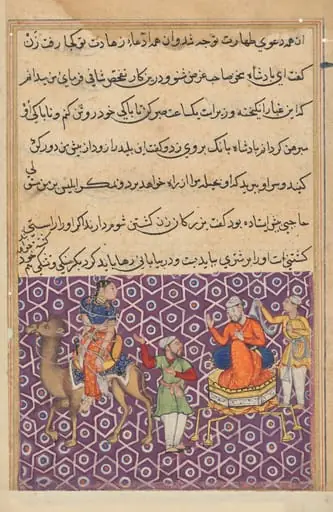 King Bahram, who has married Khassa’s daughter, has her tied to a camel to be abandoned in the desert as a result of false accusations made by Khulasa, from a Tuti-nama (Tales of a Parrot): Fifty-first Night
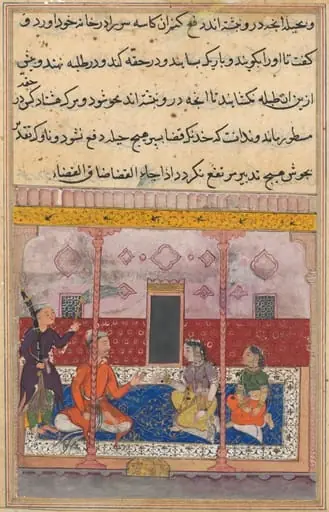 The merchant has the hateful skull ground and put into a box, from a Tuti-nama (Tales of a Parrot): Twenty-third Night
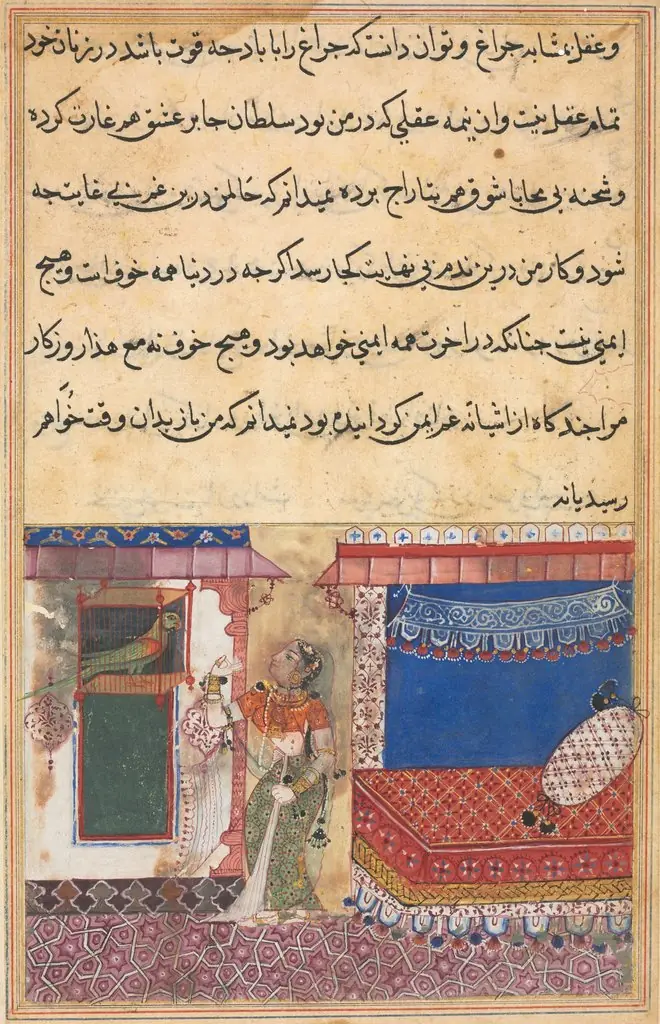 The Parrot Addresses Khujasta at the Beginning of the Eighteenth Night, from a Tuti-nama (Tales of a Parrot)
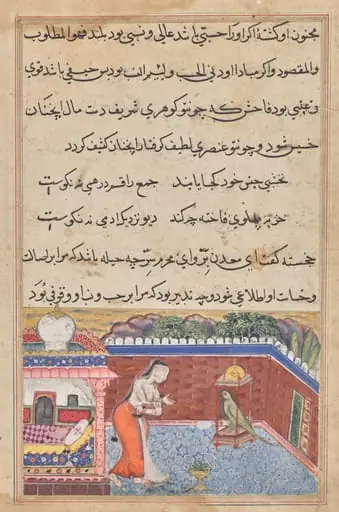 The parrot addresses Khujasta at the beginning of the thirty-first night, from a Tuti-nama (Tales of a Parrot)
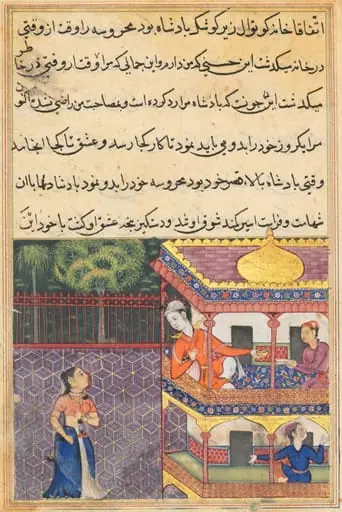 The king of Zabul sees Mahrusa from his palace balcony, from a Tuti-nama (Tales of a Parrot): Thirty-sixth Night