Artwork
Trupățiș
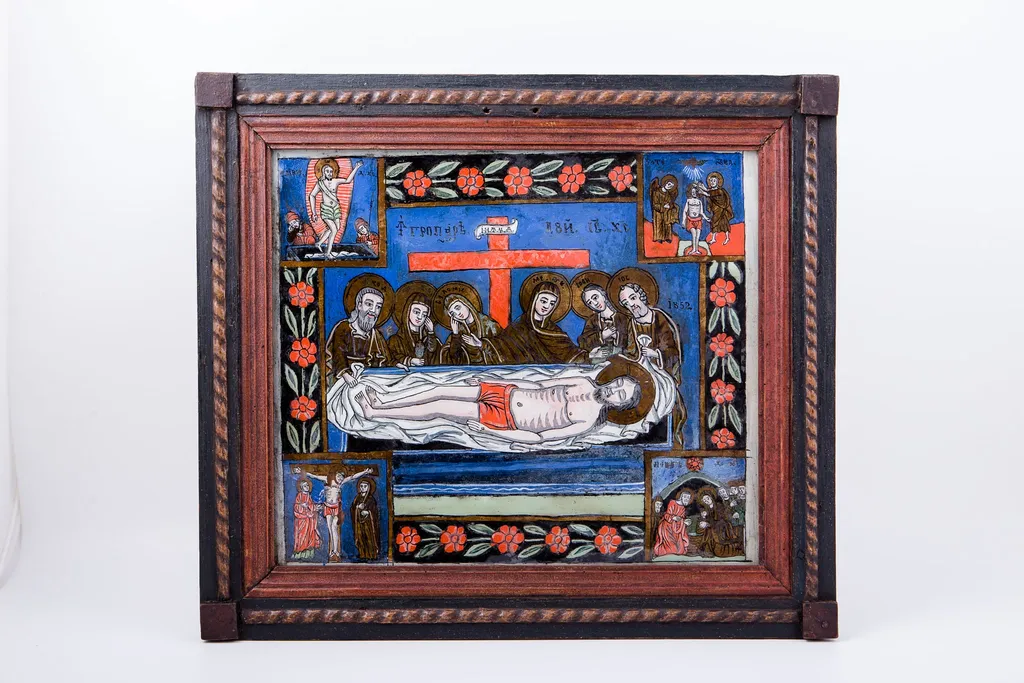
Trupățiș is a drawing by the Impressionist artist Simion Poienaru din Laz. It dates from 1852 and is held in the collection of the ASTRA National Museum Complex.
About this work
Overview
Trupățiș is an 1852 painting by Simion Poienaru din Laz, executed in a devotional style common in 19th-century Romanian religious art.
Trupățiș is an 1852 painting by Simion Poienaru din Laz, executed in a devotional style common in 19th-century Romanian religious art. It portrays a deceased man on a table, attended by figures in dark robes bearing halos. The composition is restrained, with a blue background and floral motifs framing the central scene. Smaller narrative panels in the corners suggest a connection to sacred stories, reinforcing the work’s liturgical purpose.
Subject & Meaning
The central figure, draped in white and an orange loincloth, appears to be a deceased individual being mourned or prepared for burial. The haloed attendants imply spiritual presence, possibly angels or saints, suggesting a moment between death and divine judgment. The inclusion of biblical vignettes in the corners extends the scene’s meaning beyond the immediate moment, linking personal loss to broader theological themes of redemption and eternity.
Technique & Style
The painting employs flat planes of color and minimal modeling, avoiding naturalistic depth. Figures are stylized, with sharp outlines and symbolic rather than realistic rendering. The bold use of red, green, and blue creates visual contrast without shading or perspective. These choices reflect local iconographic traditions rather than Western academic or Impressionist techniques, despite superficial color similarities.
History & Provenance
Created in 1852, Trupățiș emerged during a period of renewed interest in Romanian religious identity under Ottoman and Habsburg influence. The work likely originated in a monastic or parish context, possibly intended for private devotion or church decoration. Its survival suggests it was preserved within a religious community, though its exact early ownership remains undocumented.
Context
In mid-19th century Romania, religious painting often blended Byzantine conventions with emerging national motifs. Trupățiș reflects this synthesis: its halos and sacred narrative panels align with Orthodox iconography, while the inclusion of floral decoration and spatial arrangement shows regional folk influences. It was not part of Western art movements but rather a local expression of faith during cultural consolidation.
Legacy
Trupățiș remains a rare surviving example of devotional painting from rural Romanian communities in the 1850s. It contributes to the understanding of how religious imagery persisted outside urban academies, preserving traditional forms amid modernization. Today, it is studied as a cultural artifact rather than an artistic innovation, valued for its testimony to local spiritual life.
Artist & collection
Artist

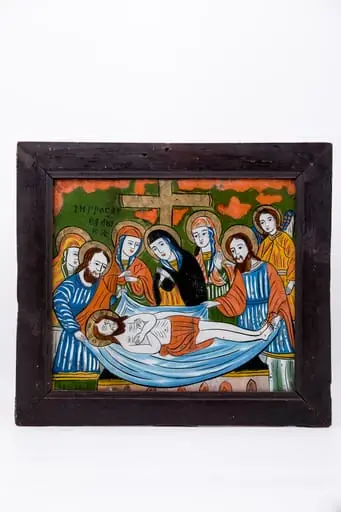 Icoana reprezintă Prohodul Domnului. Punerea în mormânt a Mântuitorului Iisus Hristos. Trupul Mântuitorului Iisus Hristos, fiind coborât de pe cruce, este învelit în țesătura giulgiului alb-albastru. Maica Domnului împreună cu Sfinții Iosif din Arimateea, Nicodim și trei femei mironosițe aducătoare de mir țin în brațe trupul Mântuitorului. Martor și aproape este Îngerul care va striga bucuria Învierii Domnului. Compozițional se creează astfel o imagine concentrică de corabie, cu Crucea Răstignirii ca și catarg, corabia prefigurând Biserica. Giulgiul și îmbrățișarea celor apropiați, uniți întru dragoste și suferință, reprezintă axa orizontală, perpendiculară pe Cruce. Compoziția este echilibrată, simetrică și circulară. Maica Domnului este îmbrăcată în veșmânt cu maforiom negru, cu sacos galben și interiorul căptușit cu albastru ceruleum. Veșmintele Sfinților și Mironosițelor sunt în combinație de roșu vermillon, albastru cu linii albe, galben solar și verde-văratic. Fondul icoanei este văzduhul verde-văratic, plin de Duhul Sfânt și un chenar decorativ sugerat ca și ancadrament, format din elemente florale stilizate - ruje roșii. Cromatica este armonioasă: roșu vermillon, albastru cobalt, ceruleum, verde văratic-forest, galben solar-chihlimbar, alb și negru. Inscripția din româno-chirilică se traduce Îngroparea Lui IC XC Iisus Hristos. Icoana este din Țara Oltului.
 Trup
Trup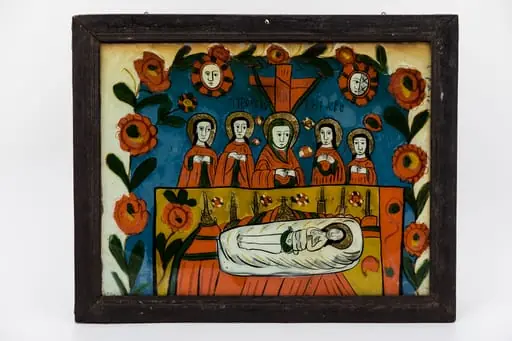 Icoana reprezintă Punerea în mormânt a Mântuitorului Iisus Hristos. Prohodul Domnului. Trupul Mântuitorului Iisus Hristos, fiind coborât de pe cruce, este învelit în țesătura giulgiului alb-gri, cu fire diafane galbene de lumină, amintind de Lumina Învierii. Maica Domnului împreună cu Sfinții Iosif din Arimateea, Nicodim și două femei mironosițe aducătoare de mir țin în brațe trupul Mântuitorului. Compozițional se creează astfel o imagine concentrică de corabie, cu Crucea Răstignirii ca și catarg, corabia prefigurând Biserica. Giulgiul și îmbrățișarea celor apropiați, uniți întru dragoste și suferință, reprezintă axa orizontală perpendiculară pe Cruce. Compoziția este echilibrată, simetrică și circulară. Maica Domnului este îmbrăcată în veșmânt cu maforiom roșu vermillon, cu sacos roșu vermillon și interiorul căptușit cu verde văratic. Fondul icoanei este cerul albastru ceruleum-cobalt, în registrul superior și de mijloc și un spațiu de galben-chihlmbar, în registrul inferior, în jurul mormântului Mântuitorului Iisus Hristos. Întreaga compoziție iconografică este încadrată de un chenar decorativ geometrizant alb, dublat de un chenar fitomorf, format dintr-o ghirlandă de 10-12 ruje roșii vermillon, cu interiorul galben-verde. În ghirlanda de ruje, sunt intercalate cele două elemente astrale martore: Soarele și Luna. Simetric și armonios, sunt 6 sfeșnice cu lumânări arzânde, lângă Trupul Mântuitorului Iisus Hristos, învăluit în giulgiu. Cromatica este armonioasă și luminos-pastelată: roșu vermillon, albastru cobalt, ceruleum, verde văratic-forest, galben chihlimbar, alb și negru. Inscripția din româno-chirilică se traduce Îngroparea Lui IC XC Iisus Hristos. Icoana este din Țara Oltului, Șcheii Brașovului.
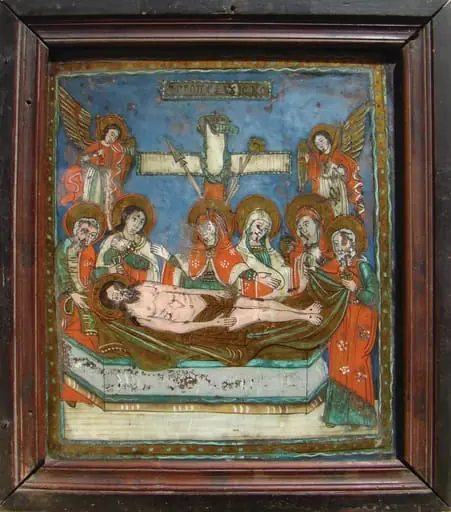 Prohodul lui Iisus
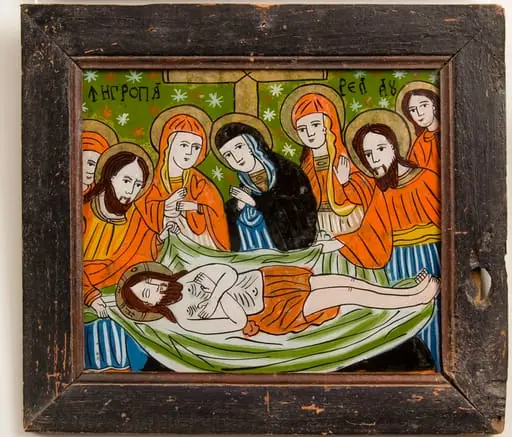 Punerea în mormânt; Îngroparea lui Iisus
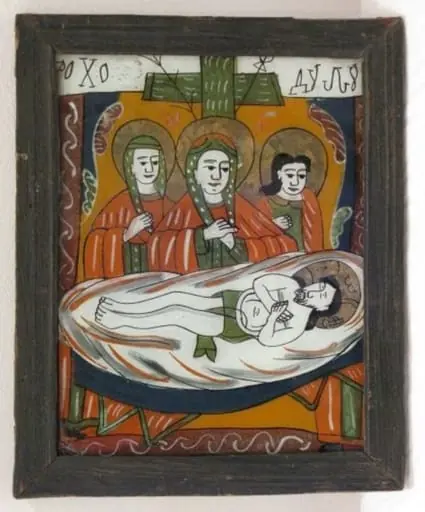 Plângerea lui Iisus
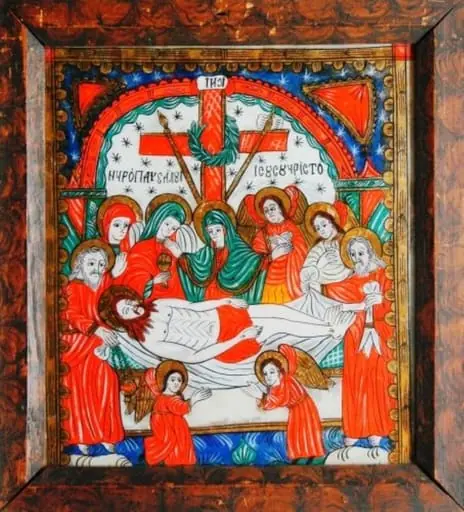 Îngroparea lui Iisus Hristos (Plângerea; Prohodul)
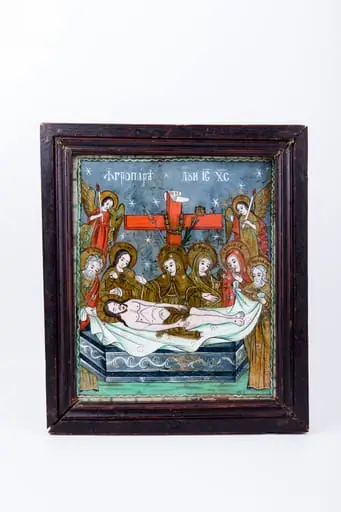
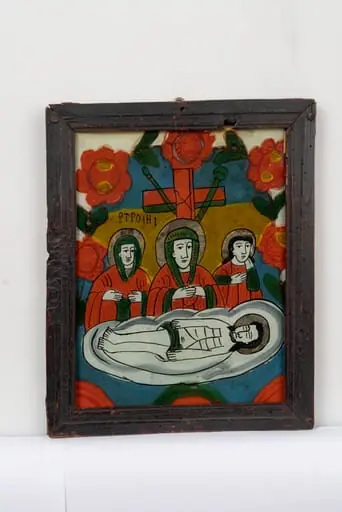 Tema icoanei face parte din ciclul Patimilor Mântuitorului și înfățișează Prohodul Domnului. Alături de Hristos așezat pe piatră sunt reprezentate doar trei personaje. Maica Domnului, în centru, cu mâinile împreunate la piept, are de-o parte un apostol, iar de cealaltă parte una dintre femeile mironosițe, probabil Maria Magdalena. În spate se profilează crucea lui Hristos și însemnele patimilor - sulița și buretele. Un șirag de rozete ornamentează fondul icoanei. Cromatica icoanei se compune din tonuri de roșu vermillon, ocru galben, alb, verde, albastru, negru și gri. Rama icoanei e profilată, băițuită și e formată din îmbinarea a patru baghete de lemn.
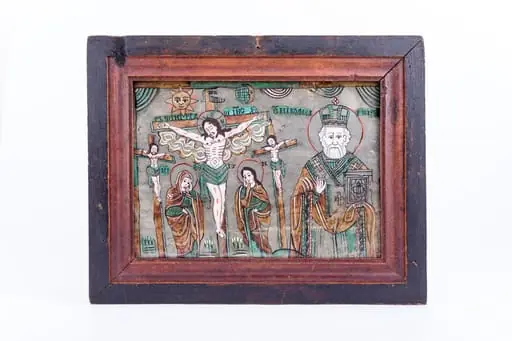 Mântuitorul Iisus Hristos, fiind răstignit pe Cruce, are în stânga pe ucenicul cel iubit, care a stat lipit de pieptul Învățătorului, la Cina cea de Taină, mai precis, pe Sfântul Apostol și Evanghelist Ioan Teologul, Evanghelistul Iubirii și în dreapta pe Maica Domnului Îndurerată, Jalnică și Plângătoare. Veșmintele Maicii Domnului sunt pământii-bronzii cu verde kaki. Sfântul Ioan este îmbrăcat în brun și kaki. Mântuitorul Iisus Hristos are o țesătură verde în jurul mijlocului și a coapselor și trupul îi este plin de răni sângerânde. În planul superior sunt simboluri astrale: soarele, deasupra Maicii Domnului, luna, deasupra Sfântului Ioan. În planul îndepărtat sun cei doi tâlhari răstigniți pe crucile lor. În cea de-a doua parte a icoanei este Sfântul Mare Ierarh Nicolae făcătorul de miuni și ocrotitor al copiilor. Ține în mâna stângă Sfânta Evanghelie închisă și cu dreapta Binecuvântează. Este unul dintre cei mai populari și iubiți sfinți, ocrotitor al caselor, familiilor și copiilor. Are barbă lungă, albă și mithră arhierească și aureolă. Este îmbrăcat în veșminte liturgice, de ierarh, sacos verde-brad, felon bronziu-kaki, epitrahil-patrafir gri-petrol cu patru cruci. Cromatica este armonioasă, dar foarte îngândurată și tristă: gri-petrol, verde-brad, kaki, brun închis, bronziu, roșu sângeriu, alb, negru. Inscripția din româno-chirilică se traduce Răstignirea Lui Iisus Hristos IC XC MP Maica Domnului Sf Nicolae. Icoana este de Laz, Valea Sebeșului, având două tematici iconografice.
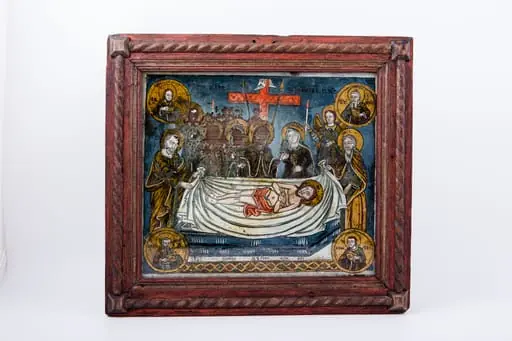 Trup și