Artwork
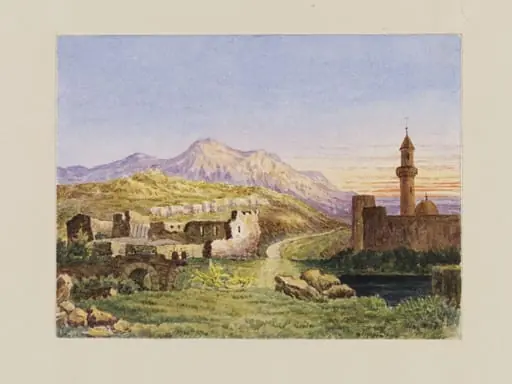
Villa Sevillana on the Road from Bona to Constantine
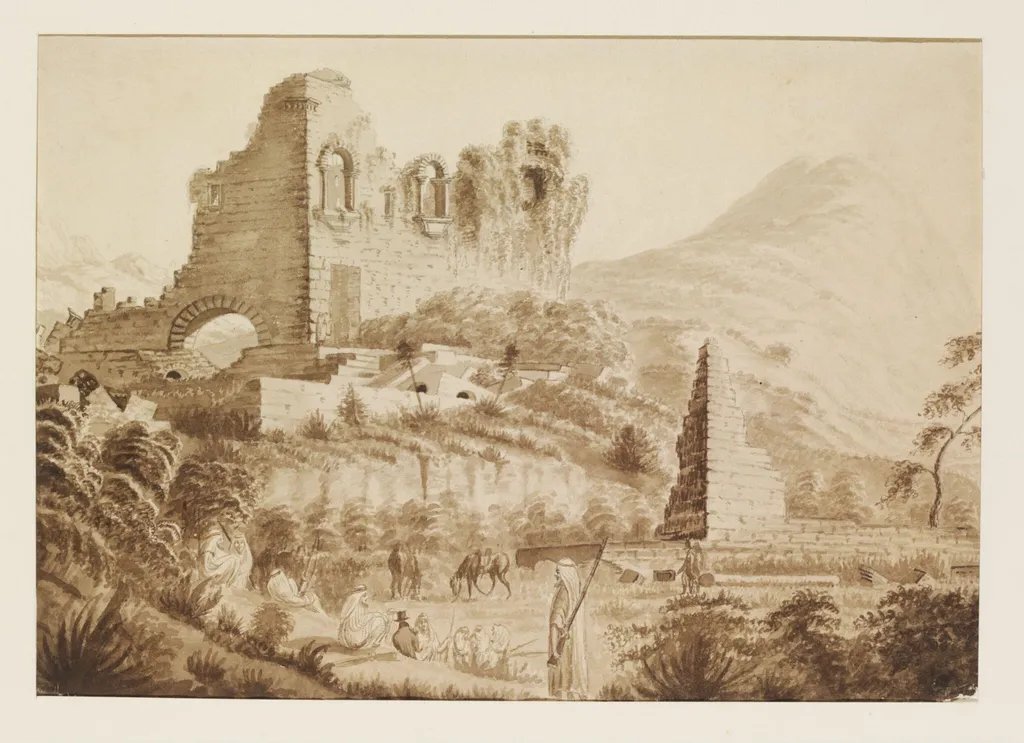
Villa Sevillana on the Road from Bona to Constantine is a watercolor work on paper by the Romanticist artist Unknown. It dates from 1810 and is held in the collection of the Victoria and Albert Museum.
About this work
Overview
The work is a watercolor dated 1810 that portrays a deteriorating stone villa situated on the road linking the Algerian towns of Bona (now Annaba) and Constantine. The composition shows the building perched on a slope, its arches and walls in partial ruin, while a sparse valley below hosts a few figures, livestock, and a slender tower amidst dry grass and scrub.
Subject & Meaning
The image captures a moment of quiet desolation, emphasizing the passage of time on an abandoned structure within a remote landscape. The muted earth tones and softened forms convey a sense of isolation, inviting contemplation of the region’s historical layers and the transitory nature of human habitation.
Technique & Style
Executed in watercolor, the artist employs light washes of brown and gray to render the crumbling masonry and surrounding terrain. The medium’s translucency lends a sketch‑like quality, while the restrained palette aligns the piece with early 19th‑century Romantic tendencies toward atmospheric, evocative depictions of ruin and wilderness.
History & Provenance
M’Donald of the British Commissariat, a participant in Lord Cochrane’s 1810 Algerian trade expedition.
Originally attributed to an unidentified hand, the drawing was once tentatively linked to a Mr. M’Donald of the British Commissariat, a participant in Lord Cochrane’s 1810 Algerian trade expedition. Chronological inconsistencies regarding the expedition’s itinerary have cast doubt on this connection, suggesting the work more likely reflects observations made by other English travelers or residents present in Algeria during that year.
Artist & collection

 Domestic Scene
 Giacomo and Cardinal Marco, investing Andrea, Abbot of San Zeno, with his Benefice
 The Nymph of Fontainebleau
 Portrait of a Woman
 Madonna and Child with Saints in the Enclosed Garden
 Venus and Minerva
 Family Group of Four on Sofa
 Wall painting from Room H of the Villa of P. Fannius Synistor at Boscoreale
 Theatre, with the Sarcophagus and Harpy Tombs, Xanthus
 St. Sophia - near Djulfa - Ispahan
 Italian landscape, with an ancient Roman sarcophagus
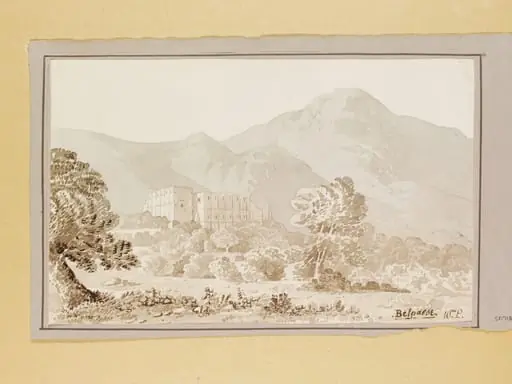 Belpaese
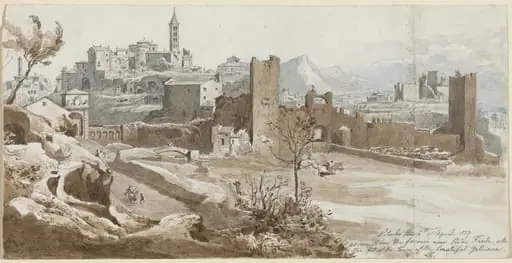 Viterbo
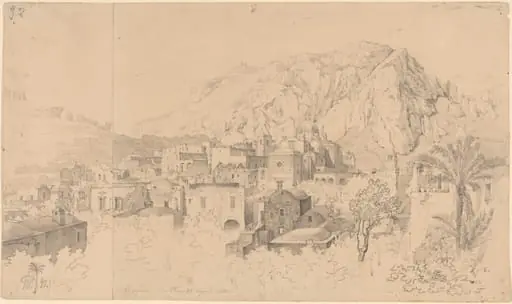 View of Capri
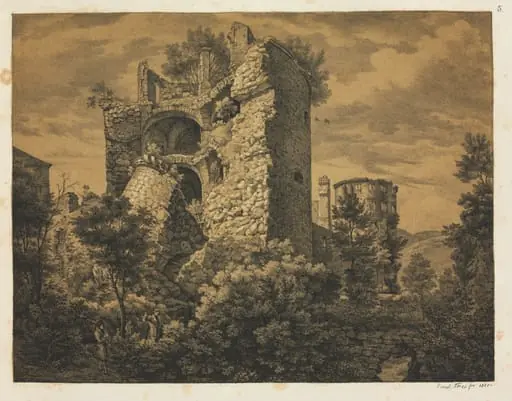 Six Views of Heidelberg Castle: Tower
 The Casa, Macao, in the gardens of which is Camoens' Cave (the residence of Lady Pereira), Macao
 Whitby
 Mountainous landscape with ruined building
 A View near Rome
 Emmaus