Artwork
Veduta del Prospetto della Chiesa del S. Francesco
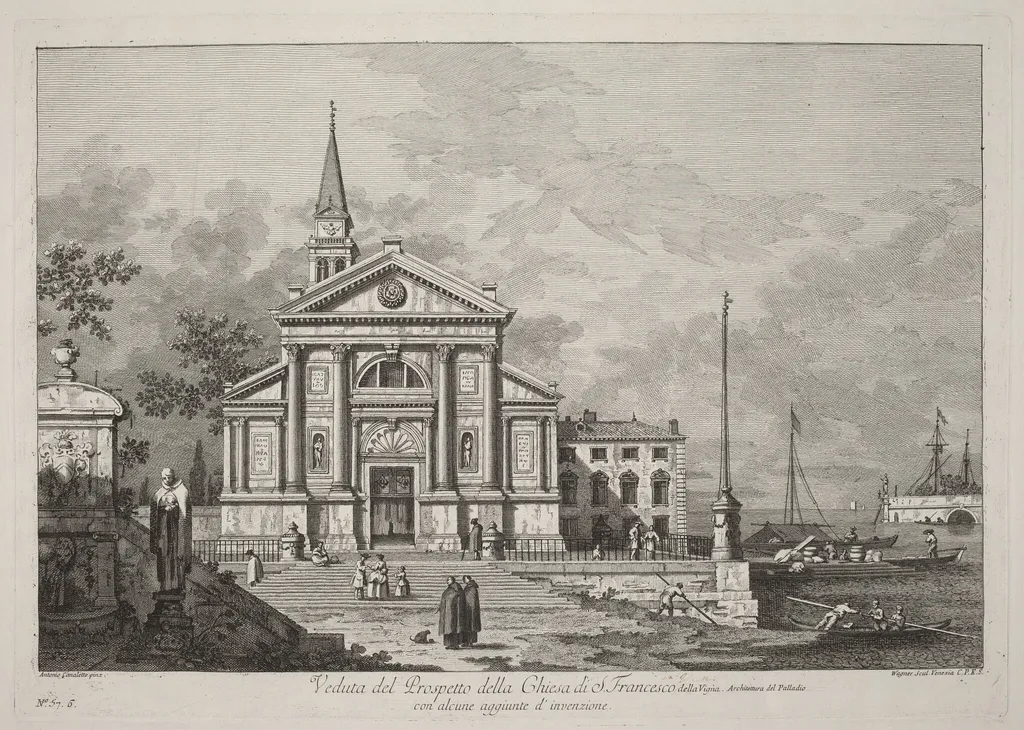
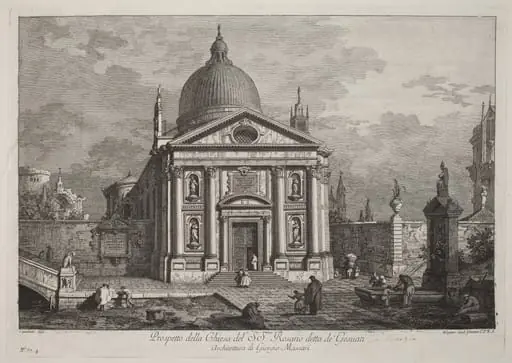
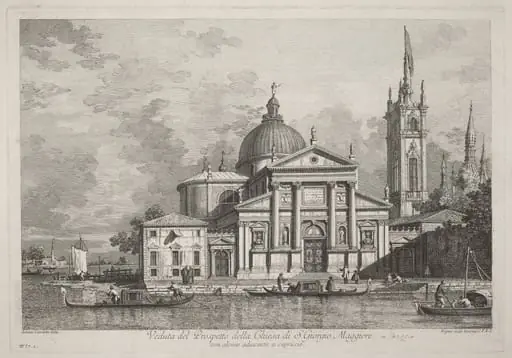
Veduta del Prospetto della Chiesa del S. Francesco is an ink print by the Baroque artist Joseph Wagner. It dates from 1742 and is held in the collection of the National Gallery of Art.
About this work
Overview
Wagner’s technique captures both structural detail and atmospheric stillness, typical of Venetian vedute of the period.
Created in 1742 by Joseph Wagner, this print depicts the facade of the Church of San Francesco in Venice. Executed in engraving and etching on laid paper, it presents a precise architectural view with subtle enhancements. The composition emphasizes symmetry and spatial depth, framing the church against a quiet harbor setting. Wagner’s technique captures both structural detail and atmospheric stillness, typical of Venetian vedute of the period.
Subject & Meaning
The image centers on the church’s grand facade, positioned directly at the water’s edge to highlight its relationship with the lagoon. Figures on the steps and along the shore suggest daily life, grounding the sacred architecture in human activity. Boats and a distant bridge reinforce the urban context. Wagner subtly augmented elements like additional figures and vessels to improve visual balance, not to document reality exactly but to compose a harmonious scene.
Technique & Style
Wagner employed engraving and etching to achieve fine lines and tonal variation, characteristic of 18th-century topographical prints. The precision of architectural elements—columns, pediments, and the central emblem—contrasts with looser, atmospheric touches in the water and sky. His use of cross-hatching and delicate line weight creates texture without clutter, reflecting a disciplined approach to rendering space and light.
History & Provenance
The print was produced during a period when Venetian views were in demand among European travelers and collectors. Wagner, an Austrian artist active in Venice, specialized in architectural prints that catered to the Grand Tour market. While the original church remains, this specific impression likely circulated as part of a series documenting Venetian landmarks, though its early ownership records remain undocumented.
Context
In the mid-18th century, Venice was a hub for printmaking, with artists like Canaletto and Guardi shaping the veduta tradition. Wagner’s work aligns with this trend, blending accuracy with compositional refinement. Unlike purely documentary images, his prints often adjusted elements for aesthetic effect, responding to patrons’ desires for idealized, orderly representations of the city’s architecture and waterways.
Legacy
Wagner’s print contributes to a broader archive of Venetian topography, preserving the church’s appearance before later alterations. Though less renowned than his contemporaries, his work reflects the commercial and artistic ecosystem of print production in Venice. Today, such images serve as historical records, offering insight into how architecture was perceived, framed, and disseminated across Europe in the Enlightenment era.
Artist & collection