Artwork
Tothill Fields
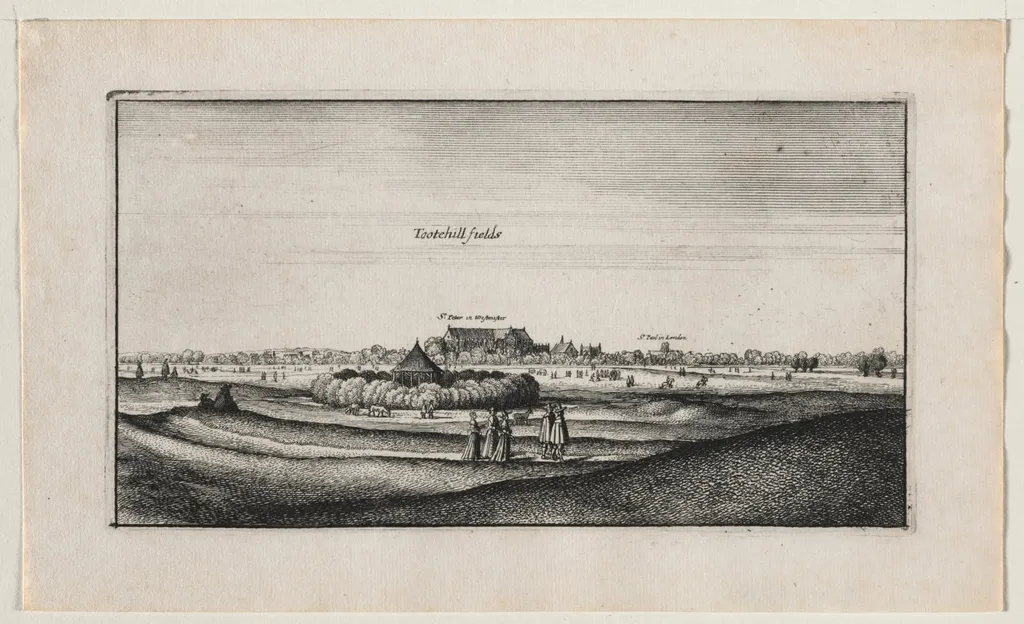
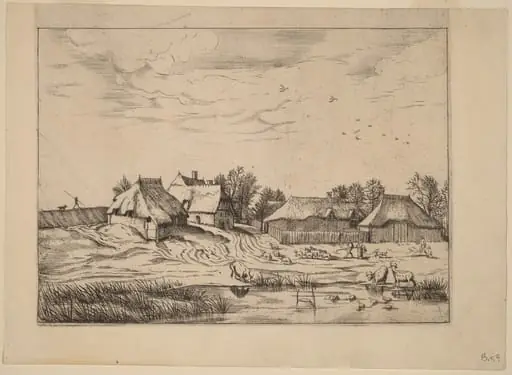
Tothill Fields is a print by Wenceslaus Hollar. It dates from 1652 and is held in the collection of the Cleveland Museum of Art.
About this work
Overview
The work reflects his interest in documenting everyday environments rather than grand monuments, offering a quiet record of mid-17th-century suburban life.
Created around 1652 by Wenceslaus Hollar, a Bohemian artist active in England, *Tothill Fields* is an etching depicting a rural outskirts area of Westminster, London. Hollar, known for precise topographical views, captured this modest landscape during a period of social and political change. The work reflects his interest in documenting everyday environments rather than grand monuments, offering a quiet record of mid-17th-century suburban life.
Subject & Meaning
The scene portrays a group of figures near a modest wooden structure, possibly a shed or outbuilding, surrounded by sparse trees. In the distance, a large edifice—likely a church or institutional building—rises above the horizon. The composition suggests a moment of pause or gathering, without narrative drama. The absence of overt symbolism points to a documentary intent: to record the physical and social texture of a place undergoing gradual urban expansion.
Technique & Style
Hollar employed fine-line etching to render texture and spatial depth with precision. Subtle gradations of tone, achieved through controlled hatching and cross-hatching, suggest light falling across figures and terrain. While not dramatic chiaroscuro in the Caravaggisti sense, the contrast between shaded ground and brighter sky enhances three-dimensionality. The meticulous detail in foliage, clothing, and architecture reflects his training in topographical draftsmanship.
History & Provenance
The print was made during Hollar’s years in London, following his return from continental Europe and before the Great Fire of 1666. It likely circulated among collectors interested in topographical accuracy. No early ownership records are widely documented, but its survival in institutional collections suggests it was valued early for its fidelity to place. The work remains part of the broader archive of Hollar’s London views preserved in British and European print rooms.
Context
Tothill Fields was a marshy, open area on the western edge of Westminster, used for grazing and occasional markets. By the 1650s, it was neither fully rural nor urban—a liminal zone shaped by London’s growth. Hollar’s depiction aligns with a broader trend among printmakers to record the changing English landscape during the Interregnum, when traditional hierarchies were in flux and documentary art gained new relevance.
Legacy
Though not among Hollar’s most famous works, *Tothill Fields* contributes to a significant body of topographical prints that document London’s pre-Fire geography. Its quiet observation influenced later topographers and urban historians seeking visual records of everyday spaces. The print endures as a reference for scholars studying 17th-century land use, architecture, and the role of print in preserving transient environments.
Artist & collection
Artist
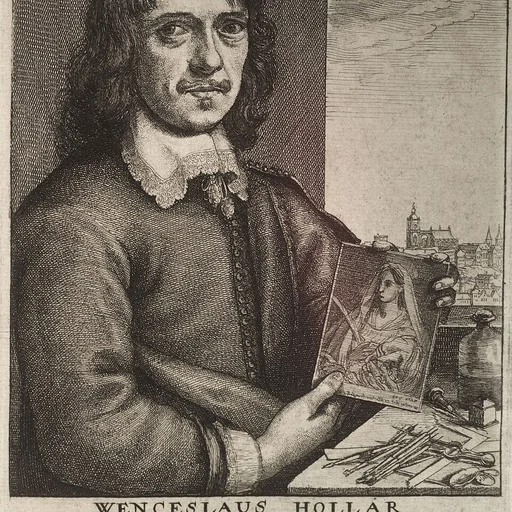
Wenceslaus Hollar (Czech: Václav Hollar (Czech pronunciation: ), German: Wenzel Hollar; 23 July 1607 – 25 March 1677) was a Czech engraver, etcher and painter.


![View of Nuremberg from the East [left section], by Hanns Lautensack](https://artifactworldgallery.com/img/hanns-lautensack--view-of-nuremberg-from-the-east-left-section--53a897f84943df87-w320.webp)