Artwork
Two somites of a mouse
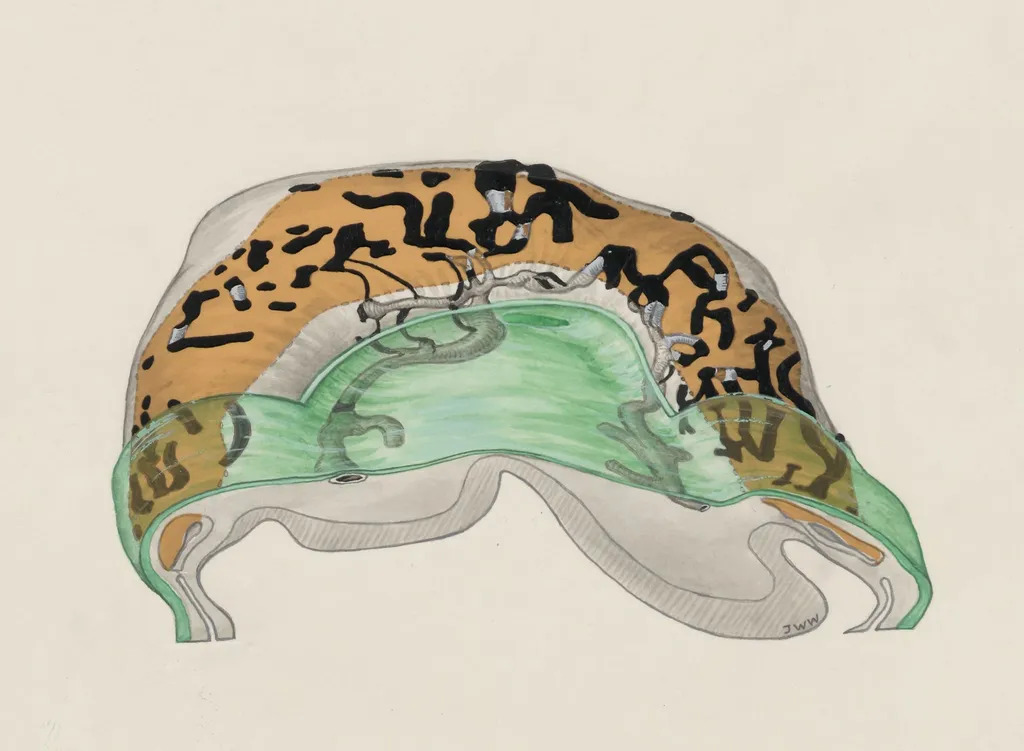
Two somites of a mouse is an unspecified work on paper by J Wetselaar-Whittaker. It dates from 1970 and is held in the collection of the Leiden University Libraries.
About this work
Overview
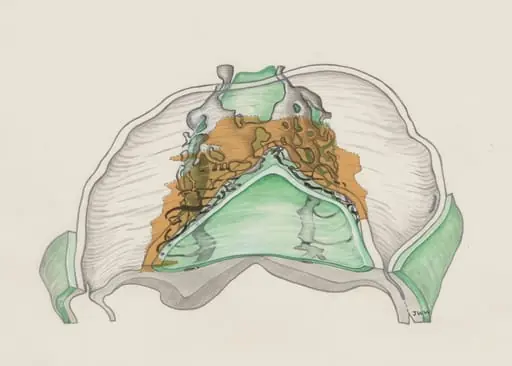
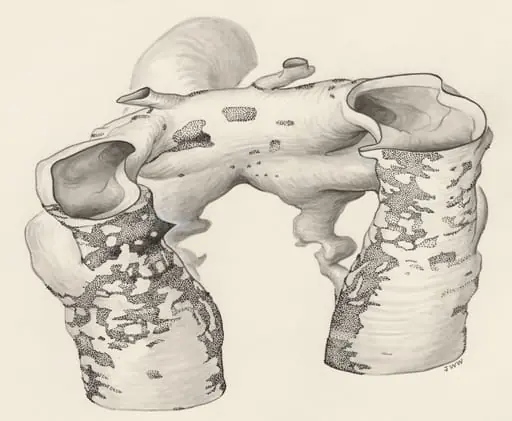
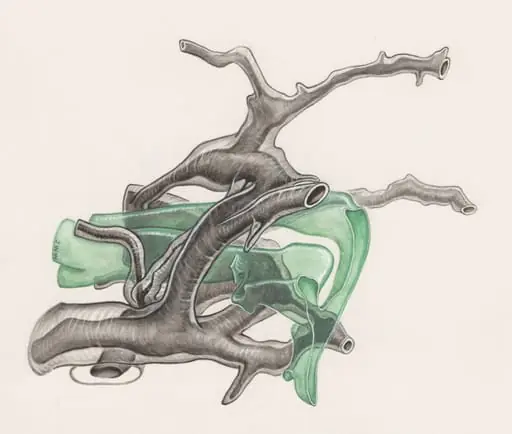
The work, titled “Two Somites of a Mouse,” is a watercolor illustration that presents a pair of minute mouse embryos positioned side by side. Rendered in soft pink tones, the embryos appear fragile and gently contoured, emphasizing their early developmental stage.
Subject & Meaning
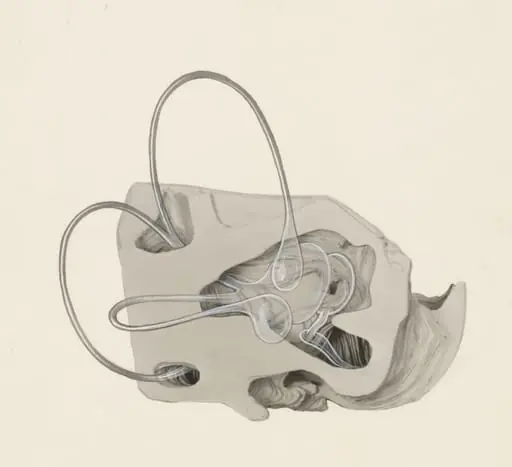
The image focuses on the first somites—segmental blocks of tissue—in a mouse embryo, highlighting the embryological process of segmentation. By isolating these structures, the illustration underscores the precision of early vertebrate development and serves as a visual aid for anatomical study.
Technique & Style
Executed with fine brushes, the artist applied a muted grey wash as a background, over which translucent layers of green and orange watercolor accentuate the embryos. The limited palette and delicate washes create a subtle contrast that draws attention to the pink forms without overwhelming the scientific detail.
History & Provenance
Created during a period when scientific illustration relied on hand‑drawn imagery, the piece reflects the collaborative tradition between artists and researchers. The original work is held in the collection of the Museum of Ethnography, which also houses related studies by the same illustrator.
Context
In the late nineteenth and early twentieth centuries, detailed watercolor renderings were essential for documenting microscopic anatomy before the widespread use of photography. This illustration exemplifies that era’s emphasis on accuracy, clarity, and the aesthetic presentation of biological specimens.
Artist & collection
Artist
This artist made precise studies of the body—drawings and sculptures that cut straight to the bones, muscles, and tissues.