Artwork
View of a Castle (recto); Eight-Sided Cup (verso)
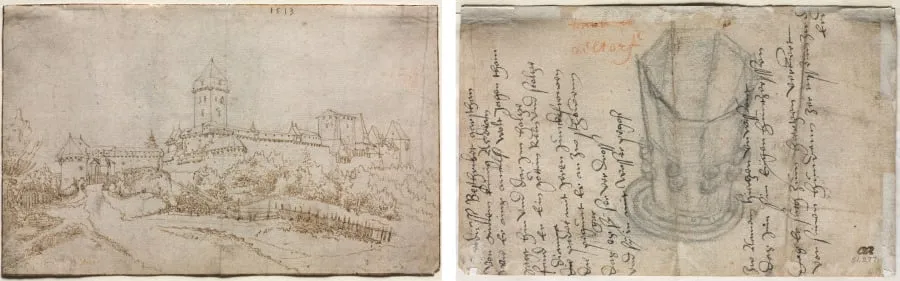
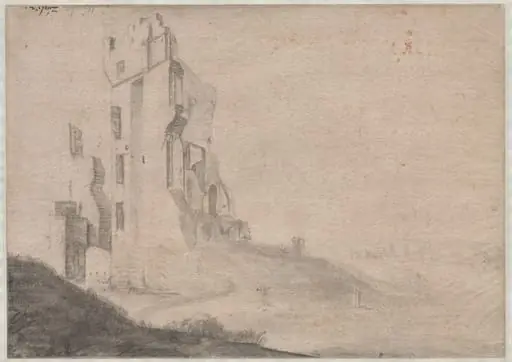
View of a Castle (recto); Eight-Sided Cup (verso) is a drawing by the Renaissance artist Wolfgang Huber. It dates from 1513 and is held in the collection of the Cleveland Museum of Art.
About this work
Overview
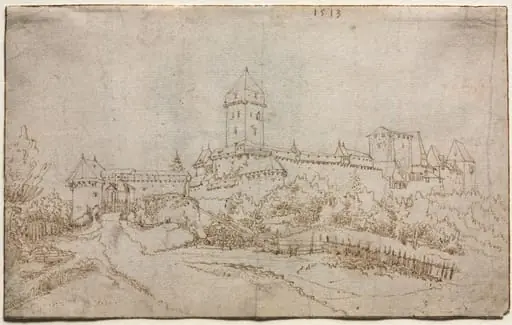
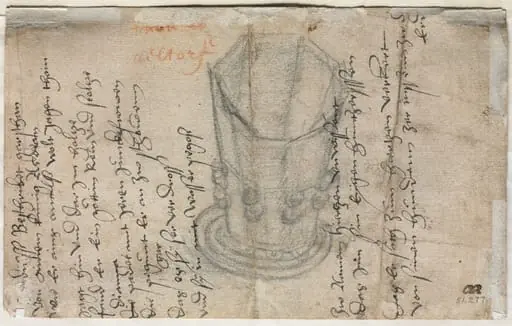
A single sheet of paper holds two distinct drawings: a landscape of a castle on the Danube’s southern bank, and on the reverse, a stylized eight-sided cup.
A single sheet of paper holds two distinct drawings: a landscape of a castle on the Danube’s southern bank, and on the reverse, a stylized eight-sided cup. Executed in pen and ink, the work reflects the spontaneous practice of a traveling artist. The castle, nestled among dense foliage and rocky terrain, occupies the middle ground, with minimal foreground detail. The reverse side bears a decorative vessel and a poetic inscription recounting the myth of Actaeon.
Subject & Meaning
The castle scene captures a specific stretch of the Danube Valley, known for its steep, forested slopes. Rather than serving as a topographical record, the drawing conveys the atmosphere of the landscape—lush, undulating, and alive. The mythological cup on the reverse, paired with a text about Actaeon’s punishment for spying on Diana, introduces a theme of transgression and divine retribution, possibly reflecting the artist’s personal or intellectual interests during his journey.
Technique & Style
Huber’s penwork is fluid and rapid, with looping, expressive lines that suggest movement and observation en route. The foliage is rendered in dense, organic strokes, while the castle’s form emerges through simplified contours. The lack of shading or perspective conventions aligns with early 16th-century German draftsmanship, where naturalism was conveyed through rhythm and detail rather than mathematical depth. The verso cup is drawn with precise, geometric clarity, contrasting the loose energy of the landscape.
History & Provenance
Created around 1513, the drawing likely originated during Huber’s travel between Feldkirch and Vienna, a route following the Danube. Its survival as a single sheet with both sides intact is uncommon, suggesting it was kept as a personal sketchbook page rather than a finished work. The poem on the verso, written in a contemporary hand, indicates the sheet was later annotated, possibly by a collector or fellow artist familiar with classical myths.
Context
In early 16th-century Central Europe, landscape was rarely an independent subject in art. Yet artists in the Danube region, including Huber, developed a distinctive sensitivity to natural forms, treating terrain with intimate attention. This drawing reflects a regional trend toward observing nature directly, separate from religious or narrative frameworks. The inclusion of a mythological vignette on the reverse reveals how classical stories remained part of educated artistic circles, even in informal sketches.
Legacy
The dual-sided drawing exemplifies the transitional role of sketching in Renaissance art—where observation, memory, and myth coexisted on a single page. Huber’s work contributes to a broader understanding of how artists in southern Germany engaged with landscape not as backdrop, but as subject. Its preservation offers insight into the private, mobile practices of draftsmen outside major urban centers, revealing art-making as an ongoing, unpolished process.
Artist & collection

 Preparatory study for a drawing of Peterborough House and Westminster Abbey
 Hilltop Castles
 Study of Heads (recto); Crenelated Fortress (verso)
 Zuylen Castle, near Utrecht (recto)/Ruin of the huis Ter Kleef, near Haarlem (verso)
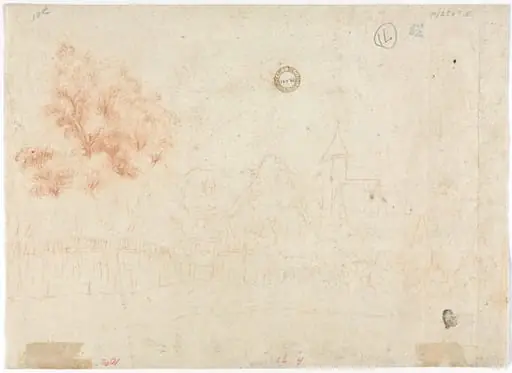 Sketch of a Village (verso)
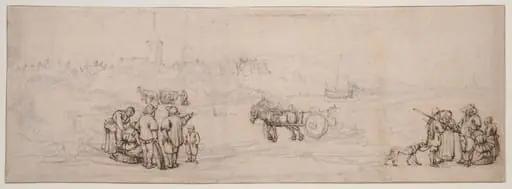 Dune Scene with Peasant Figures
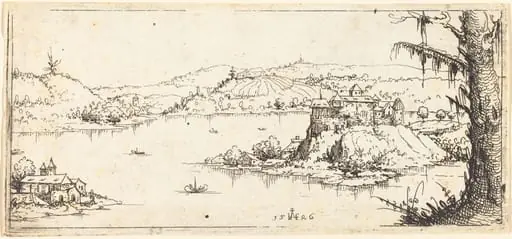 Landscape with a Large Lake at Center
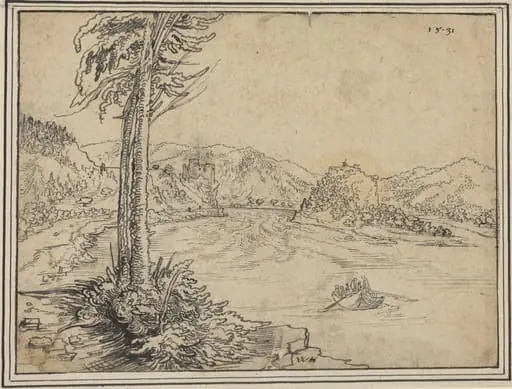 The Rapids of the Danube near Grein
 Ruin of the huis Ter Kleef near Haarlem