Artwork
John Fisher, Bishop of Rochester
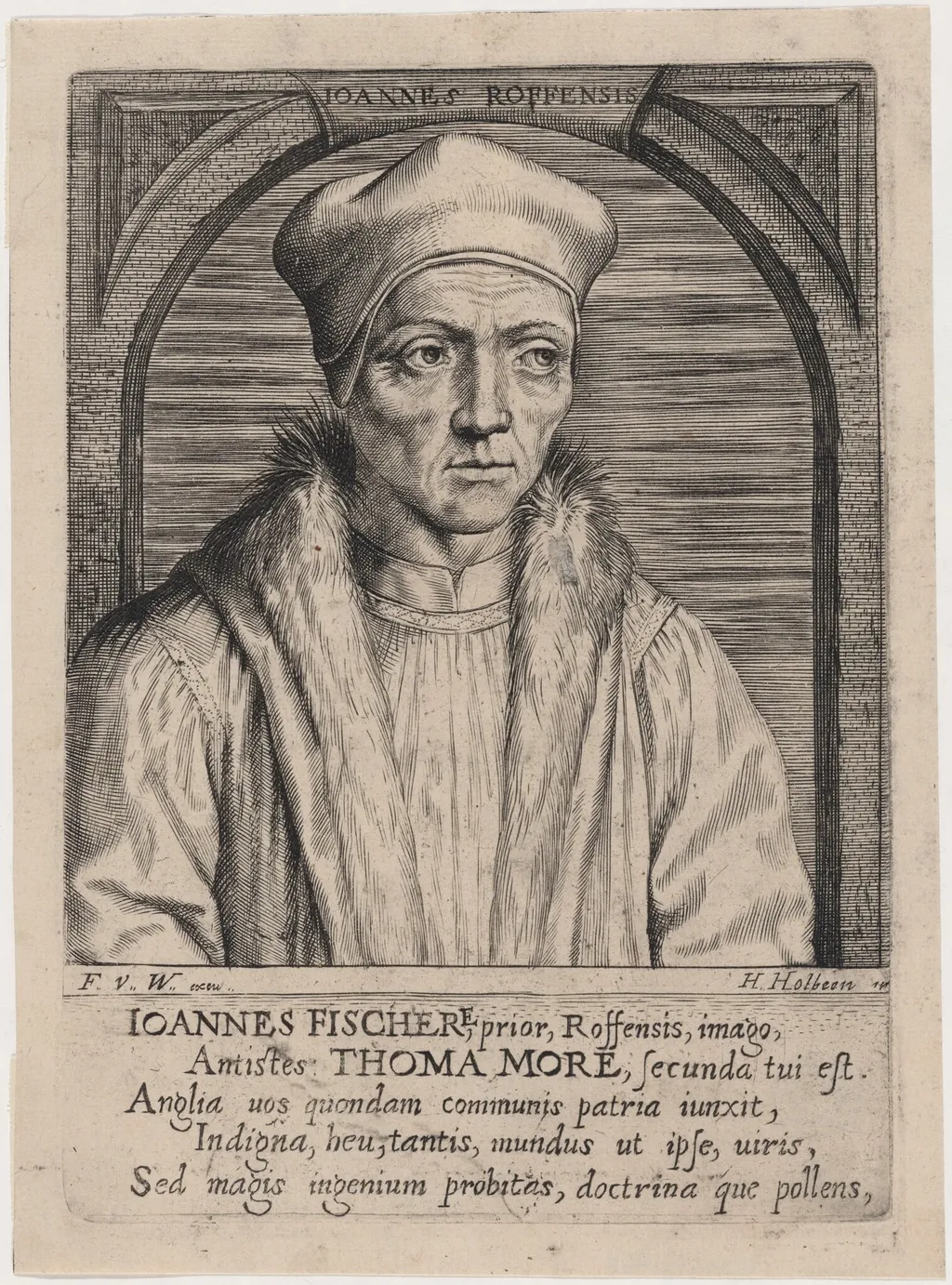
John Fisher, Bishop of Rochester is an ink print by the Baroque artist Frans van den Wyngaerde. It dates from 1646 and is held in the collection of the National Gallery of Art.
About this work
Overview
Created decades after Fisher’s death, the work is a posthumous portrait intended to convey his ecclesiastical authority and moral gravity.
An engraving from 1646 by Frans van den Wyngaerde depicts John Fisher, Bishop of Rochester. Created decades after Fisher’s death, the work is a posthumous portrait intended to convey his ecclesiastical authority and moral gravity. The image is rendered in fine linear detail, typical of Northern European printmaking traditions of the mid-seventeenth century, and was likely produced for devotional or historical circulation.
Subject & Meaning
John Fisher, executed in 1535 for refusing to acknowledge Henry VIII as head of the Church of England, is portrayed here as a solemn, contemplative figure. His attire—richly detailed clerical robes and a biretta—emphasizes his status as a bishop and scholar. The intensity of his gaze and the stillness of his posture suggest inner resolve, aligning with his reputation as a steadfast defender of Catholic orthodoxy during the English Reformation.
Technique & Style
Van den Wyngaerde employed fine, controlled lines to model form and texture, characteristic of engraving techniques in the Baroque era. The fabric of Fisher’s garments, the folds of his collar, and the contours of his face are built through cross-hatching and delicate stippling. This method allowed for precise rendering of light and shadow, enhancing the three-dimensionality of the portrait without the use of tone or color.
History & Provenance
The engraving was made in 1646, over a century after Fisher’s martyrdom, during a period of renewed Catholic interest in England’s pre-Reformation figures. Van den Wyngaerde, a Flemish artist active in the Low Countries, likely based his image on earlier portraits or written descriptions. The print may have been circulated among Catholic communities as a visual testament to Fisher’s legacy.
Context
In mid-seventeenth-century Europe, engraved portraits of religious figures served both commemorative and propagandistic roles. Fisher’s image, though created outside England, reflects broader Counter-Reformation efforts to preserve the memory of Catholic martyrs. The engraving’s formal composition and restrained emotion mirror the aesthetic values of Northern European print culture, where precision and moral gravity were prioritized over theatricality.
Legacy
This engraving remains one of the most widely reproduced visual representations of John Fisher. Though not contemporary to his life, it helped solidify his iconography in Catholic tradition. Its enduring presence in ecclesiastical and historical collections underscores its role as a key artifact in the visual memory of the English Reformation’s religious conflicts.
Artist & collection