Artwork
Mucius Scaevola Putting his Hand in a Fire
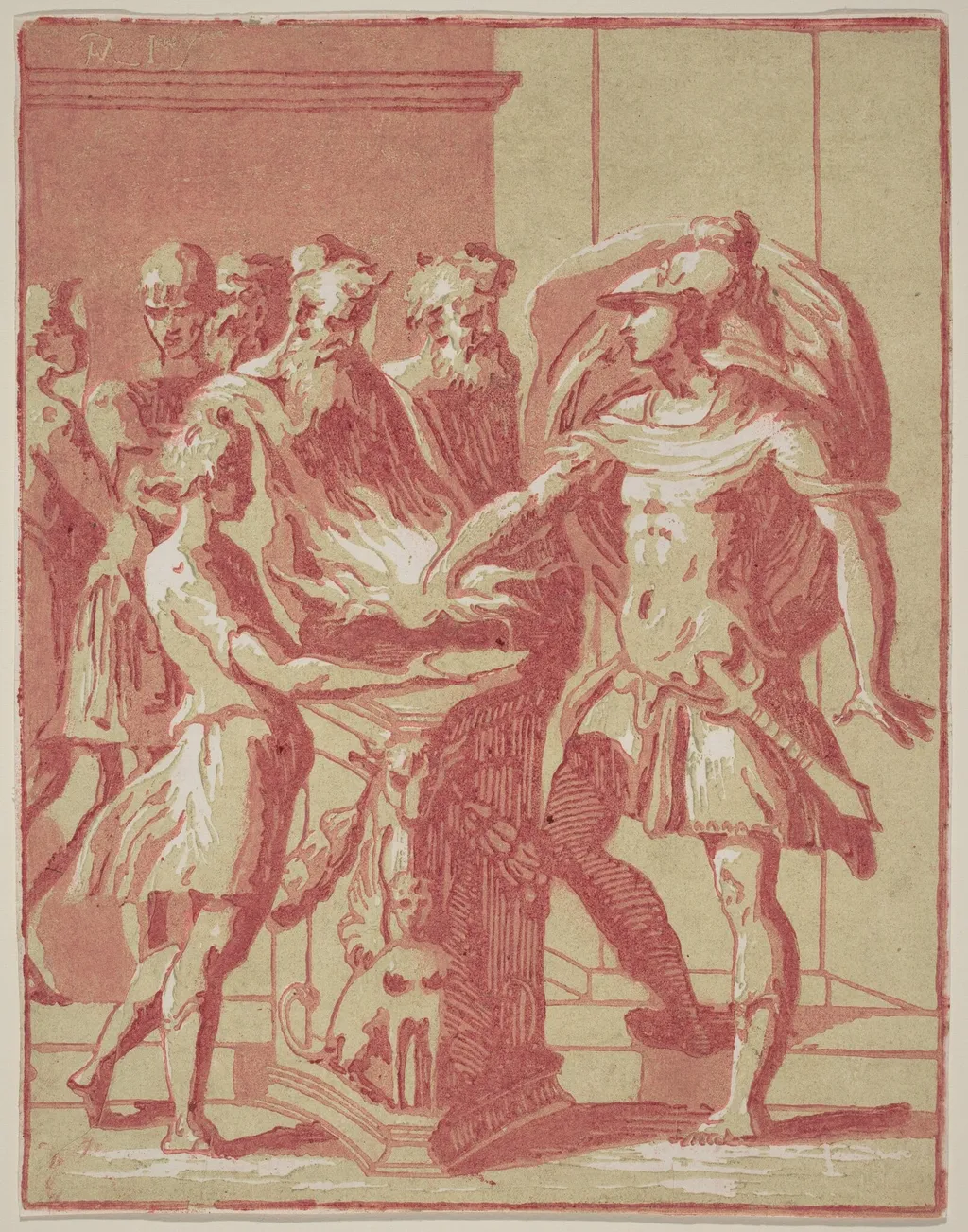
Mucius Scaevola Putting his Hand in a Fire is an ink print by the Baroque artist Anton Maria Zanetti I. It dates from 1724 and is held in the collection of the National Gallery of Art.
About this work
Overview
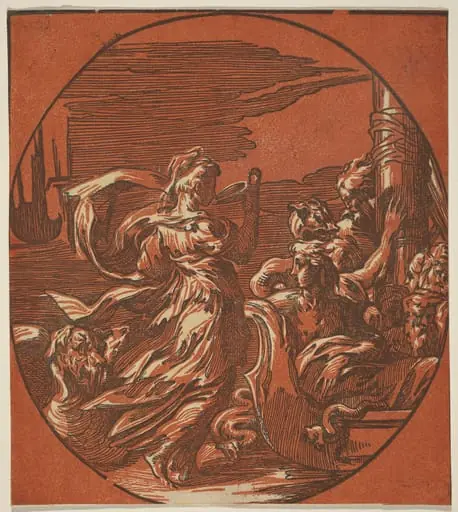
Created around 1724, this chiaroscuro woodcut by Anton Maria Zanetti I depicts the Roman legend of Mucius Scaevola enduring torture to demonstrate resolve.
Created around 1724, this chiaroscuro woodcut by Anton Maria Zanetti I depicts the Roman legend of Mucius Scaevola enduring torture to demonstrate resolve. Printed in green, pink, and red on laid paper, the image achieves tonal depth through three separate woodblocks, each applying a distinct hue. The technique, rare in its precision, reflects the period’s interest in translating painterly effects into print form.
Subject & Meaning
The scene illustrates the moment Mucius Scaevola, a Roman youth, voluntarily places his right hand in a flame to prove his fearlessness to the Etruscan king Lars Porsena. His stoic expression contrasts with the alarmed onlookers, emphasizing Roman ideals of courage and self-sacrifice. The narrative, drawn from Livy’s histories, was a classical emblem of civic virtue, frequently invoked in early modern moral art.
Technique & Style
Zanetti employed a three-block chiaroscuro method, aligning separate woodblocks to layer red, green, and pink inks. Each block carried distinct tonal ranges—shadows, midtones, and highlights—creating a sense of volume and movement. The swirling smoke and flickering fire are rendered through fine, controlled lines, mimicking the dramatic lighting of Baroque painting while exploiting the woodcut’s capacity for bold contrast.
History & Provenance
The print was produced in Venice during Zanetti’s active years as a printmaker and dealer. Though few impressions survive, it was likely part of a series illustrating classical heroes, circulated among collectors interested in antiquity. Its survival in museum collections today suggests it was valued for both technical innovation and its moral subject matter in the early 18th century.
Context
In early 18th-century Venice, there was a revival of interest in classical themes through printmaking, often aimed at educated patrons. Chiaroscuro woodcuts, though declining in popularity compared to etching, were still used to emulate the grandeur of Old Master drawings. Zanetti’s work bridges the gap between Renaissance techniques and contemporary tastes for historical narrative in print.
Legacy
Zanetti’s print stands as a late example of the chiaroscuro woodcut tradition, which had flourished in the 16th century under artists like Ugo da Carpi. While the technique faded after the Baroque era, this work preserves its capacity for expressive color and narrative intensity. It remains a reference point for understanding how classical stories were visually sustained in print culture beyond painting.
Artist & collection