Artwork
Noah's Warning about the Coming Flood Goes Unheeded
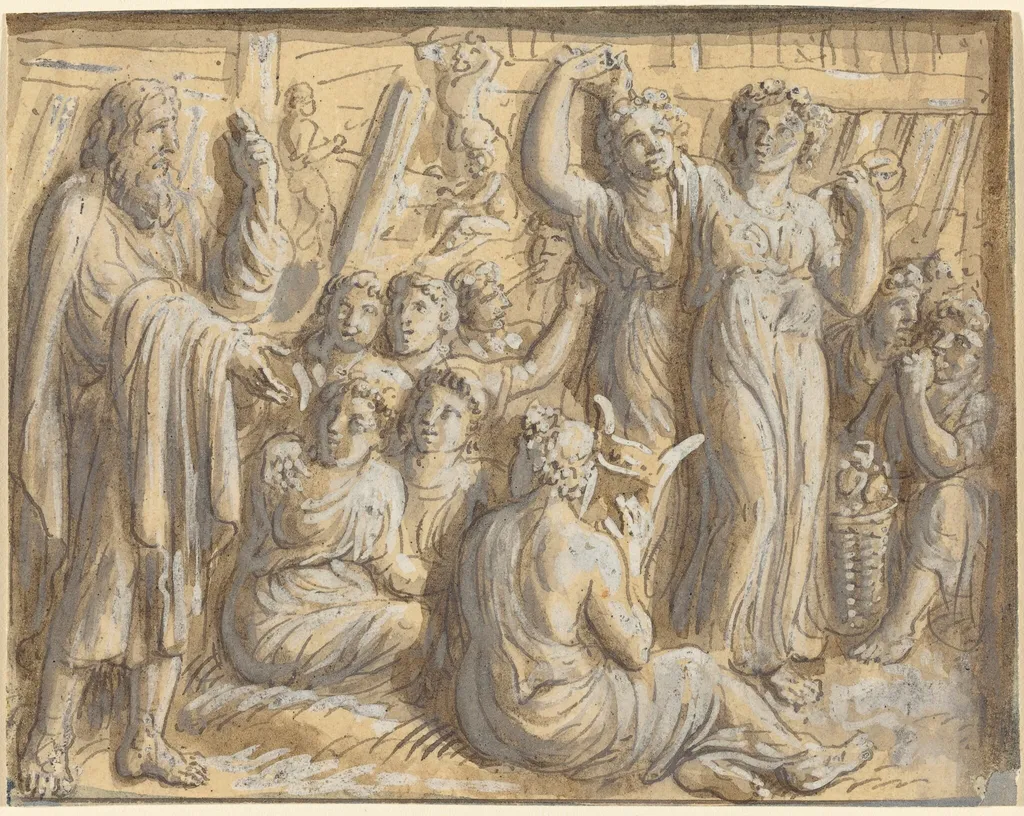
Noah's Warning about the Coming Flood Goes Unheeded is an ink drawing by the Romanticist artist Luigi Ademollo. It dates from 1806 and is held in the collection of the National Gallery of Art.
About this work
Overview
Executed in pen, black ink, and wash with white gouache on wove paper, the work is a detailed study in human apathy.
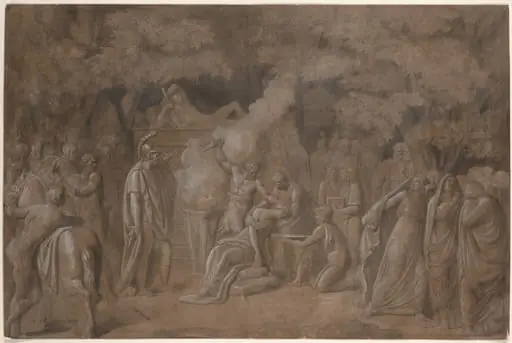
This 1806 drawing by Luigi Ademollo depicts a moment from the biblical story of Noah, capturing the moment his warning of an impending flood is met with indifference. Executed in pen, black ink, and wash with white gouache on wove paper, the work is a detailed study in human apathy. The composition centers on Noah, gesturing urgently toward the heavens, while the surrounding figures remain absorbed in their own activities, oblivious to the coming catastrophe.
Subject & Meaning
The scene illustrates Noah’s futile attempt to alert others to divine judgment. His posture—seated, holding a scroll, and pointing upward—contrasts sharply with the distracted crowd. Some hold tools, others gaze away or converse, emphasizing their disregard. The drawing conveys a quiet tragedy: the isolation of the prophetic voice in a world unwilling to listen. The theme reflects moral and spiritual neglect, common in early 19th-century religious narratives.
Technique & Style
Ademollo employs soft ink lines and subtle washes to model forms and suggest depth, while white gouache highlights facial expressions and fabric folds. The shading is delicate, focusing attention on the emotional states of the figures rather than architectural detail. The rough background wall and sparse sky figures add atmospheric tension without overwhelming the human drama. The technique prioritizes psychological nuance over grandeur, aligning with intimate narrative traditions.
History & Provenance
Created in 1806, the drawing likely served as a preparatory study for a larger commission, possibly a fresco or altarpiece. Ademollo, known for his religious and historical subjects, was active in Florence and Rome during this period. While its early ownership is undocumented, the work entered institutional collections in the 20th century, preserved for its expressive clarity and technical refinement within the context of Neoclassical and early Romantic draftsmanship.
Context
In early 19th-century Italy, religious themes remained central to academic art, even as Romanticism began to emphasize emotion and individual experience. Ademollo’s work reflects this transition: the subject is biblical, but the focus on human psychology and moral tension aligns with Romantic sensibilities. The drawing’s quiet intensity contrasts with the theatricality of contemporaneous history painting, offering a more introspective take on divine warning.
Legacy
Though not widely exhibited, this drawing is recognized for its sensitive portrayal of human indifference to moral urgency. It stands as a refined example of Italian draftsmanship at the turn of the century, bridging Neoclassical discipline with emerging Romantic empathy. Its enduring value lies in its understated power to evoke collective neglect—a theme that continues to resonate beyond its religious framework.
Artist & collection


![Joseph and His Brother in Egypt [verso], by Italian 17th Century](https://artifactworldgallery.com/img/italian-17th-century--joseph-and-his-brother-in-egypt-verso--86cfb4fbb2662a76-w320.webp)