Artwork
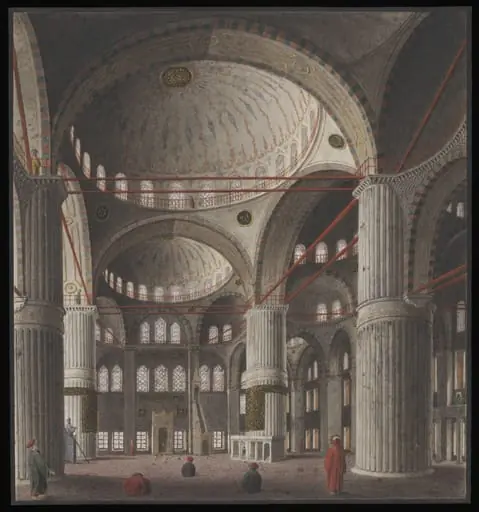
The interior of the Mosque of Aya Sofya, Istanbul
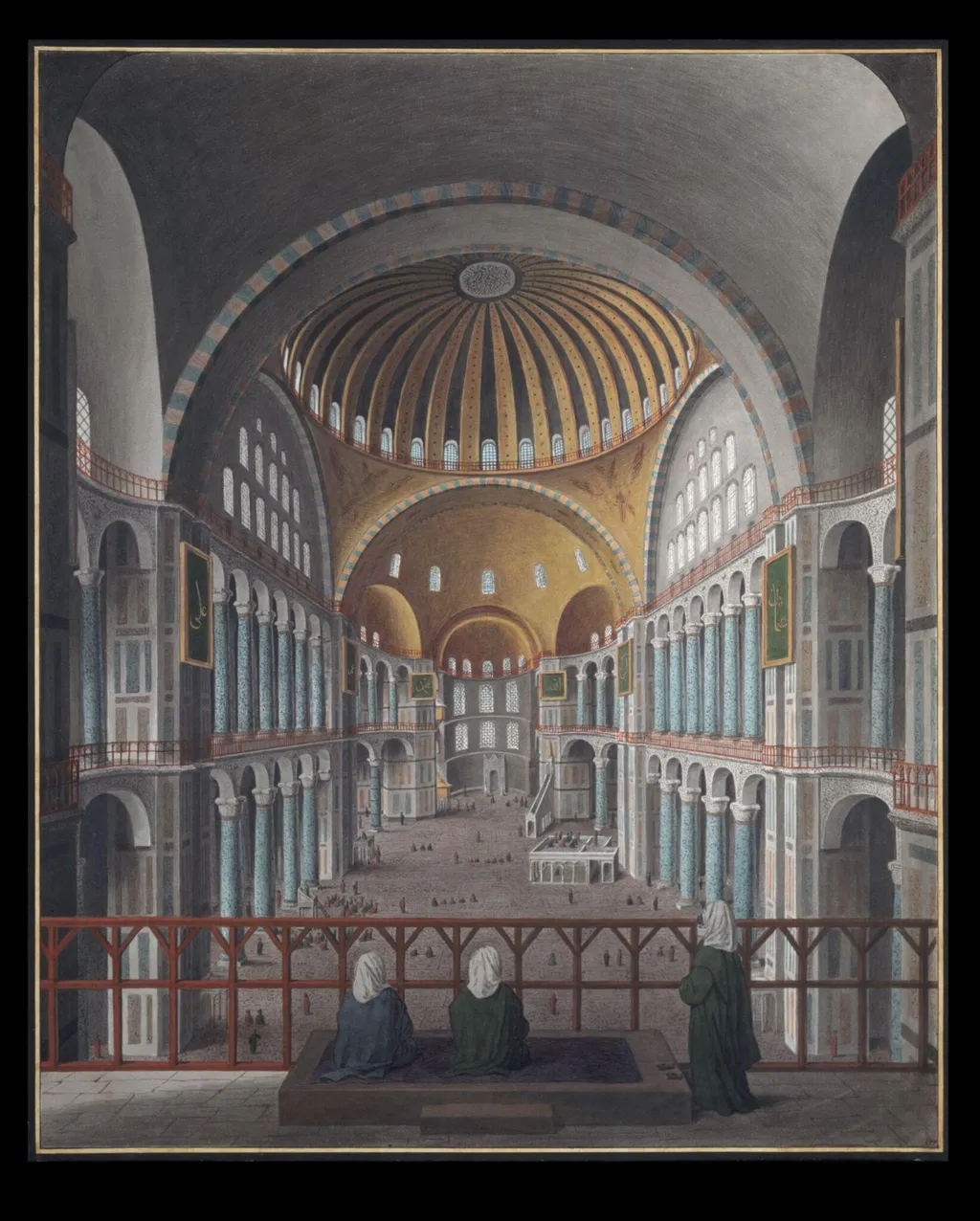
The interior of the Mosque of Aya Sofya, Istanbul is a watercolor work on paper by the Romanticist artist Anonymous Greek artist. It dates from 1809 and is held in the collection of the Victoria and Albert Museum.
About this work
Overview
This watercolour captures the interior of the Mosque of Aya Sofya in Istanbul, viewed from the upper gallery traditionally reserved for women.
This watercolour captures the interior of the Mosque of Aya Sofya in Istanbul, viewed from the upper gallery traditionally reserved for women. Created in the early 19th century, it predates the major 1850s restoration by the Fossati brothers. The work is part of a larger series commissioned by British diplomat Stratford Canning, who sought to document Ottoman architecture and customs during his tenure in Constantinople. The artist remains unidentified, though likely connected to a local studio active in the region.
Subject & Meaning
The scene focuses on the vast central space of the building, once the nave of a Byzantine church and later the prayer hall of a mosque. The view from the women’s gallery emphasizes the scale and spiritual atmosphere of the interior, with the former altar area now oriented toward Mecca. The composition reflects the layered religious history of the structure, capturing its transformation without overt commentary, serving as a quiet record of cultural transition.
Technique & Style
Executed in watercolour, the work employs delicate washes to suggest the play of light across marble surfaces and the soft shadows of the galleries. Architectural details are rendered with precision, while the absence of human figures enhances the sense of stillness and grandeur. The technique reflects both European topographical traditions and local observational practices, blending accuracy with atmospheric tone to convey the monument’s solemn presence.
History & Provenance
Commissioned by Stratford Canning during his early diplomatic service in Istanbul, beginning in 1808, the watercolour series was created to document sites and customs inaccessible to most foreigners. Access to Aya Sofya required a formal permit from the Ottoman Sultan, typically arranged through the British Embassy. The series, now held in the Victoria and Albert Museum, represents one of the earliest systematic visual records of the mosque before 19th-century restorations altered its appearance.
Context
In the early 1800s, non-Muslim visitors to Aya Sofya were rare and tightly controlled. The British Embassy often facilitated access as a diplomatic courtesy. Canning’s project emerged amid growing European interest in Byzantine and Islamic heritage, yet few outsiders had the opportunity to record the interior. This work contributes to a small but significant body of visual material made before Western restoration efforts reshaped the building’s original character.
Legacy
As one of the earliest known watercolours of Aya Sofya’s interior made before the Fossati renovations, the piece preserves details lost in later alterations. Its existence underscores the role of diplomatic networks in documenting cultural heritage during a period of limited cross-cultural access. Though the artist’s identity remains unknown, the work continues to serve as a primary visual reference for scholars studying the mosque’s pre-restoration condition.
Artist & collection

![A Pasha travelling with his escort[?], by Anonymous Greek artist](https://artifactworldgallery.com/img/anonymous-greek-artist--a-pasha-travelling-with-his-escort--01de32b8fcf30843-w320.webp)
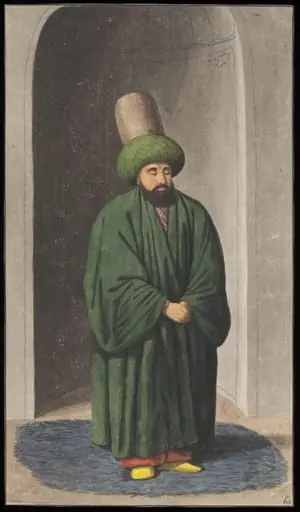
![A Dervish[?], by Anonymous Greek artist](https://artifactworldgallery.com/img/anonymous-greek-artist--a-dervish--3c8916f5a95abb6a-w320.webp)