Artwork
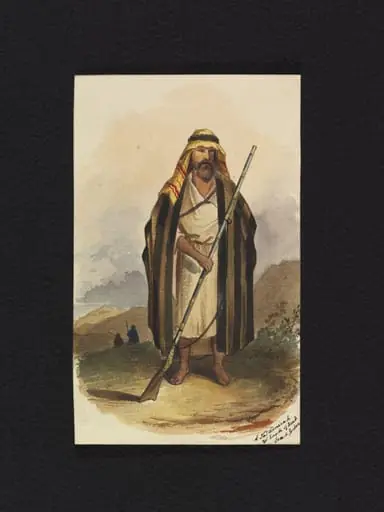
Jumah, Tribe el Hassee
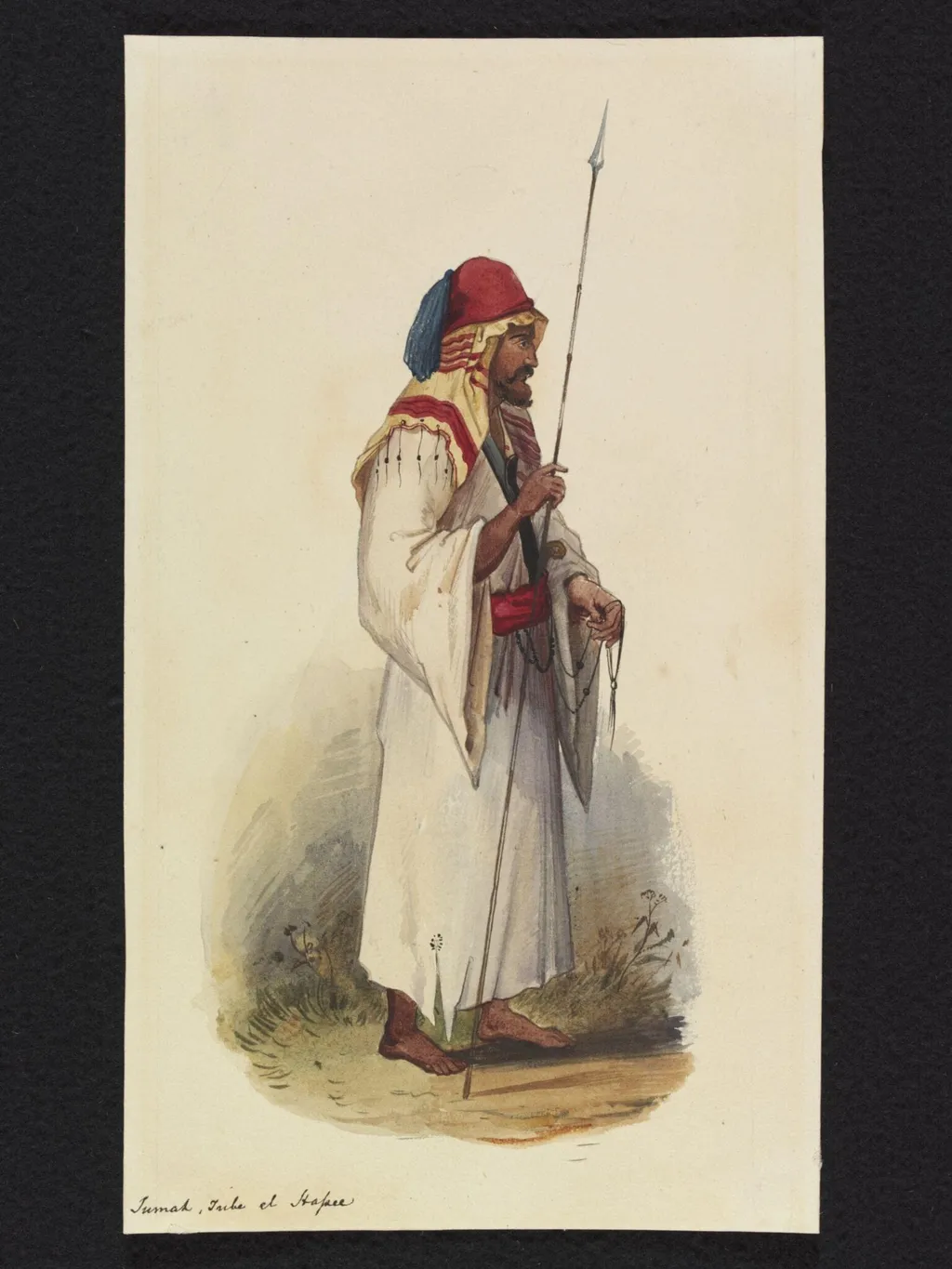
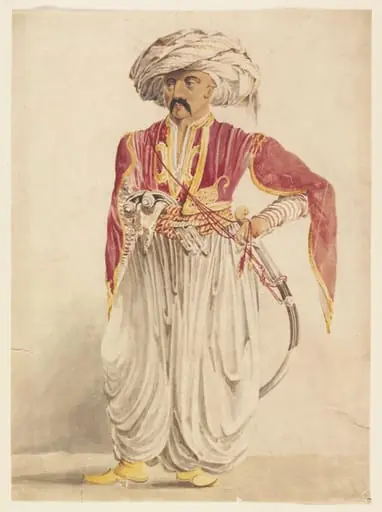
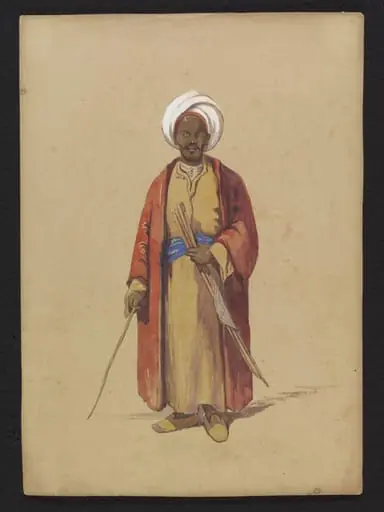
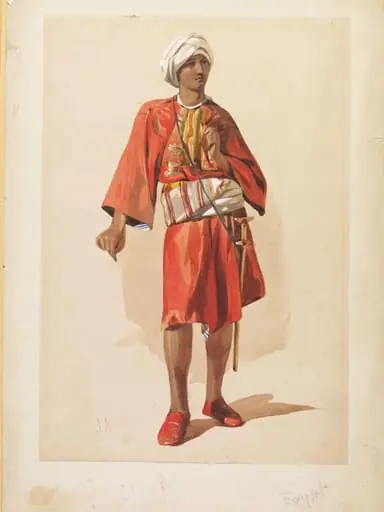
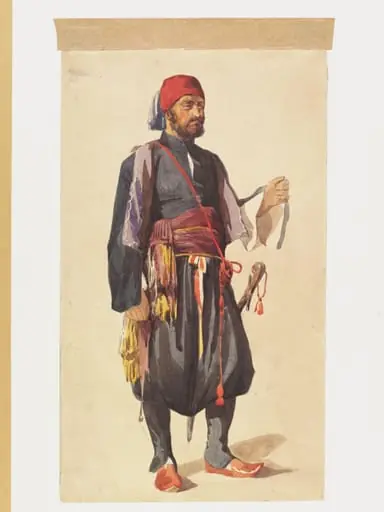
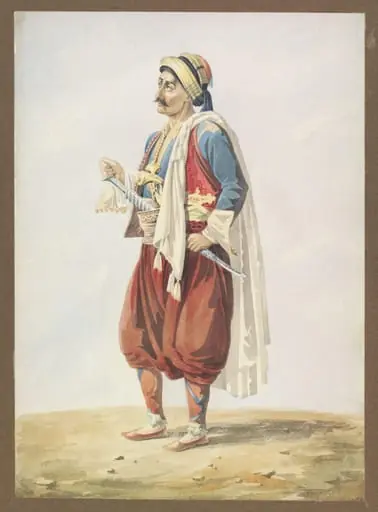
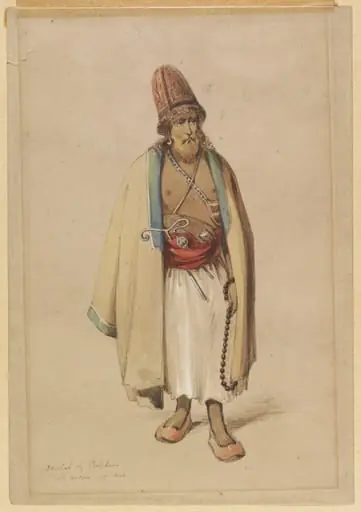
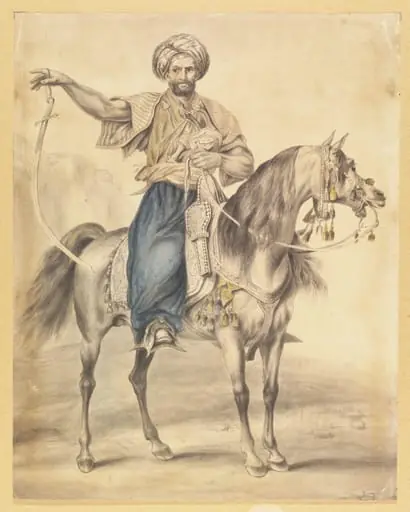
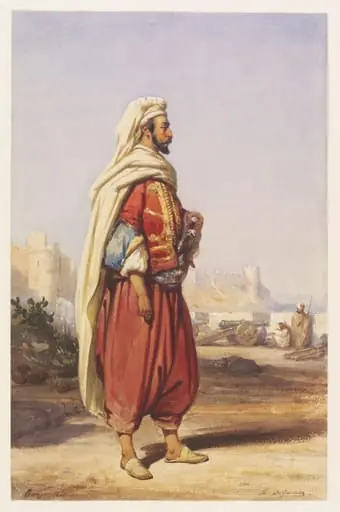
Jumah, Tribe el Hassee is a watercolor work on paper by the Orientalist artist R. Aulick. It dates from 1848 and is held in the collection of the Victoria and Albert Museum. Created in 1848 by R.
About this work
Overview
Aulick, this watercolour depicts a figure from the el Hassee tribe, originally produced as an illustration for William Francis Lynch’s 1849 expedition account.
Created in 1848 by R. Aulick, this watercolour depicts a figure from the el Hassee tribe, originally produced as an illustration for William Francis Lynch’s 1849 expedition account. The work was printed opposite page 216 in the published narrative, serving a documentary purpose rather than artistic display. It entered private collection in 1963 after acquisition from Siddons Gallery in London for one pound.
Subject & Meaning
The figure, named Jumah, is portrayed as a solitary desert dweller, dressed in a white robe with red edging, a red fez, and a blue headcloth. He holds a tall spear and stands with calm posture, suggesting dignity and readiness. The setting, sparse and arid, emphasizes isolation and resilience. The image conveys ethnographic intent, aiming to document a specific cultural identity within the broader context of 19th-century exploration.
Technique & Style
Executed in watercolour, the piece uses flat, saturated hues against a pale, unmodulated background to enhance clarity and visual contrast. Details are rendered with precision—fabric folds, weapon texture, and ground vegetation—but without dramatic shading or atmospheric depth. The style reflects a utilitarian approach, prioritizing ethnographic accuracy over expressive brushwork or romantic idealization.
History & Provenance
The watercolour was produced as part of a series commissioned for Lynch’s official expedition report, which documented the U.S. survey of the Jordan River and Dead Sea. After publication, individual prints circulated as separate artifacts. It was acquired in March 1963 by a private collector from R. Appleby’s Siddons Gallery in London, marking its transition from illustrative material to collectible object.
Context
Produced during a period of Western scientific and military expeditions into the Levant, the image reflects the era’s interest in cataloging indigenous peoples. Such illustrations were often used to support colonial narratives, framing local figures as exotic specimens. Despite its documentary function, the work retains a quiet individuality, capturing a moment of personal presence amid broader imperial agendas.
Legacy
Though not widely exhibited, the image remains a tangible artifact of 19th-century ethnographic illustration. Its survival in private hands underscores the shift from institutional use to personal collection. It contributes to ongoing scholarly discussions about representation, accuracy, and the visual politics of exploration in the Middle East during the Victorian age.
Artist & collection
Artist
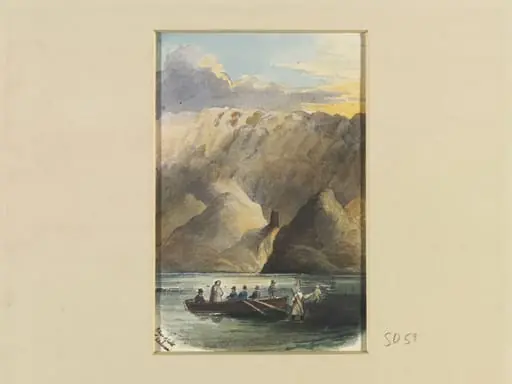
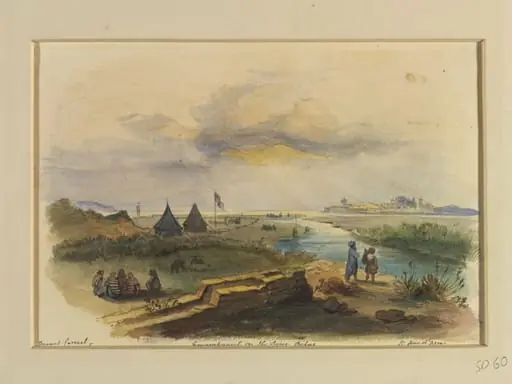
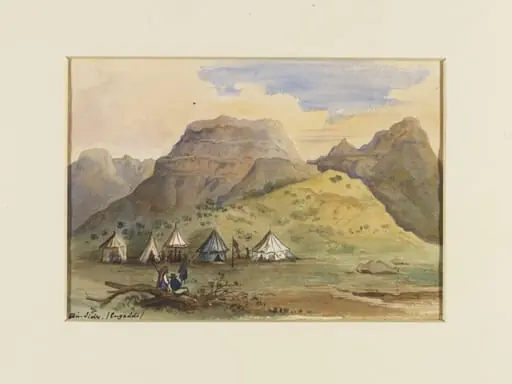
British artist R. Aulick traveled the Dead Sea’s western shore in the late 1840s and sketched the landscape in watercolour. The five works in this bundle show Bedouin camps by the Belus River, an encampment at…