Artwork
Adam and Eve with Cain and Abel
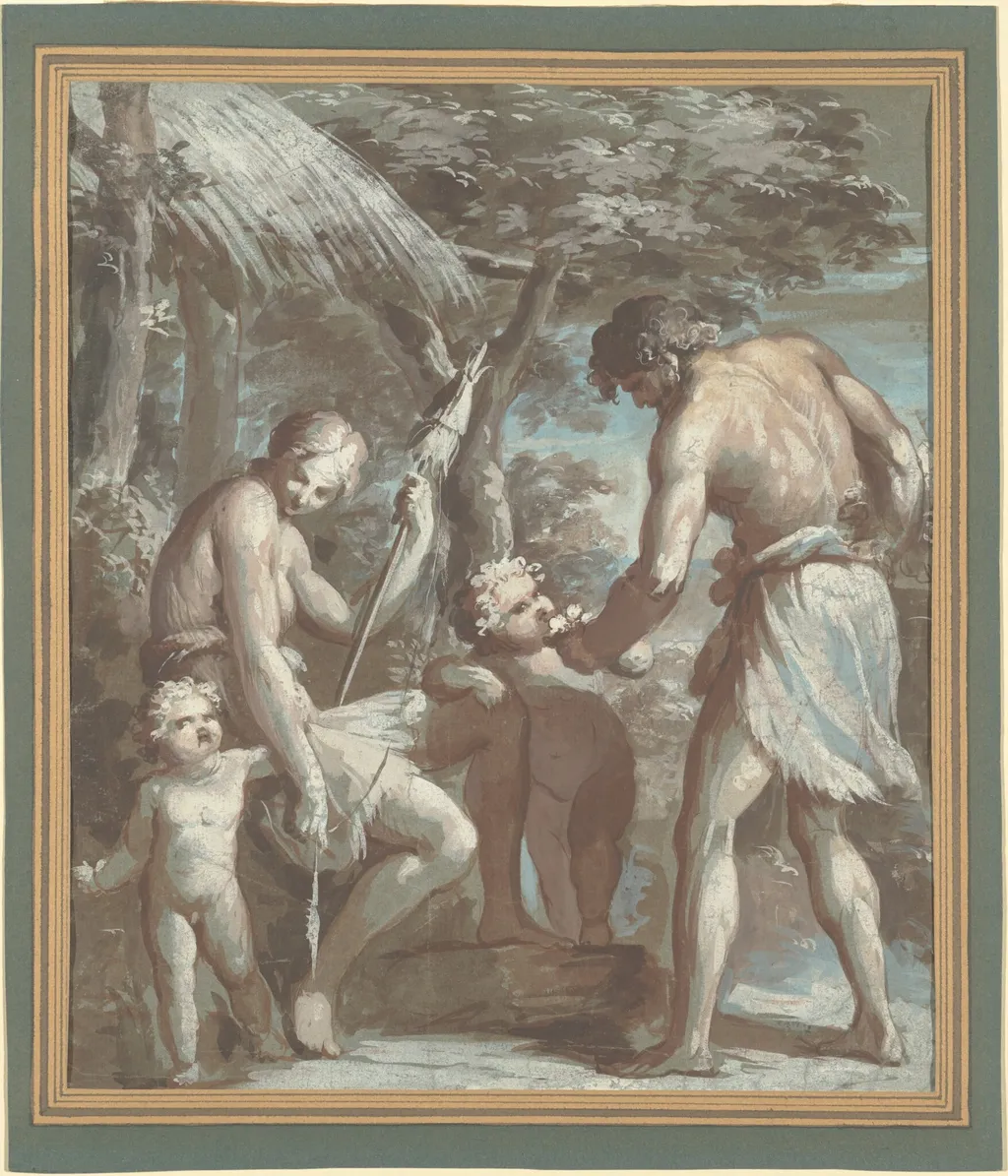
Adam and Eve with Cain and Abel is an ink drawing by the Baroque artist Carlo Alberto Baratta. It dates from 1756 and is held in the collection of the National Gallery of Art.
About this work
Overview
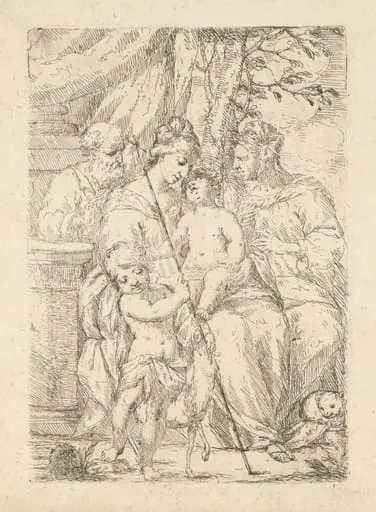
Carlo Alberto Baratta’s 1756 drawing, titled *Adam and Eve with Cain and Abel*, presents a compact tableau of the biblical progenitors and their sons. Executed on blue laid paper, the work arranges the four figures within a stark, rocky setting, positioning Adam and Eve on the left while the two youths, Cain and Abel, stand nearby, each identified by a rock and a lamb respectively.
Subject & Meaning
The composition foregrounds the earliest family narrative from Genesis, emphasizing the generational link between the first humans and their offspring. By juxtaposing the innocence of the lamb with the weight of the stone, Baratta subtly alludes to the divergent paths of Cain and Abel, foreshadowing the moral conflict that will unfold in the biblical story.
Technique & Style
Baratta employed gouache—a dense, water‑based pigment—combined with pen and brown ink, yielding vivid, flat areas of colour that render the figures almost as silhouettes. The medium’s opacity allows for sharp delineation, giving the characters a cut‑out quality that recalls theatrical set designs rather than naturalistic portraiture, and accentuates the starkness of the rocky backdrop.
History & Provenance
Created in 1756, the drawing is documented as a work by Baratta, an Italian artist active in the mid‑18th century. It remains a singular example of his religious subject matter rendered in gouache on paper, and its provenance traces through private collections before entering a museum holding of 18th‑century Italian drawings.
Artist & collection

Artist
Carlo Alberto Baratta (1754–1815) was an Italian artist, born in Genoa.