Artwork
Murder of the Innocents
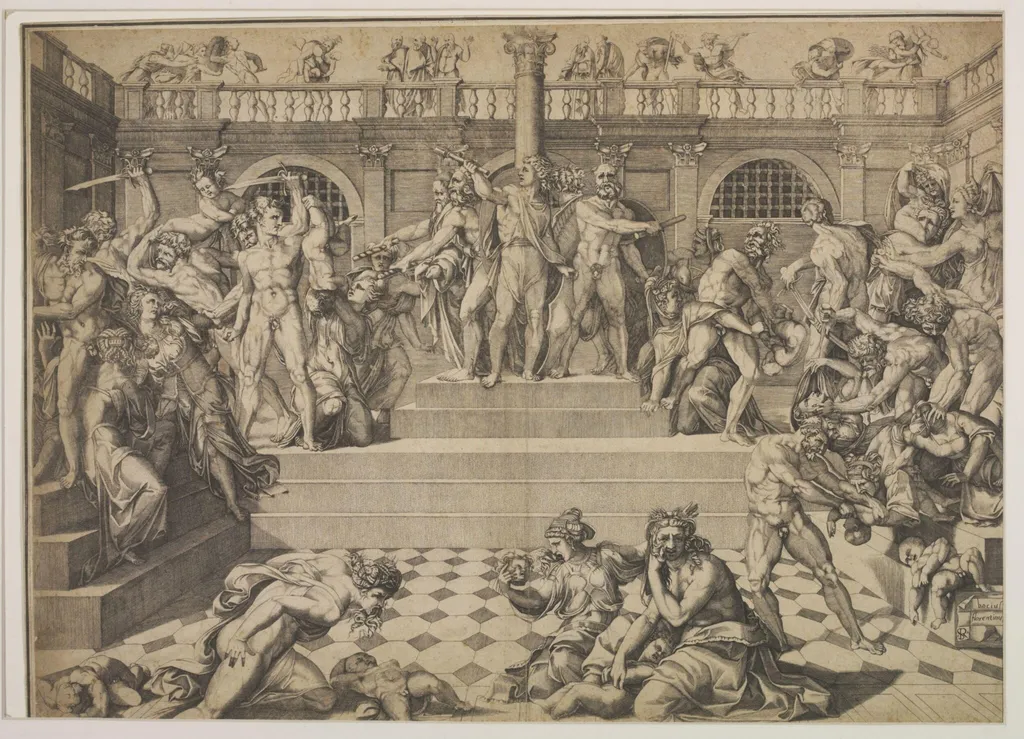
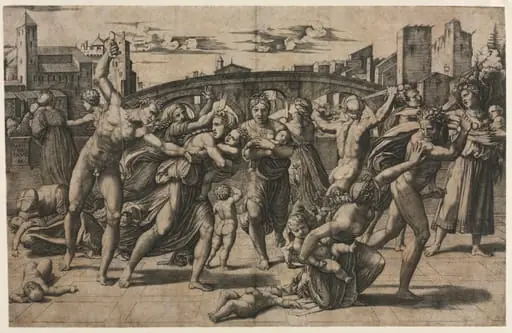
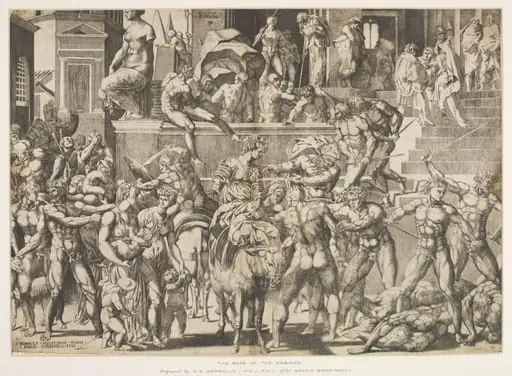
Murder of the Innocents is a print by the Renaissance artist Nicolas Beatrizet. It dates from 1520 and is held in the collection of the Victoria and Albert Museum.
About this work
Overview
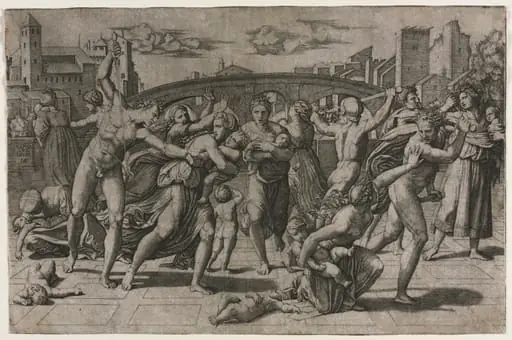
The composition is densely populated, with figures arranged across multiple levels of architecture, creating a sense of chaotic movement and spatial depth.
This engraving depicts the biblical massacre of infants ordered by King Herod, rendered in ink on paper by Nicolas Beatrizet. It is based on a lost design by Baccio Bandinelli and represents the earliest known state of the print, before later alterations by Philippe Thomassin. The composition is densely populated, with figures arranged across multiple levels of architecture, creating a sense of chaotic movement and spatial depth.
Subject & Meaning
The scene illustrates the slaughter of male infants in Bethlehem, as recounted in the Gospel of Matthew. Figures are shown in violent struggle—mothers clutching children, soldiers enforcing the order—while a few onlookers observe from elevated positions. The contrast between the anguish below and the detached figures above underscores the tragedy’s moral weight, reflecting Renaissance interpretations of divine justice and human cruelty.
Technique & Style
Beatrizet employs fine, controlled lines to model form and suggest volume, relying on chiaroscuro to heighten emotional intensity. Deep shadows anchor the figures against lighter backgrounds, giving the crowded scene a sculptural presence. The interplay of light and dark enhances the three-dimensionality of the bodies and architecture, while the intricate detailing of drapery and musculature reveals the influence of classical sculpture.
History & Provenance
The print was produced in Rome during the mid-16th century, following Bandinelli’s original design, which was likely created for a larger decorative project. Beatrizet, a French engraver active in Italy, specialized in reproducing works by prominent sculptors. This version predates later modifications by Thomassin, making it a key document in understanding the print’s initial reception and circulation among collectors.
Context
Created during a period when Italian Mannerist art emphasized complex compositions and emotional expression, the print reflects the era’s fascination with dramatic narrative and anatomical precision. Engravings like this served as vehicles for disseminating artistic ideas across Europe, allowing artists and patrons unfamiliar with original sculptures to engage with contemporary Roman styles.
Legacy
Beatrizet’s engraving contributed to the broader circulation of Bandinelli’s designs beyond their original sculptural context. Though the source work is lost, this print preserves its compositional energy and emotional gravity. It remains a significant example of 16th-century reproductive printmaking, illustrating how engravers shaped the visual culture of their time through meticulous translation of three-dimensional forms into two-dimensional media.
Artist & collection


![Castello S. Angelo di Roma [Castel Sant'Angelo in Rome], by Nicolas Beatrizet](https://artifactworldgallery.com/img/nicolas-beatrizet--castello-s-angelo-di-roma-castel-sant-angelo-in-rome--6c77d3bfe127c436-w320.webp)
![Pantheum Romanum [The Roman Pantheon], by Nicolas Beatrizet](https://artifactworldgallery.com/img/nicolas-beatrizet--pantheum-romanum-the-roman-pantheon--8069db7dd8e6f190-w320.webp)