Artwork
The Sacrifice of Iphigenia
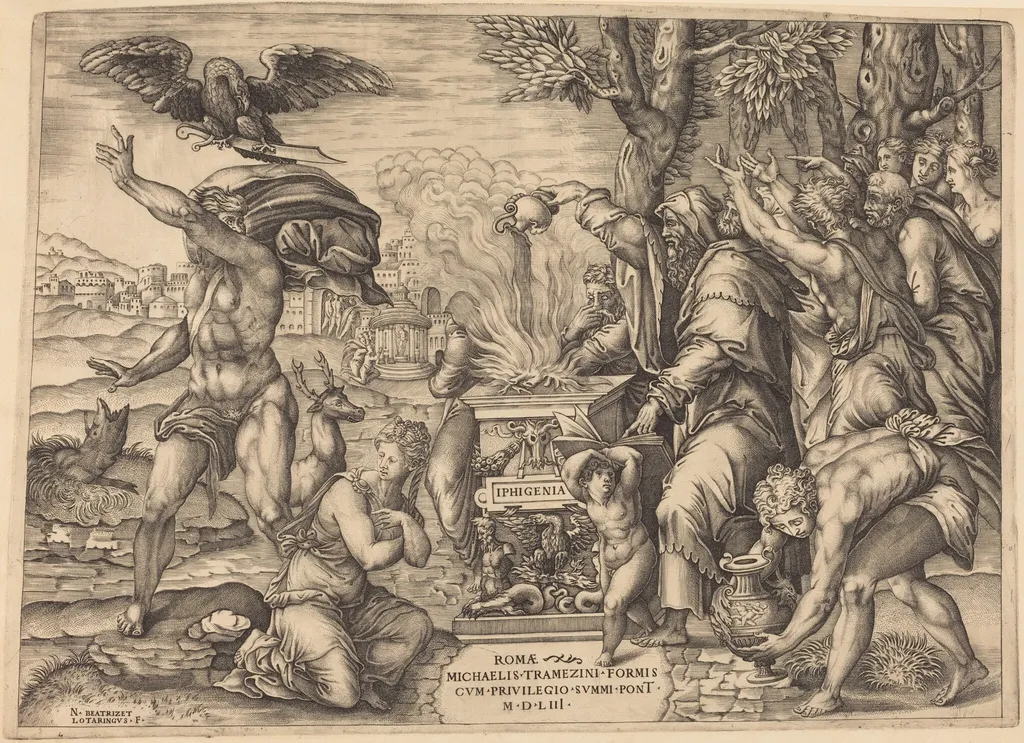
The Sacrifice of Iphigenia is an ink print by the Renaissance artist Nicolas Beatrizet. It dates from 1540 and is held in the collection of the National Gallery of Art.
About this work
Overview
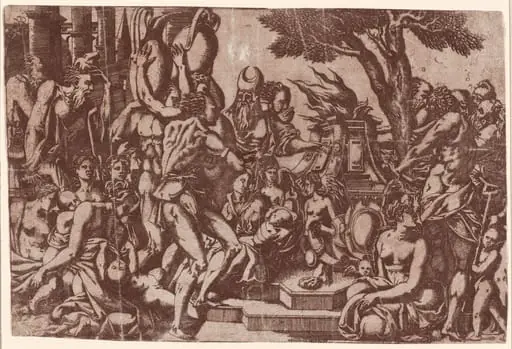
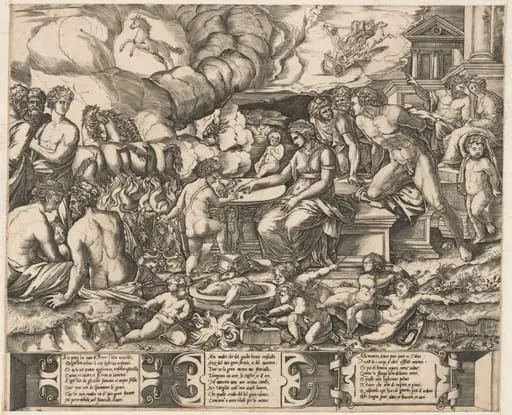
Nicolas Beatrizet’s 1540 etching, titled The Sacrifice of Iphigenia, presents a densely populated tableau that captures a moment of violent drama. The composition is crowded with human figures, animals, and architectural elements, all rendered in the fine lines characteristic of early modern printmaking.
Subject & Meaning
A winged figure hovers above, hinting at divine intervention or fate, and a burning structure looms in the distance, amplifying the sense of catastrophe.
The work visualizes the mythological episode in which Iphogenia is offered as a sacrificial victim. A seated woman clutching a child occupies the foreground, while surrounding men engage in frantic actions—drawing swords, restraining a goat—suggesting the chaotic ritual. A winged figure hovers above, hinting at divine intervention or fate, and a burning structure looms in the distance, amplifying the sense of catastrophe.
Technique & Style
Executed as an etching, the image relies on incised lines to convey texture and movement. Beatrizet’s handling of line work creates a sense of depth despite the limited tonal range, while the intricate detailing of clothing, animal fur, and architectural ruin demonstrates the artist’s skill in rendering complex scenes within the constraints of the print medium.
History & Provenance
Signed faintly at the bottom, the print bears the artist’s monogram, confirming its authorship. The inscription of “Iphigenia” on a central pedestal serves as a textual anchor, linking the visual narrative to its classical source. The work survives in several European collections, reflecting its circulation among connoisseurs of mythological prints in the sixteenth century.
Context
Beatrizet worked in a period when Northern European printmakers frequently adapted classical themes for a growing market of educated patrons. The Sacrifice of Iphigenia aligns with contemporary interests in antiquity, moral exempla, and the dramatic potential of print as a medium for storytelling.
Artist & collection


![Castello S. Angelo di Roma [Castel Sant'Angelo in Rome], by Nicolas Beatrizet](https://artifactworldgallery.com/img/nicolas-beatrizet--castello-s-angelo-di-roma-castel-sant-angelo-in-rome--6c77d3bfe127c436-w320.webp)
![Pantheum Romanum [The Roman Pantheon], by Nicolas Beatrizet](https://artifactworldgallery.com/img/nicolas-beatrizet--pantheum-romanum-the-roman-pantheon--8069db7dd8e6f190-w320.webp)