Artwork
Massacre of the Innocents without the Fir Tree
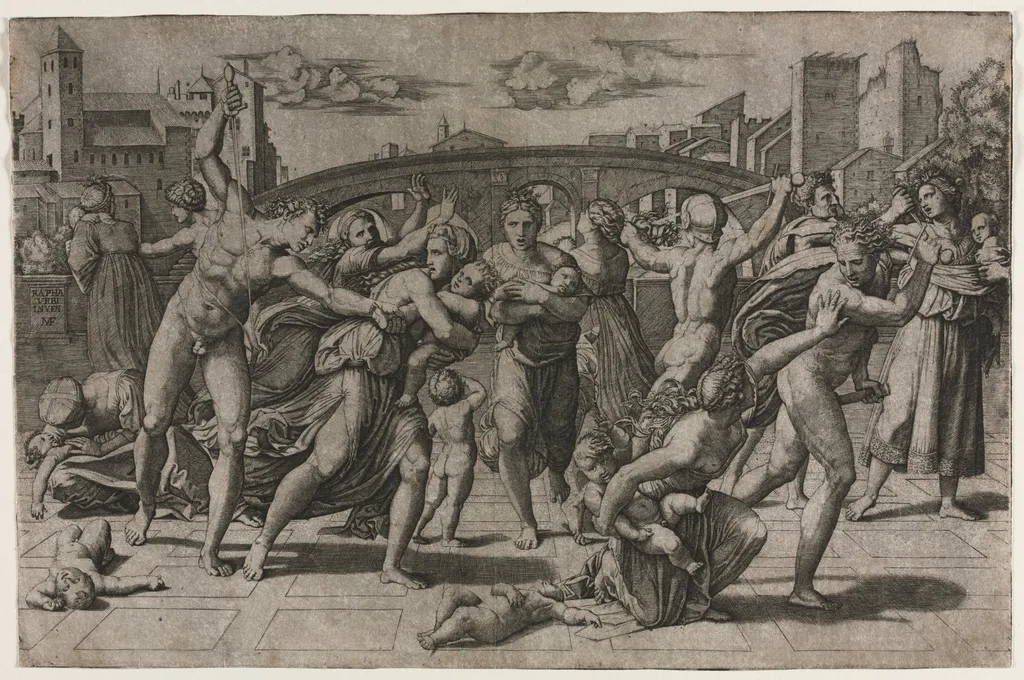
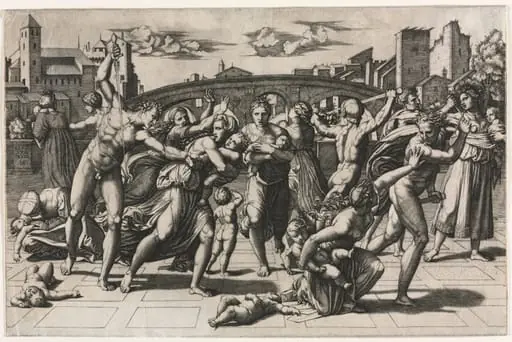
Massacre of the Innocents without the Fir Tree is a print by the Renaissance artist Marcantonio Raimondi. It dates from 1514 and is held in the collection of the Cleveland Museum of Art.
About this work
Overview
Marcantonio Raimondi’s print, titled *Massacre of the Innocents without the Fir Tree*, dates to around 1514. Executed in the early sixteenth‑century Italian printmaking tradition, the work is part of the Cleveland Museum of Art’s collection. The composition captures a violent biblical episode, rendered in a densely populated, dynamic scene that draws the eye across foreground and background.
Subject & Meaning
The image depicts the biblical massacre ordered by King Herod, focusing on the frantic struggle among adults and children. Figures are shown attacking, fleeing, or shielding infants, emphasizing the cruelty of the event. The absence of the traditional fir tree element, present in other versions, concentrates attention on the human drama and the stark contrast between protector and victim.
Technique & Style
Raimondi employs crisp, intersecting lines and pronounced chiaroscuro to model the crowded figures. Deep shadows accentuate the sense of movement and tension, while the tight hatching creates texture in clothing and architecture. The print’s linear precision and dramatic lighting reflect the influence of contemporary engraving practices and the artist’s collaboration with Raphael’s workshop.
History & Provenance
Created circa 1514, the print entered the Cleveland Museum of Art’s holdings through a mid‑twentieth‑century acquisition, though earlier ownership records are sparse. Its survival in good condition allows scholars to study Raimondi’s role in disseminating Raphael’s designs across Europe, illustrating the spread of Renaissance iconography through print media.
Artist & collection

Artist
Marcantonio Raimondi, often called simply Marcantonio (c. 1470/82 – c. 1534), was an Italian engraver, known for being the first important printmaker whose body of work consists largely of prints copying paintings. He…