Artwork
View of Drumnagh [Drimnagh] Castle, near Crumlin [...]
![View of Drumnagh [Drimnagh] Castle, near Crumlin [...], by Gabriel, ca.1729-1817 Beranger, unspecified, 1790](https://artifactworldgallery.com/img/gabriel-ca-1729-1817-beranger--view-of-drumnagh-drimnagh-castle-near-crumlin--606b31c4594851c7-w1024.webp)
View of Drumnagh [Drimnagh] Castle, near Crumlin [...] is an unspecified work on paper by the Rococo painting artist Gabriel, ca.1729-1817 Beranger. It dates from 1790 and is held in the collection of the Royal Irish Academy. This watercolor depicts Drumnagh Castle, a medieval stone structure near Crumlin in County Dublin, framed by a pastoral landscape.
About this work
Overview
This watercolor depicts Drumnagh Castle, a medieval stone structure near Crumlin in County Dublin, framed by a pastoral landscape.
This watercolor depicts Drumnagh Castle, a medieval stone structure near Crumlin in County Dublin, framed by a pastoral landscape. The scene captures the castle’s weathered masonry against a softly rendered sky, with grazing cattle in the foreground. Executed in muted tones, the work reflects a quiet observation of rural Ireland in the late 18th century, characteristic of Gabriel Beranger’s documentary approach to Irish antiquities.
Subject & Meaning
The painting presents Drumnagh Castle not as a romantic ruin, but as an integrated element of everyday rural life. Cattle grazing before its walls suggest the castle’s transition from fortified residence to passive landmark within the agricultural landscape. The absence of human figures emphasizes the quiet endurance of the structure, grounding its historical presence in the rhythms of the land.
Technique & Style
Beranger employed delicate watercolor washes to convey subtle shifts in light and texture. The sky is rendered with soft, diffused hues, while the castle’s stonework is suggested through light tonal variations rather than sharp detail. The foreground grasses and animals are loosely indicated, prioritizing atmospheric harmony over precision, aligning with the sketch-like immediacy of topographical studies of the period.
History & Provenance
Gabriel Beranger, an 18th-century Irish artist and antiquarian, produced hundreds of such drawings during extensive travels across Ireland between the 1760s and 1790s. This work is part of a broader effort to record Ireland’s architectural heritage before further decay or demolition. Many of his watercolors, including this one, were later collected by institutions such as the Museum of Ethnography in Dublin.
Context
In the late 1700s, Ireland’s medieval castles were often neglected or repurposed, their historical significance overlooked. Beranger’s work emerged amid growing interest in national antiquities, supported by emerging scholarly societies. His images served as visual records for historians and collectors, preserving forms that were increasingly vulnerable to time and change.
Legacy
Beranger’s watercolors remain among the earliest systematic visual surveys of Irish castles. Though not widely exhibited in his lifetime, his collection became a foundational resource for later archaeological and architectural studies. Today, these works offer unembellished glimpses into Ireland’s built environment before modernization altered its rural landscapes.
Artist & collection
Artist
Gabriel, ca.1729-1817 Beranger
Gabriel Beranger made watercolors of Dublin and its surroundings in the late 1700s.
![A view of the round tower of Michael of Pole in the city of Dublin [...], by Gabriel, ca.1729-1817 Beranger](https://artifactworldgallery.com/img/gabriel-ca-1729-1817-beranger--a-view-of-the-round-tower-of-michael-of-pole-in-the-city-of--066346c3e06cc1f8-w320.webp) A view of the round tower of Michael of Pole in the city of Dublin [...]
A view of the round tower of Michael of Pole in the city of Dublin [...]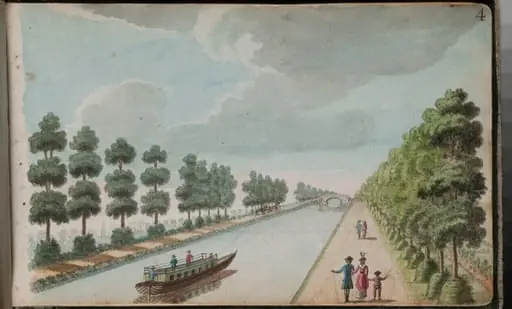 View of the Grand Canal, taken between the first bridge and the first lock looking towards Dublin
![View of the castle of Rabuck [Roebuck], 2 miles from Dublin [...], by Gabriel, ca.1729-1817 Beranger](https://artifactworldgallery.com/img/gabriel-ca-1729-1817-beranger--view-of-the-castle-of-rabuck-roebuck-2-miles-from-dublin--12853cdd66c2654f-w320.webp) View of the castle of Rabuck [Roebuck], 2 miles from Dublin [...]
View of the castle of Rabuck [Roebuck], 2 miles from Dublin [...]![Rathgar Castle, 1 1/2 miles from Dublin [...], by Gabriel, ca.1729-1817 Beranger](https://artifactworldgallery.com/img/gabriel-ca-1729-1817-beranger--rathgar-castle-1-1-2-miles-from-dublin--17cfe3f4e70405c2-w320.webp) Rathgar Castle, 1 1/2 miles from Dublin [...]
Rathgar Castle, 1 1/2 miles from Dublin [...]![Grange Castle, near Clondalken [Clondalkin], 6 miles from Dublin [...], by Gabriel, ca.1729-1817 Beranger](https://artifactworldgallery.com/img/gabriel-ca-1729-1817-beranger--grange-castle-near-clondalken-clondalkin-6-miles-from-dublin--29b767d07d01cfc8-w320.webp) Grange Castle, near Clondalken [Clondalkin], 6 miles from Dublin [...]
Grange Castle, near Clondalken [Clondalkin], 6 miles from Dublin [...]![View of Balymount [Ballymount] Castle, 3 miles from Dublin [...], by Gabriel, ca.1729-1817 Beranger](https://artifactworldgallery.com/img/gabriel-ca-1729-1817-beranger--view-of-balymount-ballymount-castle-3-miles-from-dublin--32c2f3cc4ed12e5f-w320.webp) View of Balymount [Ballymount] Castle, 3 miles from Dublin [...]
View of Balymount [Ballymount] Castle, 3 miles from Dublin [...]![A second view of Rathfarnham Castle, showing the front or entrance [...], by Gabriel, ca.1729-1817 Beranger](https://artifactworldgallery.com/img/gabriel-ca-1729-1817-beranger--a-second-view-of-rathfarnham-castle-showing-the-front-or-ent--3b1f8da88f33e09f-w320.webp) A second view of Rathfarnham Castle, showing the front or entrance [...]
A second view of Rathfarnham Castle, showing the front or entrance [...]![View of the Castle of Carrick, on the River Boyne, County of E[ast] Meath, 24 m[iles] fr[om] Dublin [...], by Gabriel, ca.1729-1817 Beranger](https://artifactworldgallery.com/img/gabriel-ca-1729-1817-beranger--view-of-the-castle-of-carrick-on-the-river-boyne-county-of-e--47a9c858b28e8890-w320.webp) View of the Castle of Carrick, on the River Boyne, County of E[ast] Meath, 24 m[iles] fr[om] Dublin [...]
View of the Castle of Carrick, on the River Boyne, County of E[ast] Meath, 24 m[iles] fr[om] Dublin [...]
![View of the Plunket's [sic] Castle, near St. Margaret's, 5 1/2 miles from Dublin [...], by Gabriel, ca.1729-1817 Beranger](https://artifactworldgallery.com/img/gabriel-ca-1729-1817-beranger--view-of-the-plunket-s-sic-castle-near-st-margaret-s-5-1-2-mi--aaf2a207a5920843-w320.webp) View of the Plunket's [sic] Castle, near St. Margaret's, 5 1/2 miles from Dublin [...]
View of the Plunket's [sic] Castle, near St. Margaret's, 5 1/2 miles from Dublin [...]![View of Kilgoben [Kilgobbin] Castle, 5 miles from Dublin [...], by Gabriel, ca.1729-1817 Beranger](https://artifactworldgallery.com/img/gabriel-ca-1729-1817-beranger--view-of-kilgoben-kilgobbin-castle-5-miles-from-dublin--924293240c630cbc-w320.webp) View of Kilgoben [Kilgobbin] Castle, 5 miles from Dublin [...]
View of Kilgoben [Kilgobbin] Castle, 5 miles from Dublin [...]![View of Monkstown Castle, 4 1/2 miles from Dublin [...], by Gabriel, ca.1729-1817 Beranger](https://artifactworldgallery.com/img/gabriel-ca-1729-1817-beranger--view-of-monkstown-castle-4-1-2-miles-from-dublin--9cf4cde63d5dec9c-w320.webp) View of Monkstown Castle, 4 1/2 miles from Dublin [...]
View of Monkstown Castle, 4 1/2 miles from Dublin [...]![View of Dundrum Castle from the court yard [...], by Gabriel, ca.1729-1817 Beranger](https://artifactworldgallery.com/img/gabriel-ca-1729-1817-beranger--view-of-dundrum-castle-from-the-court-yard--9adf863f6e8a85bf-w320.webp) View of Dundrum Castle from the court yard [...]
View of Dundrum Castle from the court yard [...]![View of the castle at Tallagh [Tallaght], 4 miles from Dublin [...], by Gabriel, ca.1729-1817 Beranger](https://artifactworldgallery.com/img/gabriel-ca-1729-1817-beranger--view-of-the-castle-at-tallagh-tallaght-4-miles-from-dublin--91b676c483b47739-w320.webp) View of the castle at Tallagh [Tallaght], 4 miles from Dublin [...]
View of the castle at Tallagh [Tallaght], 4 miles from Dublin [...]![View of two more of Dalkey's castles, the old church and church yard [...], by Gabriel, ca.1729-1817 Beranger](https://artifactworldgallery.com/img/gabriel-ca-1729-1817-beranger--view-of-two-more-of-dalkey-s-castles-the-old-church-and-chur--8acaea1fbac6279c-w320.webp) View of two more of Dalkey's castles, the old church and church yard [...]
View of two more of Dalkey's castles, the old church and church yard [...]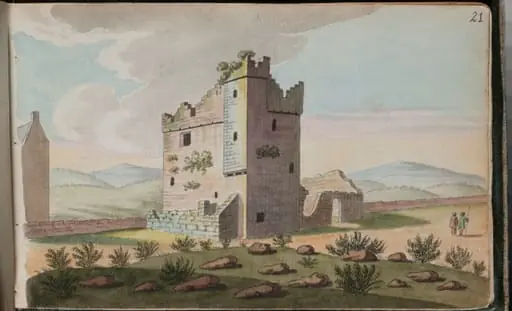 View of one of Dalkey's castles taken from the church yard on the opposite side