Artwork
View of the castle at Tallagh [Tallaght], 4 miles from Dublin [...]
![View of the castle at Tallagh [Tallaght], 4 miles from Dublin [...], by Gabriel, ca.1729-1817 Beranger, unspecified, 1790](https://artifactworldgallery.com/img/gabriel-ca-1729-1817-beranger--view-of-the-castle-at-tallagh-tallaght-4-miles-from-dublin--91b676c483b47739-w1024.webp)
View of the castle at Tallagh [Tallaght], 4 miles from Dublin [...] is an unspecified work on paper by the Rococo painting artist Gabriel, ca.1729-1817 Beranger. It dates from 1790 and is held in the collection of the Royal Irish Academy. This watercolor depicts Tallaght Castle, located four miles southwest of Dublin, as a quiet, partially obscured structure framed by trees.
About this work
Overview
This watercolor depicts Tallaght Castle, located four miles southwest of Dublin, as a quiet, partially obscured structure framed by trees.
This watercolor depicts Tallaght Castle, located four miles southwest of Dublin, as a quiet, partially obscured structure framed by trees. Two figures in the foreground engage in mundane labor—one rolling a lawn, the other standing near the gatehouse—grounding the scene in everyday life rather than grandeur. The composition emphasizes stillness and subtlety, avoiding dramatic emphasis on the architecture itself.
Subject & Meaning
The scene captures ordinary rural activity around a historic site, suggesting a shift from feudal prominence to domestic quietude. The castle, no longer a center of power, exists as a backdrop to the routine tasks of its surroundings. The figures’ modest actions imply a lived-in landscape, where history is not celebrated but quietly absorbed into daily existence.
Technique & Style
Beranger employed watercolor glazing to build delicate layers of translucent pigment, allowing light to pass through and create soft atmospheric effects. The technique enabled subtle transitions in tone and texture, particularly in the foliage and the castle’s weathered stone. Fine brushwork renders the grass and figures with quiet precision, enhancing the scene’s intimate realism without overt detail.
History & Provenance
Tallaght Castle, originally a medieval Augustinian priory and later a residence of the Archbishops of Dublin, had fallen into partial ruin by the early 19th century. This watercolor, likely painted during a period of antiquarian interest in Irish landmarks, documents the site before further decay. Its survival suggests it was kept within private or institutional collections focused on regional heritage.
Context
In the early 1800s, Ireland saw growing documentation of its architectural past amid political and cultural change. Watercolor was a favored medium for topographical studies, valued for its portability and ability to capture fleeting light. Beranger’s work aligns with this trend, presenting the castle not as a monument but as a quiet fixture within a changing rural landscape.
Legacy
The painting contributes to a visual record of Irish country estates in decline, offering a sober counterpoint to romanticized depictions of ruins. Its understated realism reflects a shift in artistic priorities—from heroic grandeur to observational accuracy. Today, it remains a quiet testament to the passage of time and the quiet persistence of everyday life around historic sites.
Artist & collection
Artist
Gabriel, ca.1729-1817 Beranger
Gabriel Beranger made watercolors of Dublin and its surroundings in the late 1700s.
![A view of the round tower of Michael of Pole in the city of Dublin [...], by Gabriel, ca.1729-1817 Beranger](https://artifactworldgallery.com/img/gabriel-ca-1729-1817-beranger--a-view-of-the-round-tower-of-michael-of-pole-in-the-city-of--066346c3e06cc1f8-w320.webp) A view of the round tower of Michael of Pole in the city of Dublin [...]
A view of the round tower of Michael of Pole in the city of Dublin [...]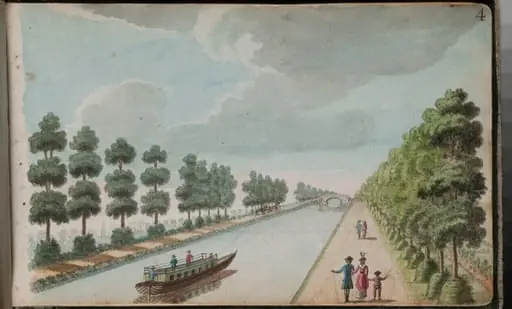 View of the Grand Canal, taken between the first bridge and the first lock looking towards Dublin
![View of the castle of Rabuck [Roebuck], 2 miles from Dublin [...], by Gabriel, ca.1729-1817 Beranger](https://artifactworldgallery.com/img/gabriel-ca-1729-1817-beranger--view-of-the-castle-of-rabuck-roebuck-2-miles-from-dublin--12853cdd66c2654f-w320.webp) View of the castle of Rabuck [Roebuck], 2 miles from Dublin [...]
View of the castle of Rabuck [Roebuck], 2 miles from Dublin [...]![Rathgar Castle, 1 1/2 miles from Dublin [...], by Gabriel, ca.1729-1817 Beranger](https://artifactworldgallery.com/img/gabriel-ca-1729-1817-beranger--rathgar-castle-1-1-2-miles-from-dublin--17cfe3f4e70405c2-w320.webp) Rathgar Castle, 1 1/2 miles from Dublin [...]
Rathgar Castle, 1 1/2 miles from Dublin [...]![Grange Castle, near Clondalken [Clondalkin], 6 miles from Dublin [...], by Gabriel, ca.1729-1817 Beranger](https://artifactworldgallery.com/img/gabriel-ca-1729-1817-beranger--grange-castle-near-clondalken-clondalkin-6-miles-from-dublin--29b767d07d01cfc8-w320.webp) Grange Castle, near Clondalken [Clondalkin], 6 miles from Dublin [...]
Grange Castle, near Clondalken [Clondalkin], 6 miles from Dublin [...]![View of Balymount [Ballymount] Castle, 3 miles from Dublin [...], by Gabriel, ca.1729-1817 Beranger](https://artifactworldgallery.com/img/gabriel-ca-1729-1817-beranger--view-of-balymount-ballymount-castle-3-miles-from-dublin--32c2f3cc4ed12e5f-w320.webp) View of Balymount [Ballymount] Castle, 3 miles from Dublin [...]
View of Balymount [Ballymount] Castle, 3 miles from Dublin [...]![A second view of Rathfarnham Castle, showing the front or entrance [...], by Gabriel, ca.1729-1817 Beranger](https://artifactworldgallery.com/img/gabriel-ca-1729-1817-beranger--a-second-view-of-rathfarnham-castle-showing-the-front-or-ent--3b1f8da88f33e09f-w320.webp) A second view of Rathfarnham Castle, showing the front or entrance [...]
A second view of Rathfarnham Castle, showing the front or entrance [...]![View of the Castle of Carrick, on the River Boyne, County of E[ast] Meath, 24 m[iles] fr[om] Dublin [...], by Gabriel, ca.1729-1817 Beranger](https://artifactworldgallery.com/img/gabriel-ca-1729-1817-beranger--view-of-the-castle-of-carrick-on-the-river-boyne-county-of-e--47a9c858b28e8890-w320.webp) View of the Castle of Carrick, on the River Boyne, County of E[ast] Meath, 24 m[iles] fr[om] Dublin [...]
View of the Castle of Carrick, on the River Boyne, County of E[ast] Meath, 24 m[iles] fr[om] Dublin [...]
![View of the Plunket's [sic] Castle, near St. Margaret's, 5 1/2 miles from Dublin [...], by Gabriel, ca.1729-1817 Beranger](https://artifactworldgallery.com/img/gabriel-ca-1729-1817-beranger--view-of-the-plunket-s-sic-castle-near-st-margaret-s-5-1-2-mi--aaf2a207a5920843-w320.webp) View of the Plunket's [sic] Castle, near St. Margaret's, 5 1/2 miles from Dublin [...]
View of the Plunket's [sic] Castle, near St. Margaret's, 5 1/2 miles from Dublin [...]![View of Kilgoben [Kilgobbin] Castle, 5 miles from Dublin [...], by Gabriel, ca.1729-1817 Beranger](https://artifactworldgallery.com/img/gabriel-ca-1729-1817-beranger--view-of-kilgoben-kilgobbin-castle-5-miles-from-dublin--924293240c630cbc-w320.webp) View of Kilgoben [Kilgobbin] Castle, 5 miles from Dublin [...]
View of Kilgoben [Kilgobbin] Castle, 5 miles from Dublin [...]![View of Monkstown Castle, 4 1/2 miles from Dublin [...], by Gabriel, ca.1729-1817 Beranger](https://artifactworldgallery.com/img/gabriel-ca-1729-1817-beranger--view-of-monkstown-castle-4-1-2-miles-from-dublin--9cf4cde63d5dec9c-w320.webp) View of Monkstown Castle, 4 1/2 miles from Dublin [...]
View of Monkstown Castle, 4 1/2 miles from Dublin [...]![View of another castle at Monkstown [...], by Gabriel, ca.1729-1817 Beranger](https://artifactworldgallery.com/img/gabriel-ca-1729-1817-beranger--view-of-another-castle-at-monkstown--aa06605166c02b4a-w320.webp) View of another castle at Monkstown [...]
View of another castle at Monkstown [...]![View of Drumnagh [Drimnagh] Castle, near Crumlin [...], by Gabriel, ca.1729-1817 Beranger](https://artifactworldgallery.com/img/gabriel-ca-1729-1817-beranger--view-of-drumnagh-drimnagh-castle-near-crumlin--606b31c4594851c7-w320.webp) View of Drumnagh [Drimnagh] Castle, near Crumlin [...]
View of Drumnagh [Drimnagh] Castle, near Crumlin [...]![View of Cappoge Castle [...], by Gabriel, ca.1729-1817 Beranger](https://artifactworldgallery.com/img/gabriel-ca-1729-1817-beranger--view-of-cappoge-castle--885594fac18874cc-w320.webp) View of Cappoge Castle [...]
View of Cappoge Castle [...]![View of Baggoths rath [Baggot Rath], a castle half a mile from Dublin [...], by Gabriel, ca.1729-1817 Beranger](https://artifactworldgallery.com/img/gabriel-ca-1729-1817-beranger--view-of-baggoths-rath-baggot-rath-a-castle-half-a-mile-from--c625749ddb0ab425-w320.webp) View of Baggoths rath [Baggot Rath], a castle half a mile from Dublin [...]
View of Baggoths rath [Baggot Rath], a castle half a mile from Dublin [...]![View of Castle-knock, 3 miles from Dublin [...], by Gabriel, ca.1729-1817 Beranger](https://artifactworldgallery.com/img/gabriel-ca-1729-1817-beranger--view-of-castle-knock-3-miles-from-dublin--4e9a7099f4e41684-w320.webp) View of Castle-knock, 3 miles from Dublin [...]
View of Castle-knock, 3 miles from Dublin [...]