Artwork
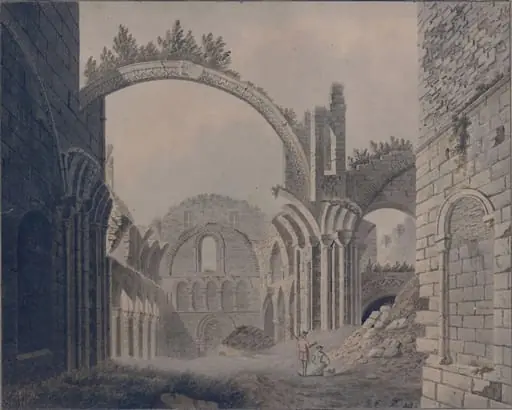
View of the inside of the old church at Killester, 2 1/2 miles from Dublin [...]
![View of the inside of the old church at Killester, 2 1/2 miles from Dublin [...], by Gabriel, ca.1729-1817 Beranger, unspecified, 1790](https://artifactworldgallery.com/img/gabriel-ca-1729-1817-beranger--view-of-the-inside-of-the-old-church-at-killester-2-1-2-mile--abfebd83941373b2-w1024.webp)
View of the inside of the old church at Killester, 2 1/2 miles from Dublin [...] is an unspecified work on paper by the Rococo painting artist Gabriel, ca.1729-1817 Beranger. It dates from 1790 and is held in the collection of the Royal Irish Academy. This watercolor depicts the interior of a ruined church in Killester, County Dublin, capturing the quiet decay of a once-sacred space.
About this work
That’s a technique where you layer thin, see-through washes of color to build depth.
This watercolor shows the inside of an old church in Killester, Ireland. Sunlight falls through broken walls onto five old gravestones. The stone floor slopes gently toward the altar.
The artist used watercolor glazing here. That’s a technique where you layer thin, see-through washes of color to build depth. The colors stay bright even after 200 years.
Look up the artist Gabriel Beranger, ca.1729-1817.
Overview
This watercolor depicts the interior of a ruined church in Killester, County Dublin, capturing the quiet decay of a once-sacred space. Five weathered headstones lie scattered across a gently sloping stone floor, leading toward the altar. The composition emphasizes stillness and erosion, with light filtering through broken walls to illuminate the interior surfaces.
Subject & Meaning
The scene presents a meditation on time and memory. The abandoned church, stripped of its function, becomes a repository of the past through its gravestones. The absence of human figures and the quiet dominance of stone and light suggest a contemplative tone, reflecting on mortality and the fading traces of communal worship.
Technique & Style
The artist employed watercolor glazing, applying multiple thin, transparent washes to build subtle tonal depth without obscuring the paper’s texture. This method preserved the luminosity of the pigments, allowing sunlight to appear to emanate from within the scene. The delicate handling of light and shadow enhances the sense of atmospheric stillness.
History & Provenance
Created by Gabriel Beranger (c.1729–1817), an Irish artist known for documenting ecclesiastical ruins, the work is part of a broader effort to record Ireland’s architectural heritage before further deterioration. Beranger’s watercolors were often made for private collectors and antiquarian circles, preserving visual records of sites now lost or altered.
Context
In the late 18th century, Ireland saw growing interest in its medieval past, particularly among antiquarians. Many churches, abandoned after the Reformation and subsequent religious shifts, were left to decay. Beranger’s work responded to this cultural moment, offering precise, unembellished records of structures that were no longer in active use.
Legacy
Beranger’s watercolors remain valuable historical documents, offering insight into Ireland’s ecclesiastical landscape before modern restoration or demolition. This piece, like others in his oeuvre, contributes to the understanding of how 18th-century observers perceived and recorded the ruins of their own cultural heritage, without romanticizing their decay.
Artist & collection
Artist
Gabriel, ca.1729-1817 Beranger
Gabriel Beranger made watercolors of Dublin and its surroundings in the late 1700s.
![A view of the round tower of Michael of Pole in the city of Dublin [...], by Gabriel, ca.1729-1817 Beranger](https://artifactworldgallery.com/img/gabriel-ca-1729-1817-beranger--a-view-of-the-round-tower-of-michael-of-pole-in-the-city-of--066346c3e06cc1f8-w320.webp) A view of the round tower of Michael of Pole in the city of Dublin [...]
A view of the round tower of Michael of Pole in the city of Dublin [...]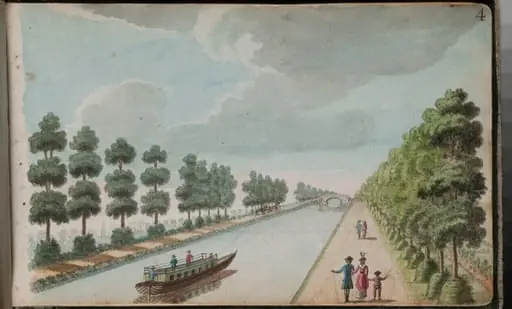 View of the Grand Canal, taken between the first bridge and the first lock looking towards Dublin
![View of the castle of Rabuck [Roebuck], 2 miles from Dublin [...], by Gabriel, ca.1729-1817 Beranger](https://artifactworldgallery.com/img/gabriel-ca-1729-1817-beranger--view-of-the-castle-of-rabuck-roebuck-2-miles-from-dublin--12853cdd66c2654f-w320.webp) View of the castle of Rabuck [Roebuck], 2 miles from Dublin [...]
View of the castle of Rabuck [Roebuck], 2 miles from Dublin [...]![Rathgar Castle, 1 1/2 miles from Dublin [...], by Gabriel, ca.1729-1817 Beranger](https://artifactworldgallery.com/img/gabriel-ca-1729-1817-beranger--rathgar-castle-1-1-2-miles-from-dublin--17cfe3f4e70405c2-w320.webp) Rathgar Castle, 1 1/2 miles from Dublin [...]
Rathgar Castle, 1 1/2 miles from Dublin [...]![Grange Castle, near Clondalken [Clondalkin], 6 miles from Dublin [...], by Gabriel, ca.1729-1817 Beranger](https://artifactworldgallery.com/img/gabriel-ca-1729-1817-beranger--grange-castle-near-clondalken-clondalkin-6-miles-from-dublin--29b767d07d01cfc8-w320.webp) Grange Castle, near Clondalken [Clondalkin], 6 miles from Dublin [...]
Grange Castle, near Clondalken [Clondalkin], 6 miles from Dublin [...]![View of Balymount [Ballymount] Castle, 3 miles from Dublin [...], by Gabriel, ca.1729-1817 Beranger](https://artifactworldgallery.com/img/gabriel-ca-1729-1817-beranger--view-of-balymount-ballymount-castle-3-miles-from-dublin--32c2f3cc4ed12e5f-w320.webp) View of Balymount [Ballymount] Castle, 3 miles from Dublin [...]
View of Balymount [Ballymount] Castle, 3 miles from Dublin [...]![A second view of Rathfarnham Castle, showing the front or entrance [...], by Gabriel, ca.1729-1817 Beranger](https://artifactworldgallery.com/img/gabriel-ca-1729-1817-beranger--a-second-view-of-rathfarnham-castle-showing-the-front-or-ent--3b1f8da88f33e09f-w320.webp) A second view of Rathfarnham Castle, showing the front or entrance [...]
A second view of Rathfarnham Castle, showing the front or entrance [...]![View of the Castle of Carrick, on the River Boyne, County of E[ast] Meath, 24 m[iles] fr[om] Dublin [...], by Gabriel, ca.1729-1817 Beranger](https://artifactworldgallery.com/img/gabriel-ca-1729-1817-beranger--view-of-the-castle-of-carrick-on-the-river-boyne-county-of-e--47a9c858b28e8890-w320.webp) View of the Castle of Carrick, on the River Boyne, County of E[ast] Meath, 24 m[iles] fr[om] Dublin [...]
View of the Castle of Carrick, on the River Boyne, County of E[ast] Meath, 24 m[iles] fr[om] Dublin [...]
![View of Merion [Merrion] Castle, 2 miles from Dublin [...], by Gabriel, ca.1729-1817 Beranger](https://artifactworldgallery.com/img/gabriel-ca-1729-1817-beranger--view-of-merion-merrion-castle-2-miles-from-dublin--ff55e85c19078a20-w320.webp)