Artwork
View of Rathcroghan, Co[unt]y of Roscommon & Province of Connaught, 84 or 85 miles from Dublin [...]
![View of Rathcroghan, Co[unt]y of Roscommon & Province of Connaught, 84 or 85 miles from Dublin [...], by Gabriel, ca.1729-1817 Beranger, unspecified, 1790](https://artifactworldgallery.com/img/gabriel-ca-1729-1817-beranger--view-of-rathcroghan-co-unt-y-of-roscommon-province-of-connau--fb427addab79d7b1-w1024.webp)
View of Rathcroghan, Co[unt]y of Roscommon & Province of Connaught, 84 or 85 miles from Dublin [...] is an unspecified work on paper by the Rococo painting artist Gabriel, ca.1729-1817 Beranger. It dates from 1790 and is held in the collection of the Royal Irish Academy. This watercolor depicts a quiet landscape in County Roscommon, Ireland, centered on a large earthen mound at Rathcroghan.
About this work
The painting shows a distant earthen mound with two men in the foreground.
The men are looking towards the mound, one sitting and one standing. This detail suggests the mound is important, maybe a local landmark.
The artist used watercolor to create this scene, a technique that can produce soft, blended colors, similar to those used by artist: Beranger, Gabriel, ca.1729-1817.
Overview
This watercolor depicts a quiet landscape in County Roscommon, Ireland, centered on a large earthen mound at Rathcroghan. The scene is viewed from a distance, with two figures in the foreground—one seated, one standing—gazing toward the earthwork. Their posture implies contemplation, drawing attention to the mound as a site of significance within the surrounding rural terrain.
Subject & Meaning
The earthen mound at Rathcroghan is believed to be an ancient ceremonial or burial site, historically linked to early Irish kingship. The presence of the two figures, oriented toward it, suggests a quiet acknowledgment of its cultural weight. Their stillness contrasts with the open landscape, reinforcing the mound’s enduring presence as a marker of place and memory.
Technique & Style
Executed in watercolor, the work employs soft washes and subtle gradations to render the rolling terrain and atmospheric haze. The medium’s transparency allows the underlying paper to suggest light, while delicate linework defines the figures and mound’s contours. This restrained approach aligns with 18th-century topographical traditions, prioritizing observation over dramatic effect.
History & Provenance
Attributed to Gabriel Beranger, an Irish artist and antiquarian active in the late 18th century, the work likely dates from his travels documenting archaeological sites across Connacht. Beranger produced numerous watercolors of Irish monuments, often for scholarly or antiquarian audiences, preserving visual records of sites before modern excavation or erosion altered them.
Context
During the late 1700s, interest in Ireland’s prehistoric monuments grew among antiquarians and travelers. Rathcroghan, associated with the legendary Queen Medb, was one of several sites being recorded as part of a broader effort to document native heritage. Beranger’s work contributed to this emerging field, offering visual evidence of sites that lacked written documentation.
Legacy
Beranger’s watercolors, including this view, remain valuable as early visual records of Ireland’s ancient landscapes. They provide insight into how such sites were perceived before industrialization and modern archaeology reshaped their context. His attention to detail and quiet composition helped establish a visual language for documenting heritage that influenced later topographical studies.
Artist & collection
Artist
Gabriel, ca.1729-1817 Beranger
Gabriel Beranger made watercolors of Dublin and its surroundings in the late 1700s.
![A view of the round tower of Michael of Pole in the city of Dublin [...], by Gabriel, ca.1729-1817 Beranger](https://artifactworldgallery.com/img/gabriel-ca-1729-1817-beranger--a-view-of-the-round-tower-of-michael-of-pole-in-the-city-of--066346c3e06cc1f8-w320.webp) A view of the round tower of Michael of Pole in the city of Dublin [...]
A view of the round tower of Michael of Pole in the city of Dublin [...]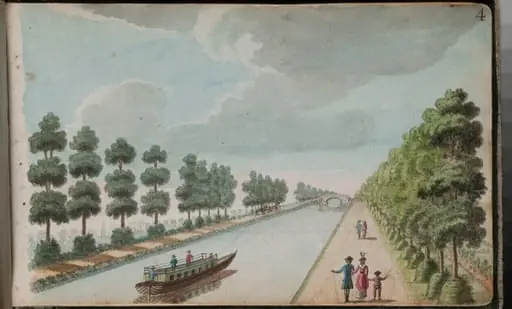 View of the Grand Canal, taken between the first bridge and the first lock looking towards Dublin
![View of the castle of Rabuck [Roebuck], 2 miles from Dublin [...], by Gabriel, ca.1729-1817 Beranger](https://artifactworldgallery.com/img/gabriel-ca-1729-1817-beranger--view-of-the-castle-of-rabuck-roebuck-2-miles-from-dublin--12853cdd66c2654f-w320.webp) View of the castle of Rabuck [Roebuck], 2 miles from Dublin [...]
View of the castle of Rabuck [Roebuck], 2 miles from Dublin [...]![Rathgar Castle, 1 1/2 miles from Dublin [...], by Gabriel, ca.1729-1817 Beranger](https://artifactworldgallery.com/img/gabriel-ca-1729-1817-beranger--rathgar-castle-1-1-2-miles-from-dublin--17cfe3f4e70405c2-w320.webp) Rathgar Castle, 1 1/2 miles from Dublin [...]
Rathgar Castle, 1 1/2 miles from Dublin [...]![Grange Castle, near Clondalken [Clondalkin], 6 miles from Dublin [...], by Gabriel, ca.1729-1817 Beranger](https://artifactworldgallery.com/img/gabriel-ca-1729-1817-beranger--grange-castle-near-clondalken-clondalkin-6-miles-from-dublin--29b767d07d01cfc8-w320.webp) Grange Castle, near Clondalken [Clondalkin], 6 miles from Dublin [...]
Grange Castle, near Clondalken [Clondalkin], 6 miles from Dublin [...]![View of Balymount [Ballymount] Castle, 3 miles from Dublin [...], by Gabriel, ca.1729-1817 Beranger](https://artifactworldgallery.com/img/gabriel-ca-1729-1817-beranger--view-of-balymount-ballymount-castle-3-miles-from-dublin--32c2f3cc4ed12e5f-w320.webp) View of Balymount [Ballymount] Castle, 3 miles from Dublin [...]
View of Balymount [Ballymount] Castle, 3 miles from Dublin [...]![A second view of Rathfarnham Castle, showing the front or entrance [...], by Gabriel, ca.1729-1817 Beranger](https://artifactworldgallery.com/img/gabriel-ca-1729-1817-beranger--a-second-view-of-rathfarnham-castle-showing-the-front-or-ent--3b1f8da88f33e09f-w320.webp) A second view of Rathfarnham Castle, showing the front or entrance [...]
A second view of Rathfarnham Castle, showing the front or entrance [...]![View of the Castle of Carrick, on the River Boyne, County of E[ast] Meath, 24 m[iles] fr[om] Dublin [...], by Gabriel, ca.1729-1817 Beranger](https://artifactworldgallery.com/img/gabriel-ca-1729-1817-beranger--view-of-the-castle-of-carrick-on-the-river-boyne-county-of-e--47a9c858b28e8890-w320.webp) View of the Castle of Carrick, on the River Boyne, County of E[ast] Meath, 24 m[iles] fr[om] Dublin [...]
View of the Castle of Carrick, on the River Boyne, County of E[ast] Meath, 24 m[iles] fr[om] Dublin [...]
![View of the Black Castle at Wiclow [sic], County of Wicklow, 24 miles from Dublin [...], by Gabriel, ca.1729-1817 Beranger](https://artifactworldgallery.com/img/gabriel-ca-1729-1817-beranger--view-of-the-black-castle-at-wiclow-sic-county-of-wicklow-24--e655d3281baa9667-w320.webp) View of the Black Castle at Wiclow [sic], County of Wicklow, 24 miles from Dublin [...]
View of the Black Castle at Wiclow [sic], County of Wicklow, 24 miles from Dublin [...]![View of a cromliach [cromlech], call'd Fan-mac-cools Quoit at Howht [sic] 8 miles from Dublin [...], by Gabriel, ca.1729-1817 Beranger](https://artifactworldgallery.com/img/gabriel-ca-1729-1817-beranger--view-of-a-cromliach-cromlech-call-d-fan-mac-cools-quoit-at-h--1853ee772457212b-w320.webp) View of a cromliach [cromlech], call'd Fan-mac-cools Quoit at Howht [sic] 8 miles from Dublin [...]
View of a cromliach [cromlech], call'd Fan-mac-cools Quoit at Howht [sic] 8 miles from Dublin [...] Mountains and Cattle
 Landscape study
 Epsom Heath
 Study from nature near Handborough, Oxfordshire
 Sketch of a common with houses
 Lowland landscape, sketch