Artwork
View of a cromliach [cromlech], call'd Fan-mac-cools Quoit at Howht [sic] 8 miles from Dublin [...]
![View of a cromliach [cromlech], call'd Fan-mac-cools Quoit at Howht [sic] 8 miles from Dublin [...], by Gabriel, ca.1729-1817 Beranger, unspecified, 1790](https://artifactworldgallery.com/img/gabriel-ca-1729-1817-beranger--view-of-a-cromliach-cromlech-call-d-fan-mac-cools-quoit-at-h--1853ee772457212b-w1024.webp)
View of a cromliach [cromlech], call'd Fan-mac-cools Quoit at Howht [sic] 8 miles from Dublin [...] is an unspecified work on paper by Gabriel, ca.1729-1817 Beranger. It dates from 1790 and is held in the collection of the Royal Irish Academy.
About this work
This painting shows a large stone structure, called a cromlech, in a landscape.
It's set near a coastline, with the sea visible in the distance.
The scene is peaceful, with no people around.
The cromlech is the main focus of the painting. It's a unique ancient monument.
To learn more about similar artworks, look up the work of artist: Beranger, Gabriel, ca.1729-1817.
Overview
The image presents an expansive view of a prehistoric stone monument situated near Howth, County Dublin, identified locally as Fan McCool’s Quoit. The composition frames the cromlech against a tranquil landscape, with the distant coastline and sea visible on the horizon, emphasizing the monument’s isolation within a natural setting.
Subject & Meaning
The central focus is the cromlech—a megalithic burial structure—highlighted as a distinctive relic of ancient ritual practice. Its placement amid a quiet, unpopulated scene underscores the enduring presence of historic monuments within the Irish countryside, inviting contemplation of past human activity in contrast with the surrounding serenity.
Technique & Style
Rendered with a clear, observational approach, the work captures the stone arrangement and surrounding terrain in a balanced, naturalistic manner. The muted palette and soft delineation of distant sea and sky convey atmospheric depth, while the detailed rendering of the cromlech’s massive stones conveys their solidity and age.
History & Provenance
The scene depicts the cromlech known locally as Fan McCool’s Quoit, located near Howth, approximately eight miles north of Dublin. The site has long been associated with local folklore, linking the monument to the legendary figure of Fionn mac Cumhaill, a connection reflected in the name used by early observers.
Context
Megalithic structures such as this cromlech are characteristic of the Neolithic period in Ireland, serving as communal burial sites or ritual focal points. The Howth coastline, visible in the background, situates the monument within a broader maritime landscape that has shaped settlement and cultural narratives throughout Irish history.
Artist & collection
Artist
Gabriel, ca.1729-1817 Beranger
Gabriel Beranger made watercolors of Dublin and its surroundings in the late 1700s.
![A view of the round tower of Michael of Pole in the city of Dublin [...], by Gabriel, ca.1729-1817 Beranger](https://artifactworldgallery.com/img/gabriel-ca-1729-1817-beranger--a-view-of-the-round-tower-of-michael-of-pole-in-the-city-of--066346c3e06cc1f8-w320.webp) A view of the round tower of Michael of Pole in the city of Dublin [...]
A view of the round tower of Michael of Pole in the city of Dublin [...]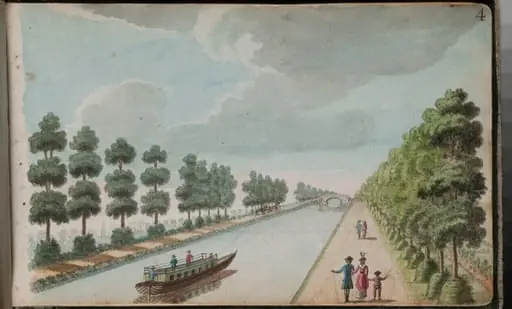 View of the Grand Canal, taken between the first bridge and the first lock looking towards Dublin
![View of the castle of Rabuck [Roebuck], 2 miles from Dublin [...], by Gabriel, ca.1729-1817 Beranger](https://artifactworldgallery.com/img/gabriel-ca-1729-1817-beranger--view-of-the-castle-of-rabuck-roebuck-2-miles-from-dublin--12853cdd66c2654f-w320.webp) View of the castle of Rabuck [Roebuck], 2 miles from Dublin [...]
View of the castle of Rabuck [Roebuck], 2 miles from Dublin [...]![Rathgar Castle, 1 1/2 miles from Dublin [...], by Gabriel, ca.1729-1817 Beranger](https://artifactworldgallery.com/img/gabriel-ca-1729-1817-beranger--rathgar-castle-1-1-2-miles-from-dublin--17cfe3f4e70405c2-w320.webp) Rathgar Castle, 1 1/2 miles from Dublin [...]
Rathgar Castle, 1 1/2 miles from Dublin [...]![Grange Castle, near Clondalken [Clondalkin], 6 miles from Dublin [...], by Gabriel, ca.1729-1817 Beranger](https://artifactworldgallery.com/img/gabriel-ca-1729-1817-beranger--grange-castle-near-clondalken-clondalkin-6-miles-from-dublin--29b767d07d01cfc8-w320.webp) Grange Castle, near Clondalken [Clondalkin], 6 miles from Dublin [...]
Grange Castle, near Clondalken [Clondalkin], 6 miles from Dublin [...]![View of Balymount [Ballymount] Castle, 3 miles from Dublin [...], by Gabriel, ca.1729-1817 Beranger](https://artifactworldgallery.com/img/gabriel-ca-1729-1817-beranger--view-of-balymount-ballymount-castle-3-miles-from-dublin--32c2f3cc4ed12e5f-w320.webp) View of Balymount [Ballymount] Castle, 3 miles from Dublin [...]
View of Balymount [Ballymount] Castle, 3 miles from Dublin [...]![A second view of Rathfarnham Castle, showing the front or entrance [...], by Gabriel, ca.1729-1817 Beranger](https://artifactworldgallery.com/img/gabriel-ca-1729-1817-beranger--a-second-view-of-rathfarnham-castle-showing-the-front-or-ent--3b1f8da88f33e09f-w320.webp) A second view of Rathfarnham Castle, showing the front or entrance [...]
A second view of Rathfarnham Castle, showing the front or entrance [...]![View of the Castle of Carrick, on the River Boyne, County of E[ast] Meath, 24 m[iles] fr[om] Dublin [...], by Gabriel, ca.1729-1817 Beranger](https://artifactworldgallery.com/img/gabriel-ca-1729-1817-beranger--view-of-the-castle-of-carrick-on-the-river-boyne-county-of-e--47a9c858b28e8890-w320.webp) View of the Castle of Carrick, on the River Boyne, County of E[ast] Meath, 24 m[iles] fr[om] Dublin [...]
View of the Castle of Carrick, on the River Boyne, County of E[ast] Meath, 24 m[iles] fr[om] Dublin [...]
![View of a cromliach [cromlech] on the lands of Loughlins town, 7 miles from Dublin [...], by Gabriel, ca.1729-1817 Beranger](https://artifactworldgallery.com/img/gabriel-ca-1729-1817-beranger--view-of-a-cromliach-cromlech-on-the-lands-of-loughlins-town--2ec5dcc741513545-w320.webp) View of a cromliach [cromlech] on the lands of Loughlins town, 7 miles from Dublin [...]
View of a cromliach [cromlech] on the lands of Loughlins town, 7 miles from Dublin [...]![View of Castle-knock, 3 miles from Dublin [...], by Gabriel, ca.1729-1817 Beranger](https://artifactworldgallery.com/img/gabriel-ca-1729-1817-beranger--view-of-castle-knock-3-miles-from-dublin--4e9a7099f4e41684-w320.webp) View of Castle-knock, 3 miles from Dublin [...]
View of Castle-knock, 3 miles from Dublin [...]![View of the Plunket's [sic] Castle, near St. Margaret's, 5 1/2 miles from Dublin [...], by Gabriel, ca.1729-1817 Beranger](https://artifactworldgallery.com/img/gabriel-ca-1729-1817-beranger--view-of-the-plunket-s-sic-castle-near-st-margaret-s-5-1-2-mi--aaf2a207a5920843-w320.webp) View of the Plunket's [sic] Castle, near St. Margaret's, 5 1/2 miles from Dublin [...]
View of the Plunket's [sic] Castle, near St. Margaret's, 5 1/2 miles from Dublin [...]![View of Cappoge Castle [...], by Gabriel, ca.1729-1817 Beranger](https://artifactworldgallery.com/img/gabriel-ca-1729-1817-beranger--view-of-cappoge-castle--885594fac18874cc-w320.webp) View of Cappoge Castle [...]
View of Cappoge Castle [...]![View of the remains of a druidical monument at Douth [Dowth], Co[unty] of Meath, 2 miles from Slane, & 24 miles from Dublin [...], by Gabriel, ca.1729-1817 Beranger](https://artifactworldgallery.com/img/gabriel-ca-1729-1817-beranger--view-of-the-remains-of-a-druidical-monument-at-douth-dowth-c--599f96d588ed28a4-w320.webp) View of the remains of a druidical monument at Douth [Dowth], Co[unty] of Meath, 2 miles from Slane, & 24 miles from Dublin [...]
View of the remains of a druidical monument at Douth [Dowth], Co[unty] of Meath, 2 miles from Slane, & 24 miles from Dublin [...]![A view of the ruins of Mallahidert [Mulhuddart] Church, on the road to Navan, at about 5 miles from Dublin [...], by Gabriel, ca.1729-1817 Beranger](https://artifactworldgallery.com/img/gabriel-ca-1729-1817-beranger--a-view-of-the-ruins-of-mallahidert-mulhuddart-church-on-the--3403306d8314c03b-w320.webp) A view of the ruins of Mallahidert [Mulhuddart] Church, on the road to Navan, at about 5 miles from Dublin [...]
A view of the ruins of Mallahidert [Mulhuddart] Church, on the road to Navan, at about 5 miles from Dublin [...]![View of Rathcroghan, Co[unt]y of Roscommon & Province of Connaught, 84 or 85 miles from Dublin [...], by Gabriel, ca.1729-1817 Beranger](https://artifactworldgallery.com/img/gabriel-ca-1729-1817-beranger--view-of-rathcroghan-co-unt-y-of-roscommon-province-of-connau--fb427addab79d7b1-w320.webp) View of Rathcroghan, Co[unt]y of Roscommon & Province of Connaught, 84 or 85 miles from Dublin [...]
View of Rathcroghan, Co[unt]y of Roscommon & Province of Connaught, 84 or 85 miles from Dublin [...]![View of the tumulus or barrow at Douth [Dowth], Co. of E[ast] Meath, 25 miles from Dublin [...], by Gabriel, ca.1729-1817 Beranger](https://artifactworldgallery.com/img/gabriel-ca-1729-1817-beranger--view-of-the-tumulus-or-barrow-at-douth-dowth-co-of-e-ast-mea--32266a93c2c75aee-w320.webp) View of the tumulus or barrow at Douth [Dowth], Co. of E[ast] Meath, 25 miles from Dublin [...]
View of the tumulus or barrow at Douth [Dowth], Co. of E[ast] Meath, 25 miles from Dublin [...]![Another view of Castleknock with an [sic] mutilated tower on a hill at some distance [...], by Gabriel, ca.1729-1817 Beranger](https://artifactworldgallery.com/img/gabriel-ca-1729-1817-beranger--another-view-of-castleknock-with-an-sic-mutilated-tower-on-a--4e08fdbddd5c4a48-w320.webp) Another view of Castleknock with an [sic] mutilated tower on a hill at some distance [...]
Another view of Castleknock with an [sic] mutilated tower on a hill at some distance [...]