Artwork
Caricature of the Laocoon Group
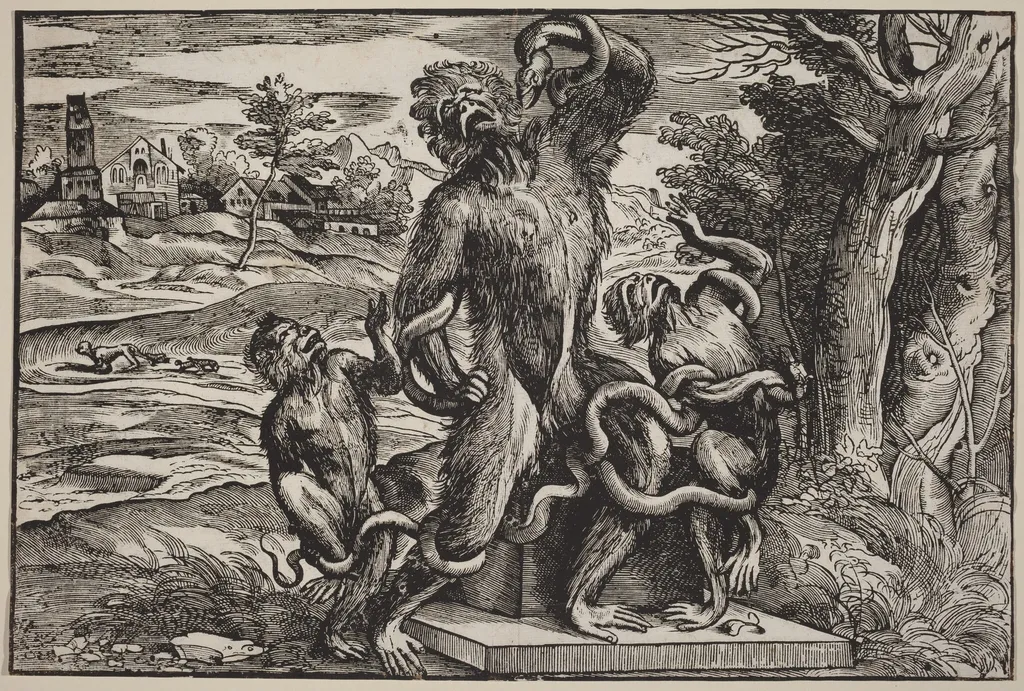
Caricature of the Laocoon Group is an ink print by the Renaissance artist Nicolò Boldrini. It dates from 1542 and is held in the collection of the National Gallery of Art.
About this work
Overview
Nicolò Boldrini’s woodcut, dated around 1542, presents a dramatic interpretation of the classical Laocoon narrative. Executed on white laid paper, the print captures a central figure ensnared by two massive serpents, set against a landscape of a hilltop village, trees, and rocky terrain, rendered with sharp lines and dynamic shading.
Subject & Meaning
The image references the myth of Laocoon, the Trojan priest who, according to legend, was attacked by sea serpents as punishment for warning against the wooden horse. Boldrini’s rendition emphasizes the struggle and tension of the moment, using the serpents’ twisting forms to convey the violent climax of the story.
Technique & Style
Created through the woodcut process, the artist carved the composition into a wood block, applied ink, and pressed it onto paper. This method, prevalent in the sixteenth century, allowed for reproducible images with bold contrasts. The print’s crisp incisions and careful cross‑hatching generate a sense of movement and depth despite the medium’s limitations.
History & Provenance
The work originates from the mid‑16th century, a period when prints served both as artistic expressions and as means of disseminating classical themes. While specific ownership records are scarce, the piece reflects the broader Renaissance interest in antiquity and the circulation of mythological subjects through print culture.
Context
Boldrini operated within the Venetian printmaking tradition, which frequently reproduced works of renowned painters and sculptors. The Laocoon group, famously rediscovered in 1506, inspired numerous artists; this woodcut demonstrates how the dramatic sculpture entered the visual vocabulary of printmakers seeking to reach a wider audience.
Artist & collection