Artwork
Reges Anglia
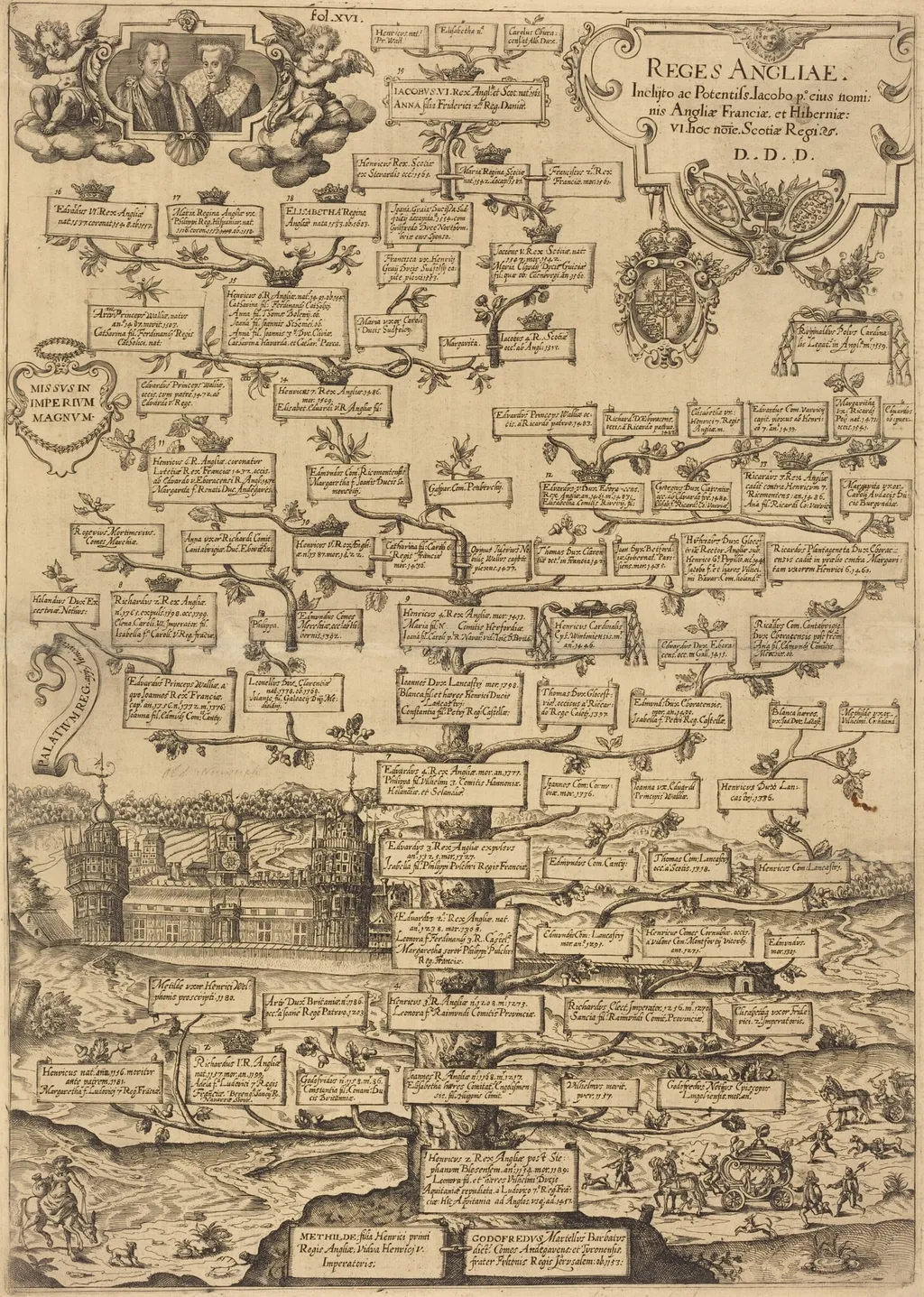
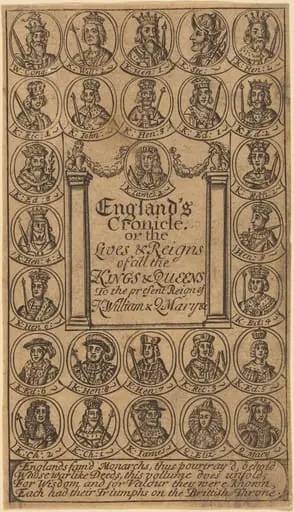
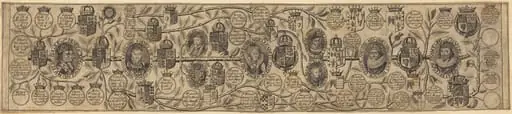
Reges Anglia is an ink print by the Baroque artist British 17th Century. It dates from 1650 and is held in the collection of the National Gallery of Art. This print depicts the lineage of English monarchs as a dense, ornamental family tree, blending heraldic symbolism with genealogical record.
About this work
Overview
At its apex, a winged figure bears the title 'Reges Angliae,' while maritime and architectural motifs anchor the composition in national identity.
This print depicts the lineage of English monarchs as a dense, ornamental family tree, blending heraldic symbolism with genealogical record. Crowded with tiny portraits, Latin inscriptions, and decorative scrolls, it merges ancestry with authority. At its apex, a winged figure bears the title 'Reges Angliae,' while maritime and architectural motifs anchor the composition in national identity. The work exemplifies 17th-century printmaking’s capacity to condense complex historical narratives into a single, intricate field.
Subject & Meaning
The image presents English kings and queens as a divinely sanctioned lineage, with each monarch rendered in miniature detail—crowned, armored, or robed—to signify status and continuity. The winged figure above suggests divine oversight, while the ship and castle below evoke England’s naval power and territorial sovereignty. Latin text reinforces legitimacy through scholarly tradition, transforming genealogy into a visual manifesto of royal endurance.
Technique & Style
Executed through etching, drypoint, and aquatint, the print achieves remarkable precision through fine, interwoven lines that mimic lacework and textile patterns. The artist exploited the tonal range of aquatint for subtle shading and the sharpness of drypoint for delicate textures in armor and hair. These techniques allowed for dense detail without visual clutter, reflecting the era’s technical mastery in reproductive printmaking.
History & Provenance
Created in the early 1600s, the print likely served as a decorative or educational object for elite households or institutions. Its production coincided with efforts to consolidate Tudor and Stuart legitimacy after decades of religious and political upheaval. Though the artist remains unconfirmed, the style aligns with London-based engravers who catered to antiquarian and aristocratic patrons seeking visual affirmations of dynastic order.
Context
In an age before photography, such prints functioned as authoritative visual records of lineage and power. Similar genealogical charts appeared in manuscripts and printed books, but this piece stands out for its ornamental intensity and integration of heraldic elements. It reflects broader European trends in using art to encode political narratives, where visual complexity equated to intellectual and dynastic weight.
Legacy
Though largely overlooked today, the print represents a significant moment in the visual codification of British monarchy. Its intricate technique influenced later heraldic and genealogical illustrations, and its fusion of art and history prefigured modern approaches to institutional memory. Surviving copies are rare, preserved in national collections as artifacts of early modern political iconography.
Artist & collection

Artist
This artist made detailed engravings and etchings in 17th-century Britain, often for book pages.

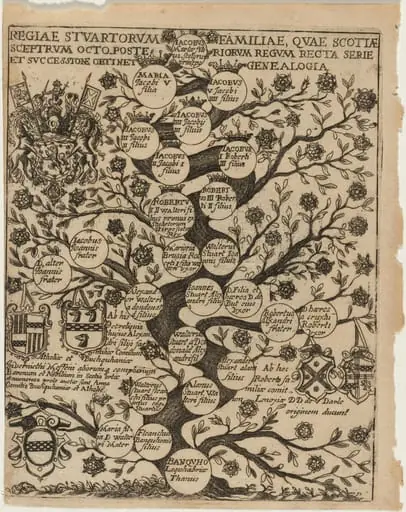 Family Tree of the Stuarts Stemming From Banquho
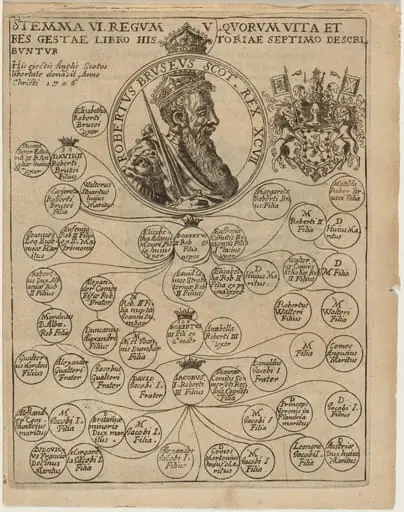 Robert de Bruce VIII, King of Scotland
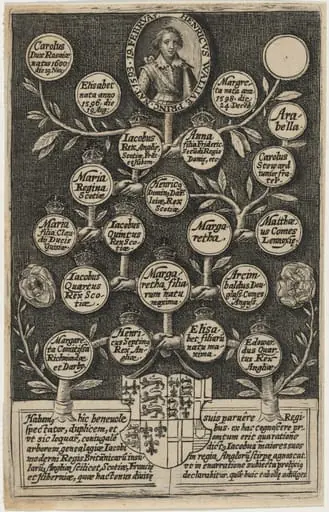 Henry Frederick, Prince of Wales
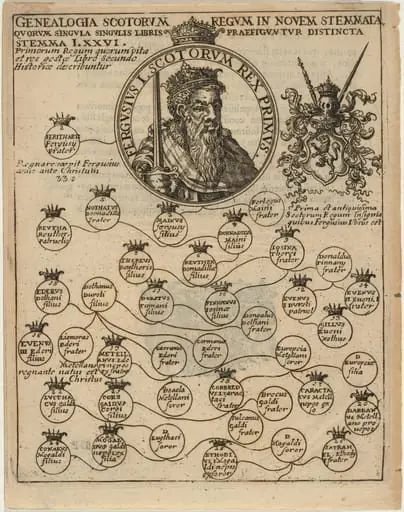 Fergus I of Scotland With Geneology
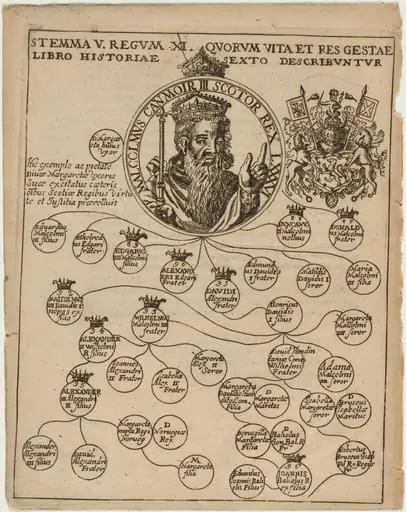 Malcolm III with Geneology
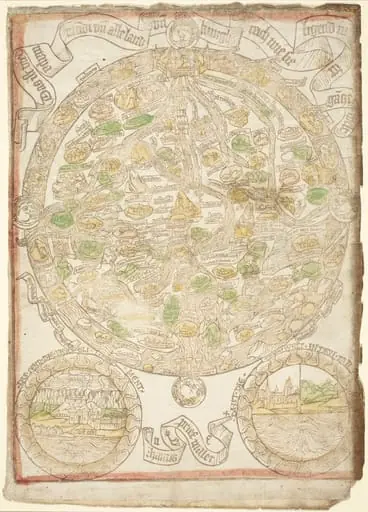 Map of the World
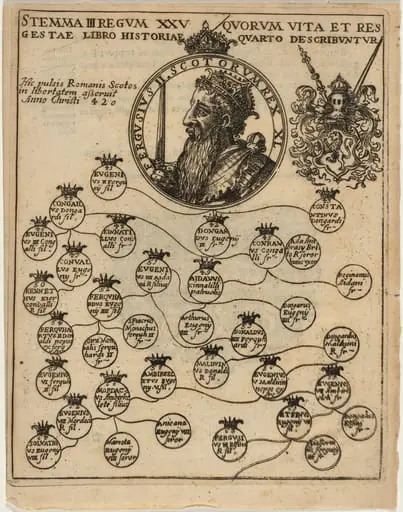 Fergus II of Scotland with Geneology
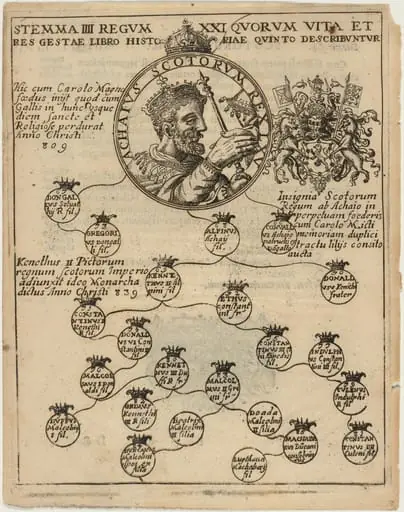 Achaius of Scotland, with Geneology
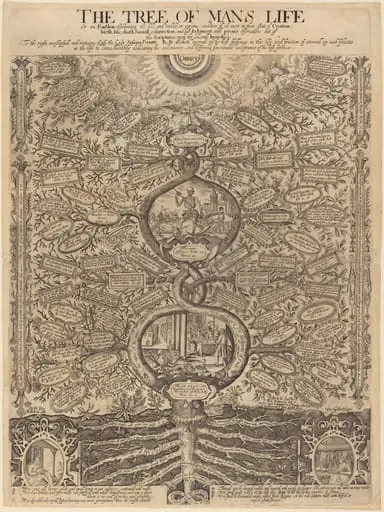 The Tree of Man's Life
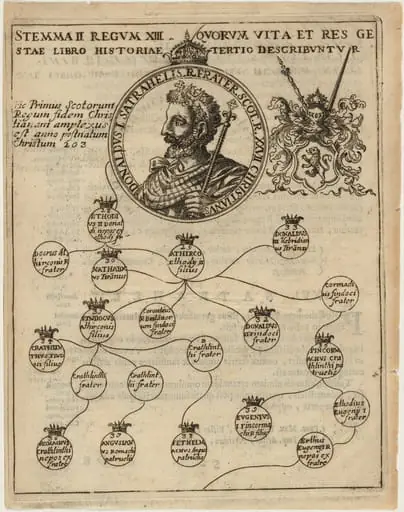 Donald I of Scotland with Geneology
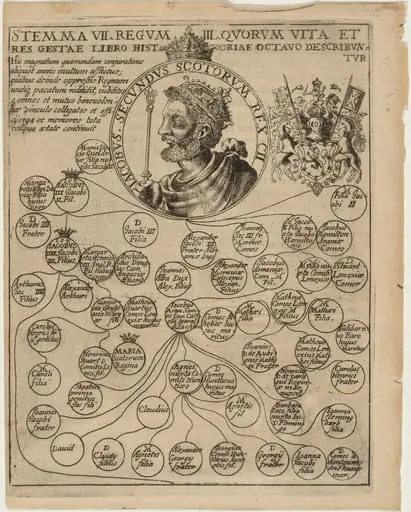 James II of Scotland with Geneology of the Stuarts
 The Land of Cockaigne