Artwork
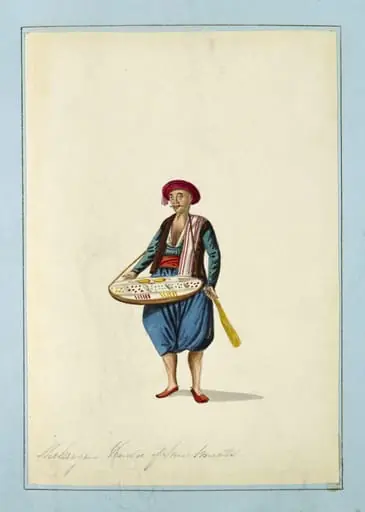
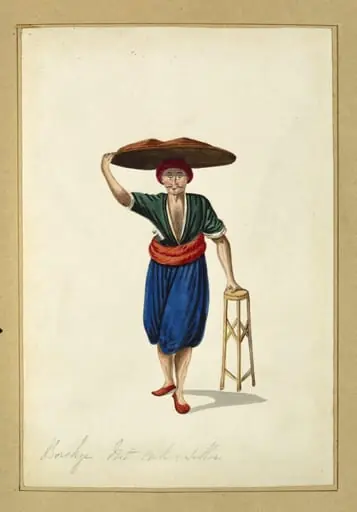
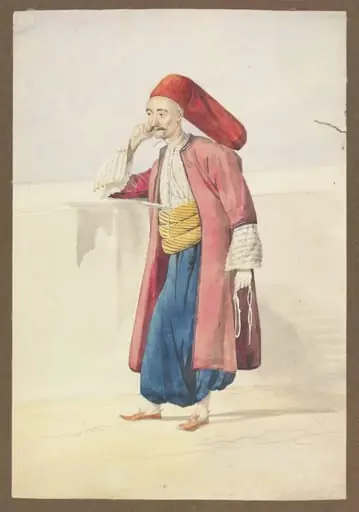
Servant bearing a present of Sweetmeats on Festival occasions -
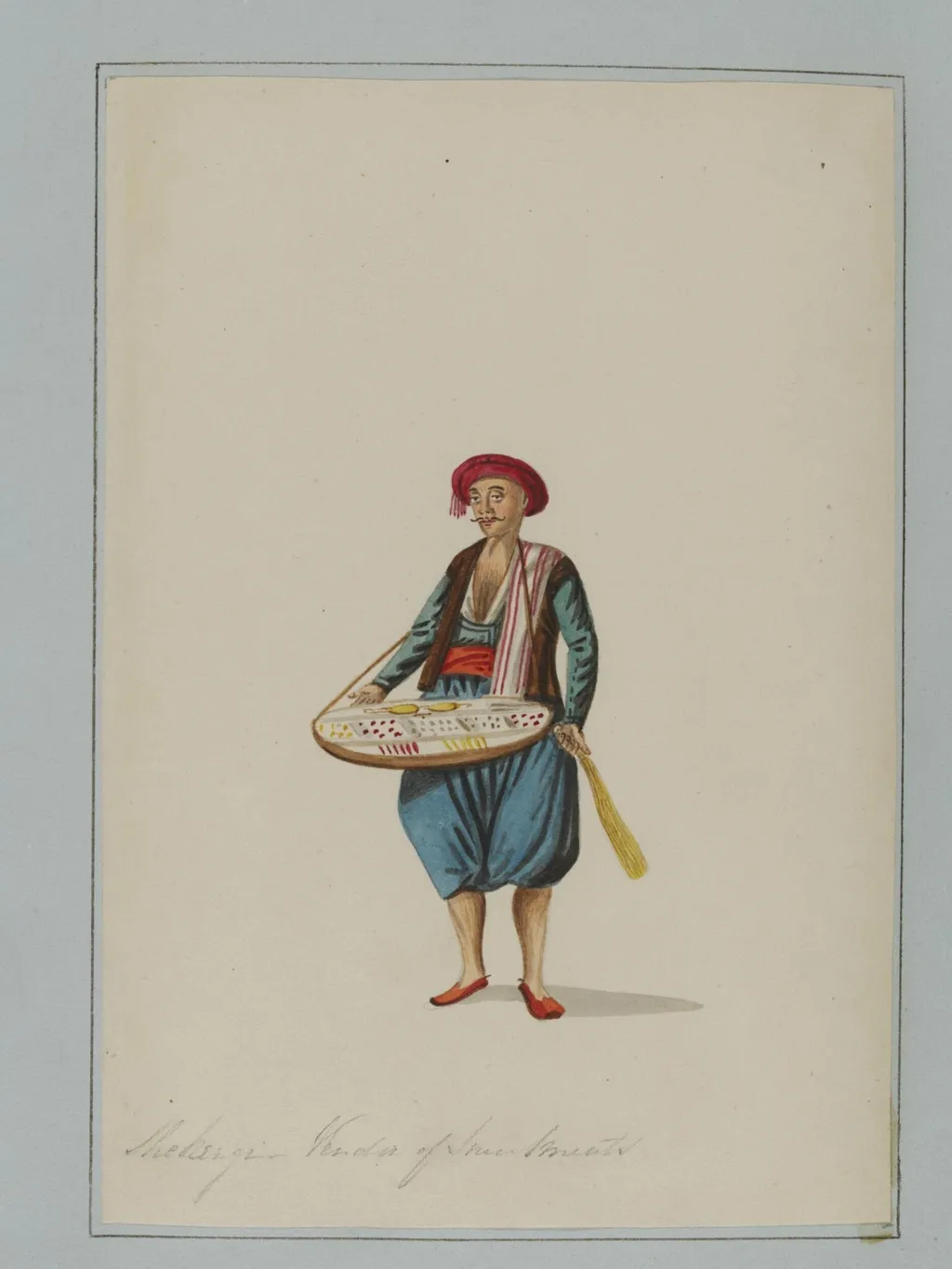
Servant bearing a present of Sweetmeats on Festival occasions - is a watercolor work on paper by the Biedermeier artist Charles Frederick Brockdorff. It dates from 1832 and is held in the collection of the Victoria and Albert Museum. This watercolour is one of 54 sketches in an album documenting Turkish figures and daily life.
About this work
Overview
The drawings, likely made for private collection, reflect an interest in Ottoman customs during the late 18th or early 19th century.
This watercolour is one of 54 sketches in an album documenting Turkish figures and daily life. Created on paper and mounted with varied colored backings, the album is bound in morocco leather with gilt lettering. The drawings, likely made for private collection, reflect an interest in Ottoman customs during the late 18th or early 19th century. The work’s modest scale and detailed observation align with similar albums produced by British officers and travelers of the period.
Subject & Meaning
The image portrays a servant carrying a tray of sweetmeats, likely intended for a festive occasion. His attire—red hat, striped tunic, blue trousers, and red footwear—suggests a specific social role rather than elite status. The broom in his other hand implies he has just completed a task, now transitioning to ceremonial duty. The calm, faintly smiling expression conveys quiet dignity, emphasizing the servant’s role in sustaining communal rituals.
Technique & Style
The artist employs transparent watercolour with restrained washes to define form and texture. The sweets on the tray are rendered with vivid, localized pigments that contrast sharply against the unadorned background, drawing focus to their color and variety. Figures are outlined with light ink, and clothing folds are suggested rather than heavily modeled. The style prioritizes clarity and observation over dramatic effect, characteristic of documentary sketches from this tradition.
History & Provenance
The album likely originated in the Ottoman Empire and entered a European collection in the early 1800s. Its binding and mounting suggest it was assembled for a Western patron, possibly a military officer or diplomat. Comparable albums, including those by Lt. Col. Charles Hamilton Smith, indicate a broader trend of collecting such material. Some related works in the Victoria and Albert Museum bear inscriptions in French and Arabic-script Turkish, hinting at multilingual provenance.
Context
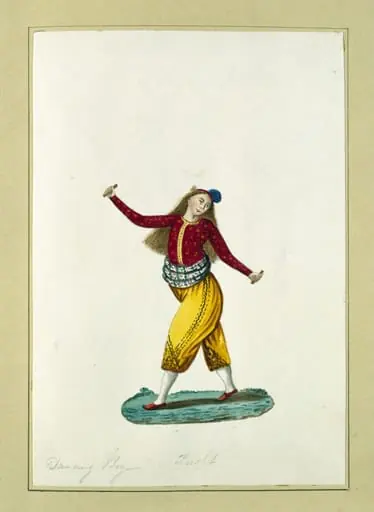
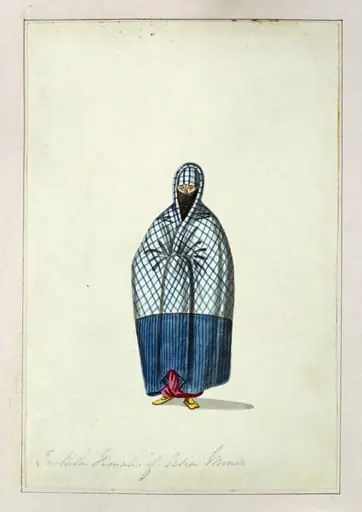
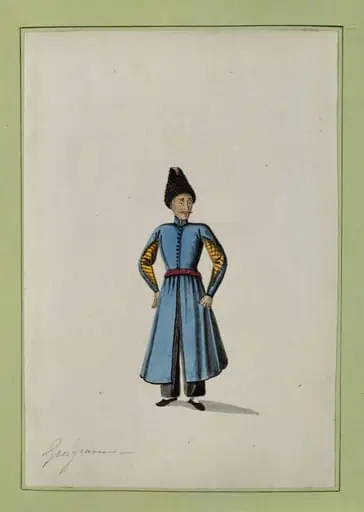
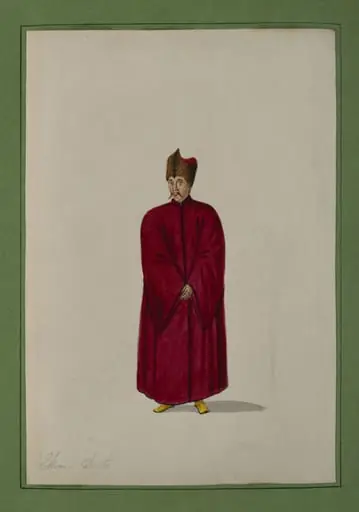
This drawing belongs to a genre of visual documentation produced by Western observers in the Ottoman Empire, often commissioned or collected as ethnographic records. Such albums served both personal curiosity and nascent academic interest in non-European cultures. The inclusion of everyday figures—servants, artisans, traders—rather than royalty or battle scenes reflects a shift toward depicting ordinary life, a trend emerging in travel literature and visual culture of the period.
Legacy
The album contributes to a growing archive of Ottoman visual culture preserved in European institutions. While not widely exhibited, its existence informs scholarly understanding of cross-cultural observation in the early 19th century. Similar works in the Victoria and Albert Museum and other collections continue to be studied for insights into social hierarchy, dress, and ritual practices, offering a quiet but valuable counterpoint to grander historical narratives.
Artist & collection
Artist
Charles Frederick Brockdorff painted detailed watercolours of North African life and costume in the 1830s.

![A Seller of Milk-puddings [Mahallebi], by Aloysius Rosarius Amadeus Raymondus Andreas Preziosi](https://artifactworldgallery.com/img/aloysius-rosarius-amadeus-raymondus-andreas-preziosi--a-seller-of-milk-puddings-mahallebi--3da9fd2db017402d-w320.webp)
![A Saka, or water carrier[?], by Anonymous Greek artist](https://artifactworldgallery.com/img/anonymous-greek-artist--a-saka-or-water-carrier--fea97d6d74c0c945-w320.webp)