Artwork
Ornament for Knife Handle
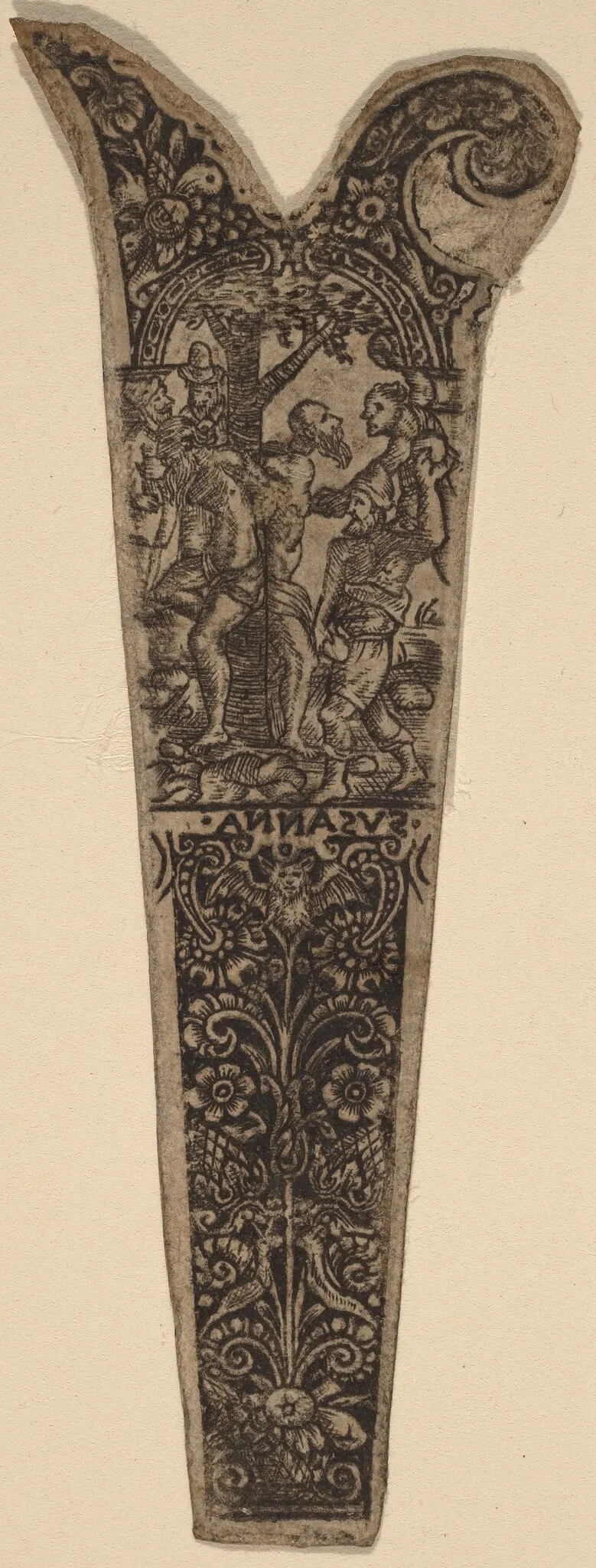
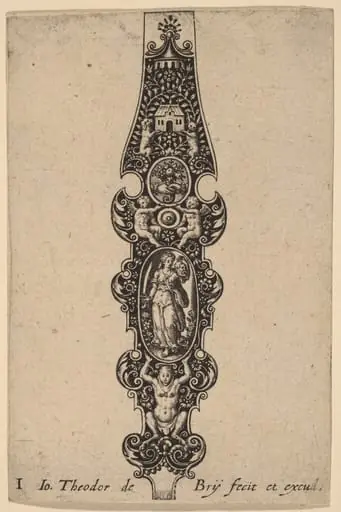
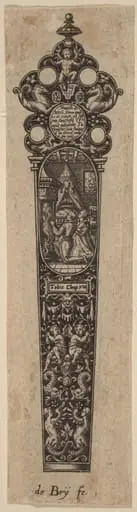
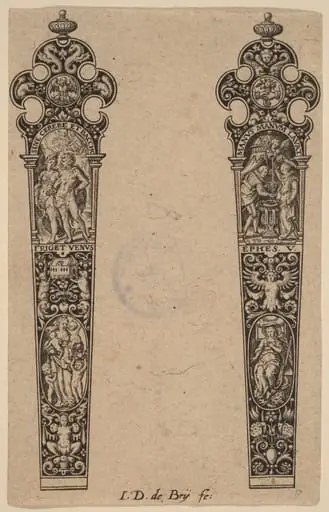
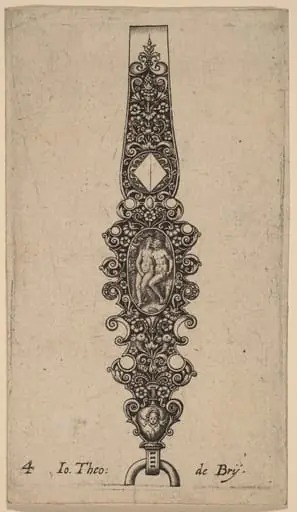
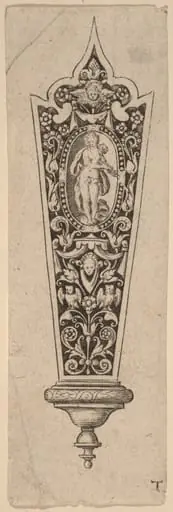
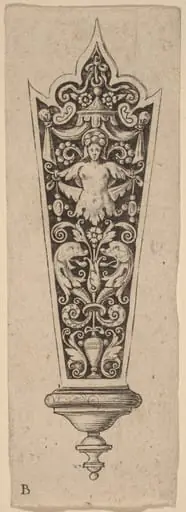
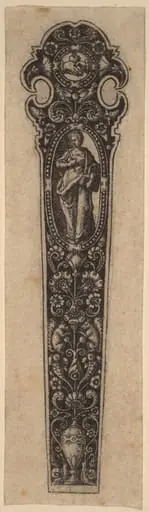
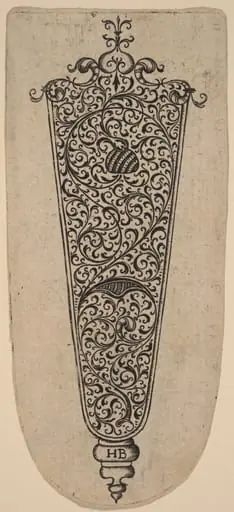
Ornament for Knife Handle is an ink print by the Renaissance artist Theodor de Bry. It dates from 1563 and is held in the collection of the National Gallery of Art.
About this work
Overview
De Bry, trained as a goldsmith and engraver, applied his mastery of metalwork to a functional object, transforming it into a miniature visual narrative.
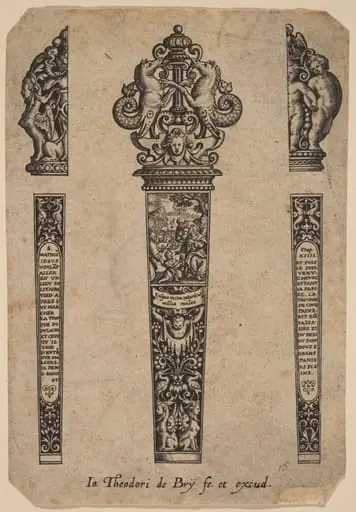
Created in 1563 by Theodor de Bry, this engraving was designed as a decorative motif for a knife handle. Executed in fine black-and-white lines, the composition features a vertical arrangement of figural and ornamental elements. De Bry, trained as a goldsmith and engraver, applied his mastery of metalwork to a functional object, transforming it into a miniature visual narrative. The work reflects the Renaissance fusion of utility and artistic refinement.
Subject & Meaning
The upper register depicts two winged figures framing a group of people beneath a tree, possibly alluding to an idyllic or mythological scene. Below, a dense band of scrolling foliage and abstract patterns fills the lower portion. The inscription 'AMOR' near the base suggests a thematic connection to love, perhaps evoking courtly ideals or pastoral romance. The imagery, though compact, invites symbolic interpretation common in Renaissance decorative arts.
Technique & Style
De Bry employed fine-line engraving to achieve intricate detail, with precise incisions creating contrast and texture. The composition is tightly controlled, balancing figural elements with rhythmic vegetal motifs. The monochrome palette and linear clarity reflect the conventions of printmaking at the time, where engraving served both reproductive and original design purposes. The scale and density indicate the work was intended for close viewing, suited to personal adornment.
History & Provenance
Made during de Bry’s early career, before his well-known publications on the Americas, this piece originates from his time in the Low Countries or Germany. As a Protestant exile, he moved between Strasbourg, Antwerp, and Frankfurt, where he developed his craft. The object likely circulated among elite patrons who valued finely engraved metalwork. Its survival suggests it was preserved as an artistic object rather than used as a functional tool.
Context
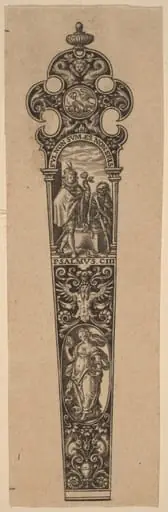
In mid-16th-century Europe, engraved ornamentation was widely used on personal items like knives, daggers, and jewelry, blending aesthetics with status. De Bry’s work aligns with the Northern Renaissance tradition of detailed, narrative decoration. Such designs often drew from classical, mythological, or allegorical sources, reflecting humanist interests. This piece exemplifies how artistic skill was applied beyond painting and sculpture to everyday luxury goods.
Legacy
Though lesser known than his later publications, this engraving demonstrates de Bry’s foundational skill in linear composition and decorative design. It anticipates the precision and narrative density he would later apply to his illustrated voyages. The work remains a quiet example of how printmaking bridged fine art and craft, influencing the visual culture of personal objects in early modern Europe.
Artist & collection
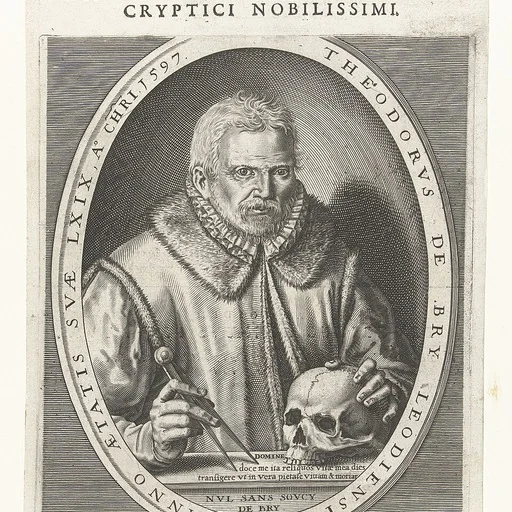
Artist
Theodor de Bry (also Theodorus de Bry; 1528 – 27 March 1598) was a Walloon engraver, goldsmith, editor and publisher, famous for his depictions of early European expeditions to the Americas.