Artwork
Design for a Decorative Panel with Two Sirens Holding a Vase Embellished with Dolphins and other Decorative Motifs
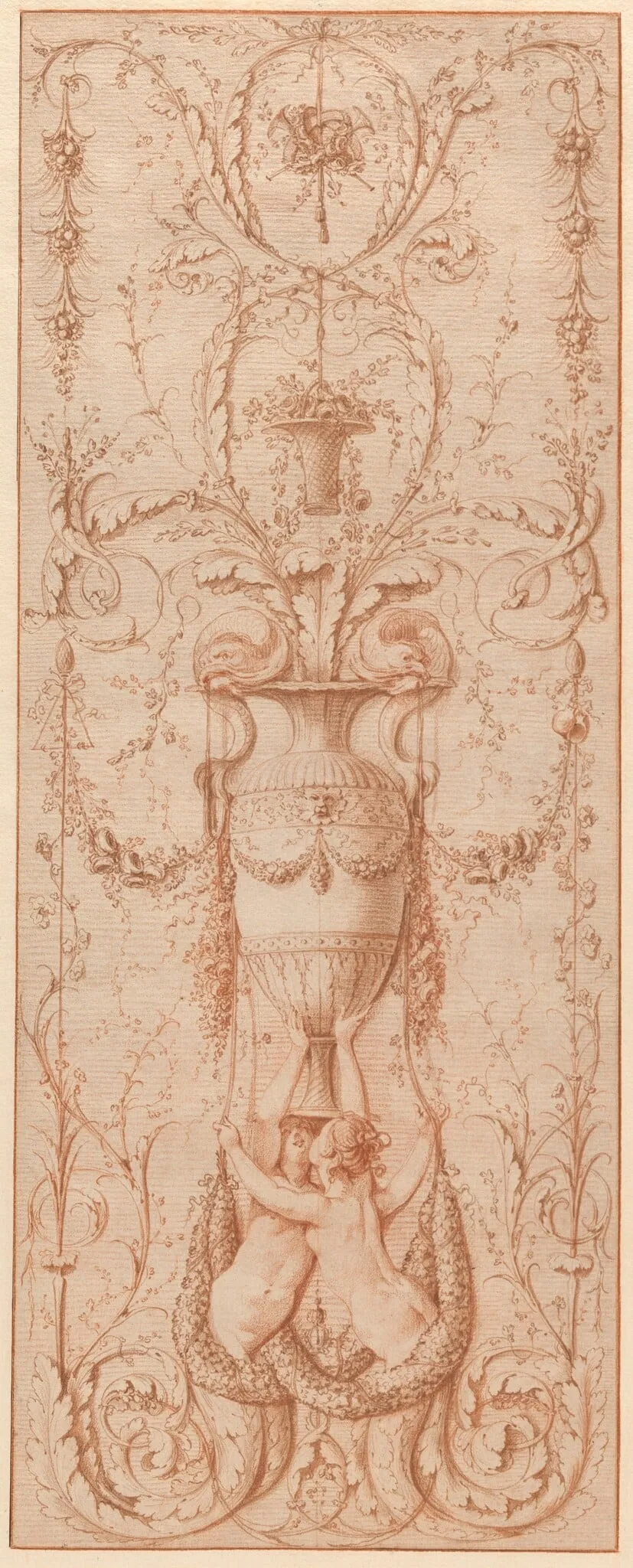
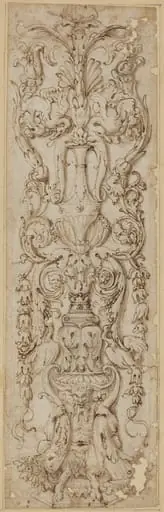
Design for a Decorative Panel with Two Sirens Holding a Vase Embellished with Dolphins and other Decorative Motifs is a chalk drawing by the Romanticist artist Gilles Paul Cauvet. It dates from 1777 and is held in the collection of the National Gallery of Art.
About this work
Overview
Created in 1777 by Gilles Paul Cauvet, this drawing is a preparatory study for a decorative panel, executed in red chalk on laid paper.
Created in 1777 by Gilles Paul Cauvet, this drawing is a preparatory study for a decorative panel, executed in red chalk on laid paper. It belongs to the collection of the National Gallery of Art in Washington, D.C., and exemplifies the ornamental sensibilities of late 18th-century French design. The work reflects the artist’s engagement with mythological and natural motifs commonly used in interior decoration during the Rococo and early Neoclassical periods.
Subject & Meaning
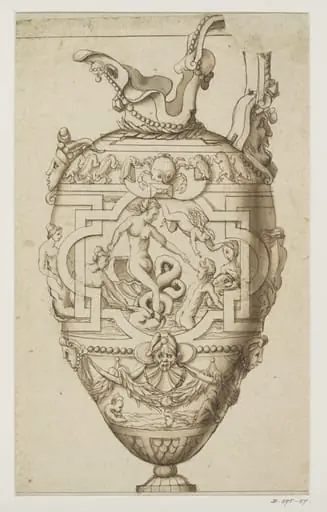
Two sirens, depicted with human torsos and serpentine tails, cradle a tall, ornate vase. Dolphins coil around the vessel’s base, while scrolling foliage and floral elements fill the surrounding space. The imagery draws from classical mythology and marine symbolism, suggesting themes of harmony between nature and artifice. The sirens’ graceful forms and the vase’s weight imply a balance of beauty and structural function, typical of decorative arts meant to adorn elite interiors.
Technique & Style
Cauvet employed red chalk with fluid, layered strokes to create soft gradations of tone and form. The lines blend seamlessly, allowing subtle shifts in light and shadow to model the figures and foliage without sharp contours. This technique emphasizes texture and movement, enhancing the organic flow of the composition. The drawing’s delicate handling reflects a focus on elegance and rhythm rather than precise detail, characteristic of preparatory designs for decorative arts.
History & Provenance
The drawing was produced during Cauvet’s active period as a designer for French decorative arts, likely intended for a private or royal interior. It entered the National Gallery of Art’s collection through established acquisitions of European drawings, preserving its role as a record of design practice in pre-Revolutionary France. Its survival offers insight into the workshop processes of artists who translated ornamental concepts into applied media.
Context
In the 1770s, French decorative arts increasingly fused classical motifs with fluid, naturalistic forms, bridging Rococo exuberance and emerging Neoclassical restraint. Cauvet’s work aligns with designers like Jean-Baptiste Oudry and the Gobelins manufactory, who produced patterns for tapestries and furniture. This drawing reflects a broader cultural interest in mythological allegory as a vehicle for refined domestic decoration among the aristocracy.
Legacy
Though Cauvet’s name is less prominent than his contemporaries, this drawing preserves his contribution to the visual language of French decorative design. It serves as a tangible link between artistic conception and material execution, illustrating how drawings functioned as intermediaries in the production of luxury interiors. The work remains a reference for scholars studying the transition from ornamental excess to classical order in late 18th-century France.
Artist & collection