Artwork
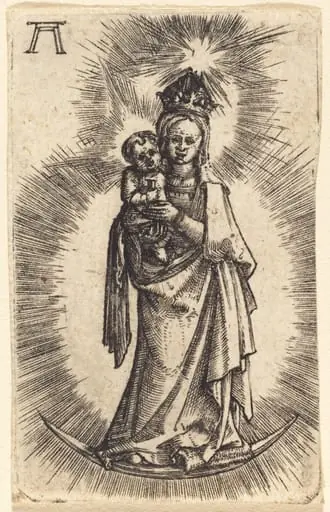
The Virgin and Child on a Crescent with a Starry Crown
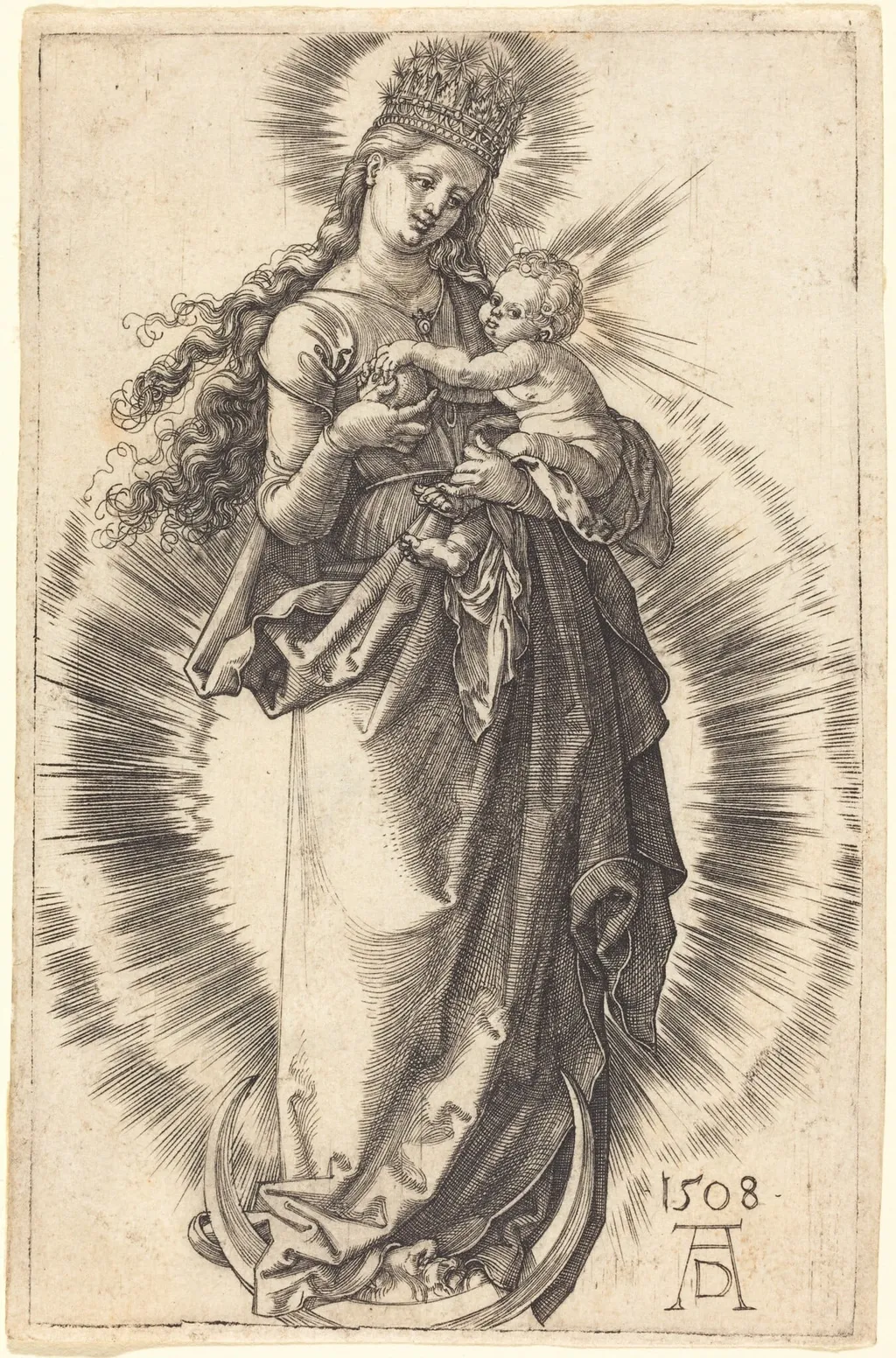
The Virgin and Child on a Crescent with a Starry Crown is an ink print by the Northern Renaissance artist Albrecht Dürer. It dates from 1508 and is held in the collection of the Cooper Hewitt, Smithsonian Design Museum.
About this work
Overview
She wears a crown of twelve stars, and her mantle flows dynamically around her figure, contrasting with the intricate, swirling clouds that fill the background.
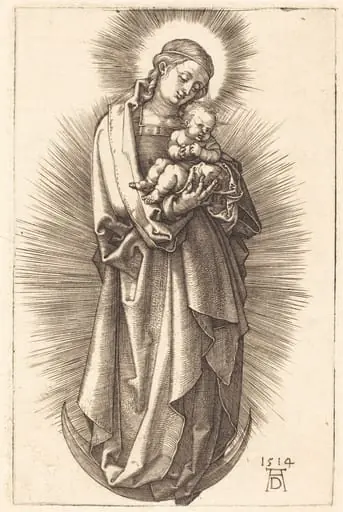
Albrecht Dürer's 'The Virgin and Child on a Crescent with a Starry Crown' is a 1508 engraving on laid paper that visualizes the Woman of the Apocalypse described in Revelation 12:1. The composition centers on the Virgin Mary standing upon a waxing crescent moon, her feet resting on the lunar curve while she supports the Christ Child. She wears a crown of twelve stars, and her mantle flows dynamically around her figure, contrasting with the intricate, swirling clouds that fill the background. Dürer employs his signature mastery of line to render complex textures, from the soft drapery of the garments to the metallic sheen of the crown and the atmospheric depth of the sky. Created during the height of the German Renaissance, this work exemplifies Dürer's ability to synthesize Northern European attention to detail with Italianate principles of proportion and composition. The piece reflects the artist's deep engagement with Catholic iconography and his technical innovation in printmaking, establishing a definitive image of the Immaculate Conception that influenced subsequent religious art. It stands as a mature example of Dürer's graphic output from his second Italian period, demonstrating his capacity to convey theological concepts with both spiritual gravity and precise naturalism.
Subject & Meaning
The composition draws on traditional iconography of the Virgin enthroned on a moon, a motif linked to the Woman of the Apocalypse and the celestial symbolism of purity. The star‑crowned halo surrounding the figures reinforces their heavenly status, while the intimate portrayal of mother and child underscores the theological emphasis on the Incarnation and the protective role of Mary.
Technique & Style
Dürer employed fine engraving lines to render intricate textures, from the delicate folds of Mary’s drapery to the subtle shading of the moon’s surface. The use of cross‑hatching creates a nuanced tonal range, demonstrating the artist’s early mastery of line work and his ability to convey depth within the constraints of a monochrome medium.
History & Provenance
Created during the early phase of Dürer’s career, the print reflects his rapid development after his first trips to Italy. While specific ownership records are scarce, the engraving was circulated among collectors of religious prints in the Holy Roman Empire and later entered museum collections as an example of Dürer’s formative printmaking practice.
Artist & collection
Artist
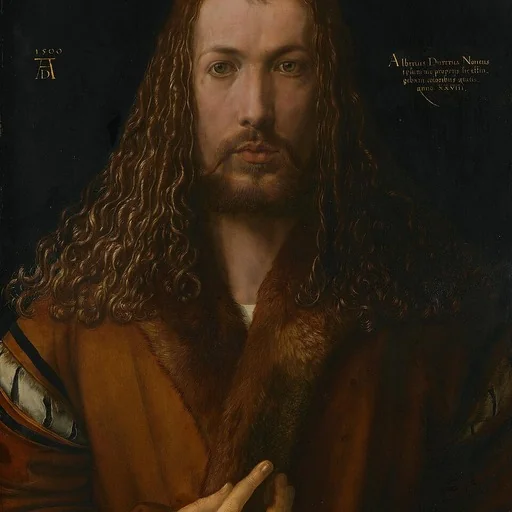
Albrecht Dürer spent his life in Nuremberg, a busy German city where artists traded prints like currency.

Museum
Cooper Hewitt, Smithsonian Design Museum
Continue through works from the same source collection.
![Madonna and Child [obverse], by Albrecht Dürer](https://artifactworldgallery.com/img/albrecht-durer--madonna-and-child-obverse--d7b8ebf05d22ebe5-w320.webp)
![Lot and His Daughters [reverse], by Albrecht Dürer](https://artifactworldgallery.com/img/albrecht-durer--lot-and-his-daughters-reverse--b4ebf9b282faa17a-w320.webp)

 The Virgin and Child on a Crescent with a Diadem
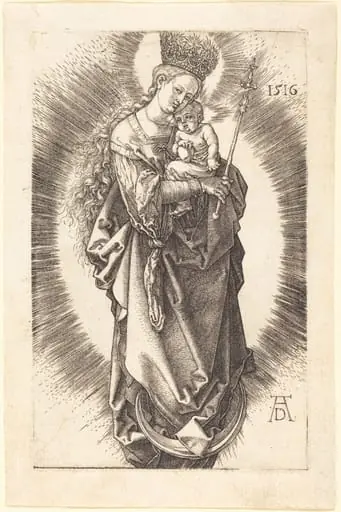 The Virgin and Child on a Crescent with a Sceptre and a Starry Crown
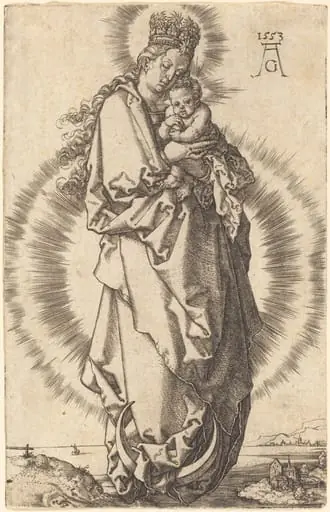 The Virgin with the Child on the Crescent
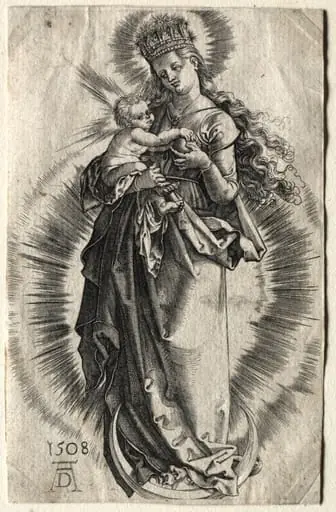 Virgin on a Crescent with a Starry Crown
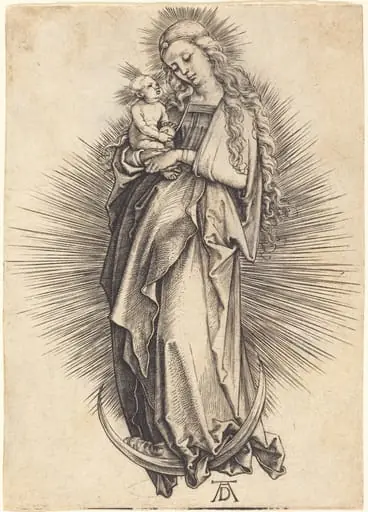 The Virgin on the Crescent
 The Virgin on the Crescent
 The Virgin and Child on the Crescent
 The Virgin and Child on the Crescent
 The Virgin and Child on the Crescent
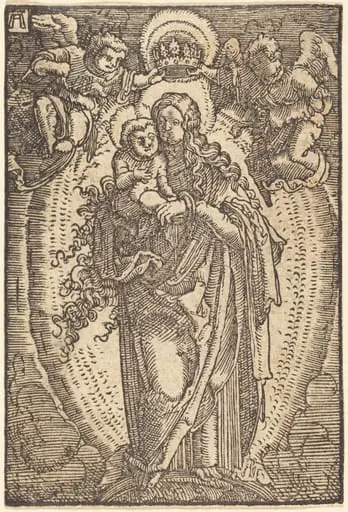 The Virgin and Child on a Crescent
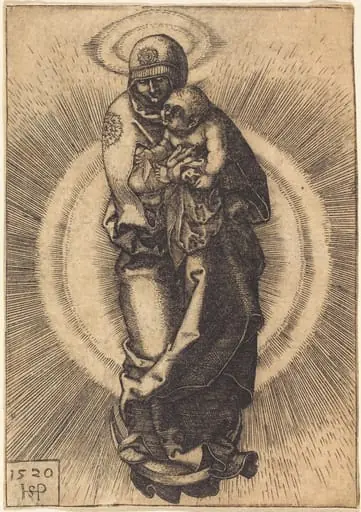 The Virgin and Child on the Crescent
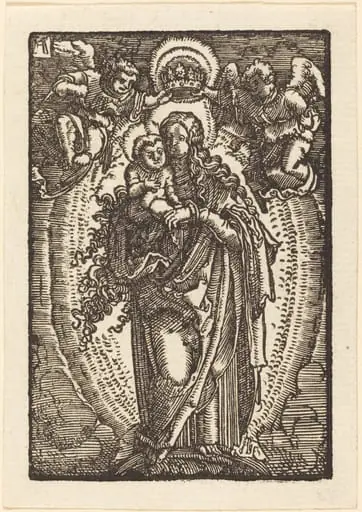 The Virgin and Child on a Crescent