Artwork
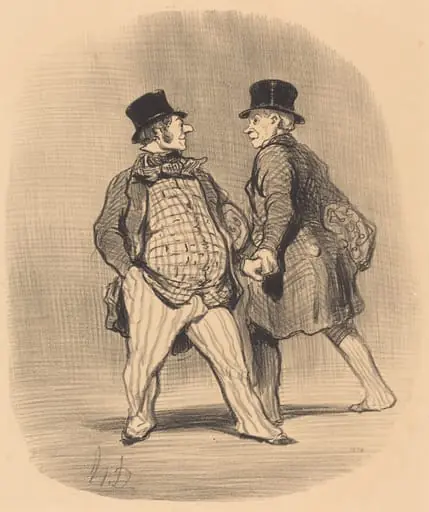
Mais quand je vous dis que je ne peux pas remuer les pieds...
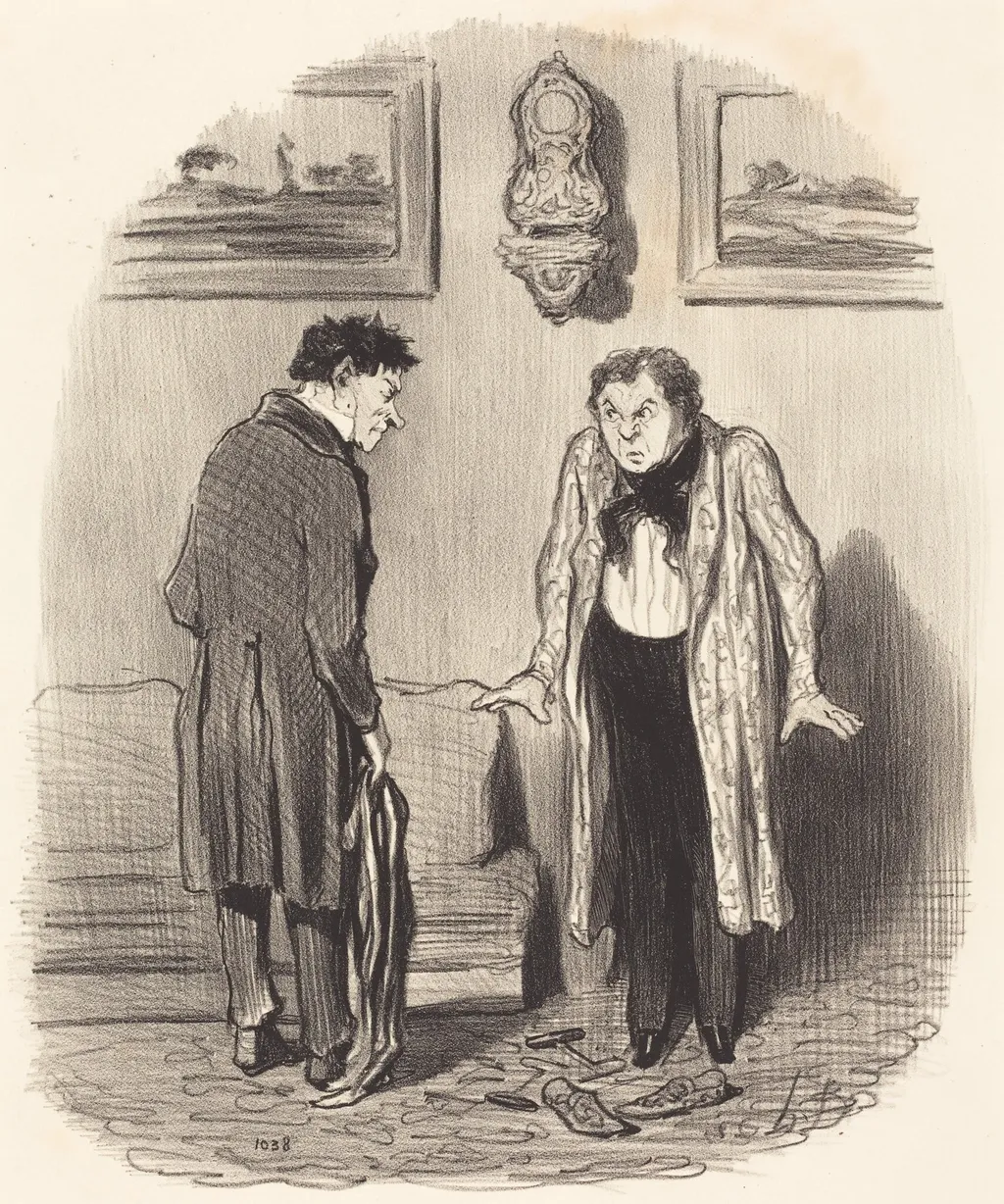
Mais quand je vous dis que je ne peux pas remuer les pieds... is an ink print by the Romanticist artist Honoré Daumier. It dates from 1847 and is held in the collection of the National Gallery of Art.
About this work
Overview
Produced during his tenure with satirical journals like *Le Charivari*, the work exemplifies his use of printmaking to convey social critique.
Created in 1847, this lithograph by Honoré Daumier captures a moment of domestic tension with sharp observational wit. Produced during his tenure with satirical journals like *Le Charivari*, the work exemplifies his use of printmaking to convey social critique. Unlike overt political cartoons, this piece focuses on human frailty and miscommunication, rendered through the accessible medium of lithography, which allowed for wide circulation among the urban middle class.
Subject & Meaning
Two men are locked in a futile exchange: one, agitated and gesticulating, insists he cannot move his feet; the other, weary and passive, listens with resignation. The scene evokes the absurdity of stubborn argument, possibly reflecting broader societal frustrations under the July Monarchy. Daumier avoids direct political symbols, instead using intimate human behavior to suggest the futility of rigid positions—whether personal or political—amidst a culture of growing discontent.
Technique & Style
Daumier employed rapid, expressive linework typical of his lithographic process, exploiting the medium’s capacity for tonal variation and spontaneity. Shading is minimal yet effective, with loose strokes defining posture and emotion rather than detail. The figures’ exaggerated gestures and facial expressions are rendered with economy, emphasizing psychological tension over realism. The sparse interior—shelves with a vase and framed images—grounds the scene without distraction, focusing attention on the interaction.
History & Provenance
The print was published in *Le Charivari*, a leading satirical weekly where Daumier contributed hundreds of lithographs between 1832 and 1860. Though not signed or dated on the plate, its style and thematic concerns align with his mid-1840s output. It likely circulated among Parisian readers familiar with the journal’s critiques of bourgeois pretension and political ineptitude. No specific early ownership records are documented, but it entered public collections in the late 19th or early 20th century as interest in Daumier’s graphic work grew.
Context
In 1847, France was nearing revolution, with public frustration mounting over Louis-Philippe’s regime and economic hardship. While Daumier had been imprisoned for earlier political caricatures, this work avoids direct allegory, instead capturing the quiet absurdities of everyday life. His shift toward domestic scenes reflected both censorship pressures and a deeper interest in universal human behavior, making his social commentary more subtle yet enduring.
Legacy
Daumier’s lithographs, including this one, influenced later generations of illustrators and cartoonists by demonstrating how minimal lines could convey complex emotion and social insight. His ability to transform mundane moments into resonant critiques established a model for narrative realism in print. Though less celebrated than his political works, pieces like this reveal his enduring focus on the dignity and folly of ordinary people.
Artist & collection

Artist
Honoré-Victorin Daumier was a French painter, sculptor, and printmaker, whose many works offer commentary on the social and political life in France, from the Revolution of 1830 to the fall of the Second French Empire in 1870.









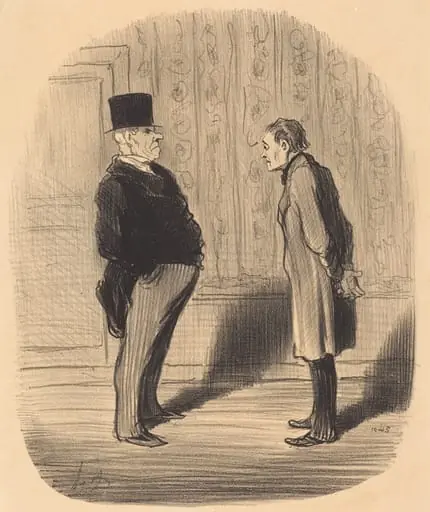 Eh! bien monsieur et mes trois termes...
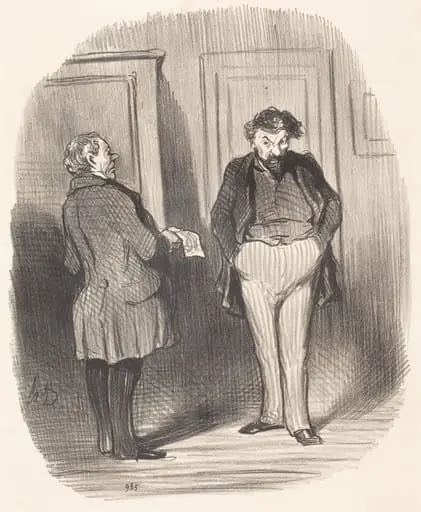 Pourriez-vous me dire...? J'ai la grippe!...
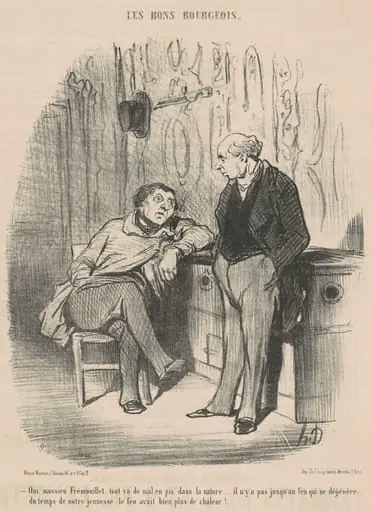 Oui, Mossieu Fremouillet, tout va de mal en pis ...
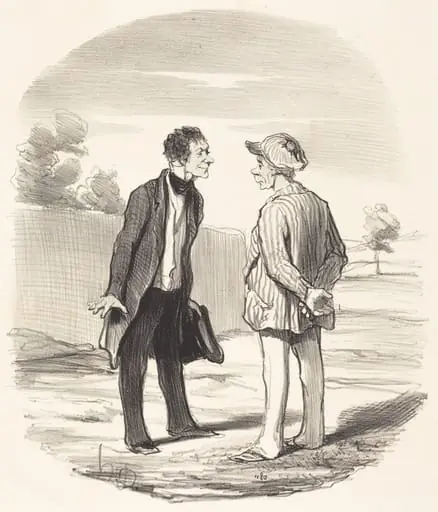 Oui, monsieur Gimblet, l'ordre ne sera... rétabli...
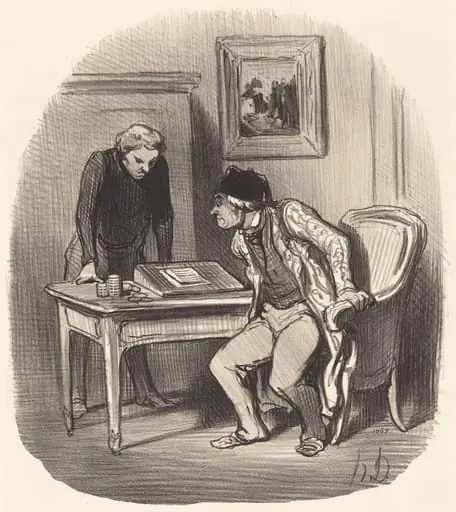 Le Compte est-il bien exact?...
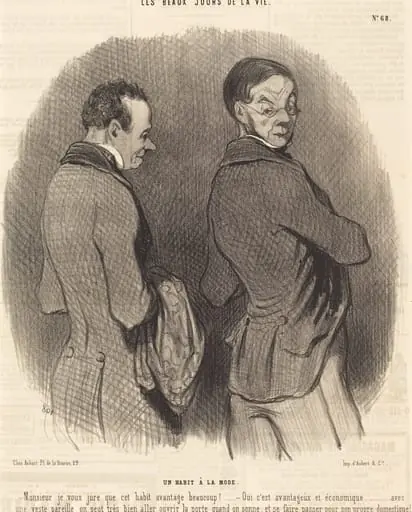 Un Habit a la mode
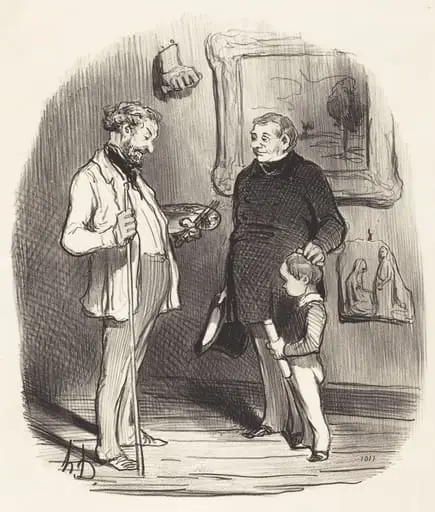 V'la mon petit... s'il n'a pas assez de moyens...
 Confrère, méfiez-vous du petit baron...
 Tiens... je ne te reconnaissais pas...