Artwork
Cina cea de taină
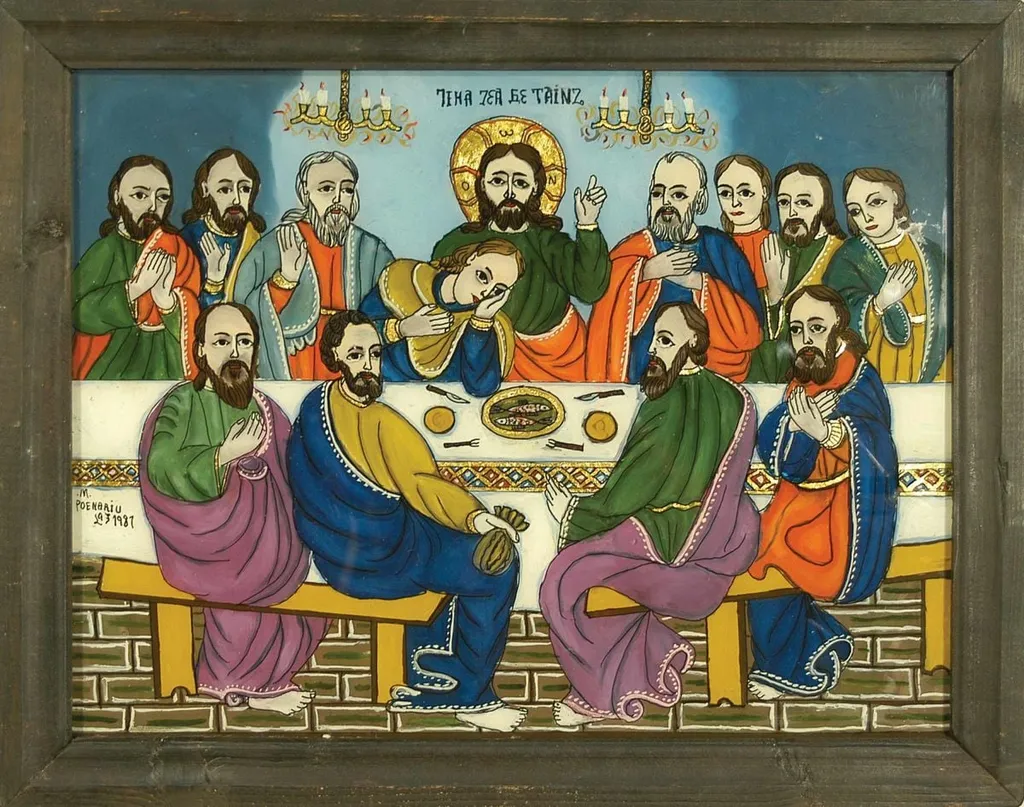
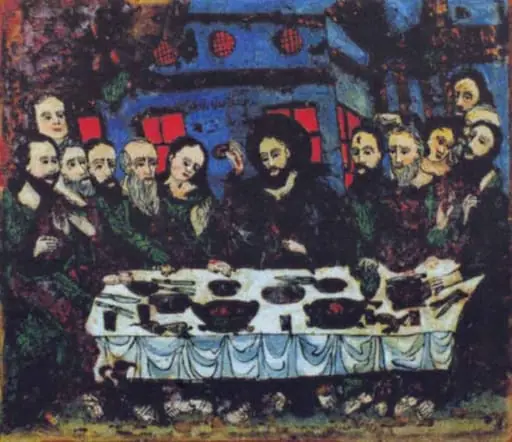
Cina cea de taină is an unspecified painting by Maria Deac Poenariu. It dates from 1987 and is held in the collection of the Alba Iulia Unification National Museum.
About this work
Overview
The use of vivid, unmodulated color and simplified forms reflects a deliberate stylistic choice rooted in folk traditions rather than academic realism.
Created in 1987 by Maria Deac Poenariu, this painting depicts a communal meal with thirteen figures. It is part of the permanent collection at the Museum of Ethnography. The composition draws visual parallels to religious iconography while portraying a secular gathering. The use of vivid, unmodulated color and simplified forms reflects a deliberate stylistic choice rooted in folk traditions rather than academic realism.
Subject & Meaning
The scene presents thirteen men gathered around a table, with one central figure holding bread and appearing to speak. His halo-like glow and the elevated position suggest symbolic importance, though the setting lacks overt religious markers. The gestures of folded or raised hands imply ritual or shared reverence. The work may evoke themes of community, leadership, or collective memory, blending everyday life with subtle spiritual undertones.
Technique & Style
The painting employs flat, saturated hues—greens, blues, reds, and purples—with no shading or perspective to model form. Background elements like golden chandeliers and a radiant halo are rendered as decorative motifs rather than naturalistic details. Facial expressions are minimal yet distinct, emphasizing emotion through posture and gesture. The style aligns with folk or naive painting traditions, prioritizing symbolic clarity over anatomical accuracy.
History & Provenance
Painted in 1987, the work entered the collection of the Museum of Ethnography shortly after its creation. It was not exhibited widely outside institutional contexts, and little public documentation exists regarding its commission or initial reception. Its preservation within the museum underscores its value as a cultural artifact reflecting late 20th-century Romanian artistic expression rooted in local visual customs.
Context
Produced during the final years of communist Romania, the painting avoids overt political messaging, instead drawing on domestic and ritual imagery familiar to rural communities. The emphasis on communal dining and symbolic lighting may reflect enduring cultural values amid state-enforced secularism. Its folk-inspired aesthetic contrasts with official art trends, suggesting a quiet assertion of regional identity through traditional visual language.
Legacy
The painting remains a singular example within the museum’s collection of works by female artists from the period. It contributes to broader scholarly interest in non-conformist Romanian art that drew from vernacular traditions. While not widely reproduced, its presence in a major ethnographic institution ensures its role as a reference point for studies on identity, ritual, and visual culture in late socialist Romania.
Artist & collection
Artist
Romanian sacred-art drawings and paintings, 1970s–1990s, show biblical figures and local saints in clear line and flat color.
Museum
Alba Iulia Unification National Museum
Continue through works from the same source collection.
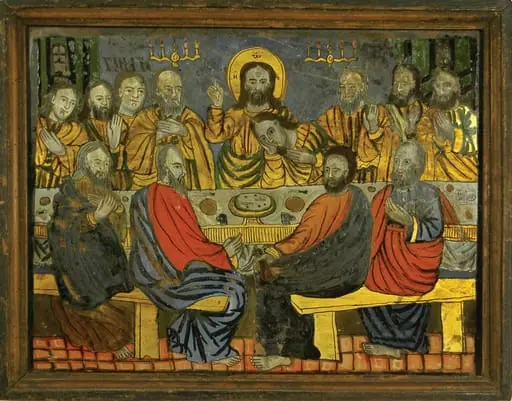 Cina cea de taină
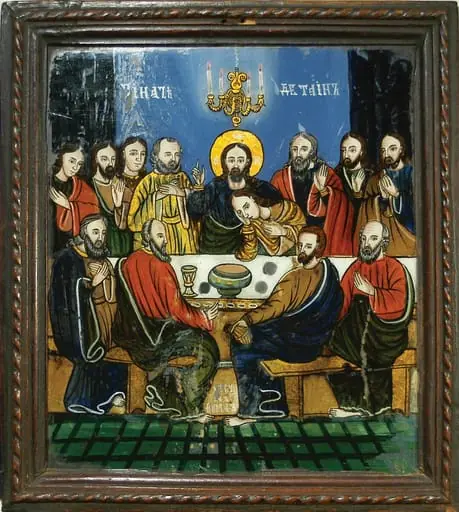 Cina cea de taină
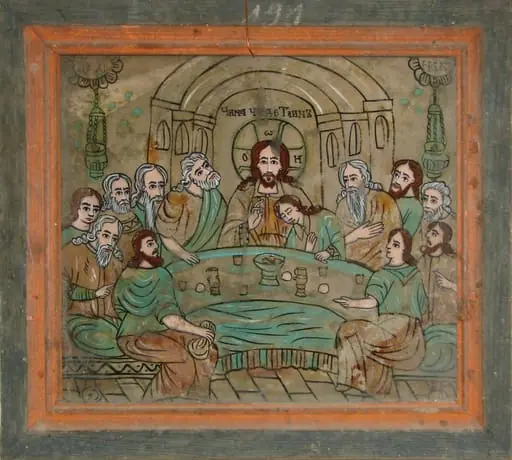 Cina cea de taină
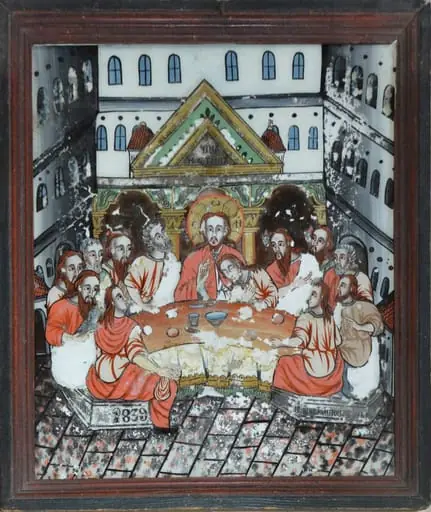 Cina cea de taină
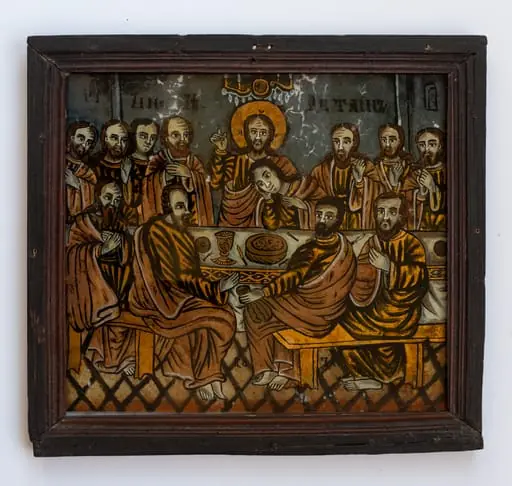 Cina cea de Taină
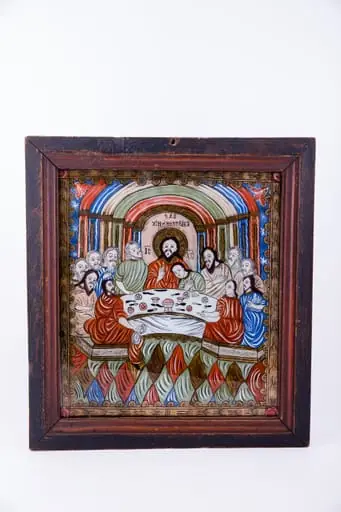 Scena Cinei celei de Taină se desfășoară într-un interior sugerat de elemente arhitectonice, coloane și șase arcade alternativ-cromatic pictate. În centrul icoanei este Mântuitorul Iisus Hristos binecuvântând mâncarea, la masă, alături de ucenici și apostoli. Cu brațul stâng îl ține lipit de piept pe Ioan cel iubit, Sfântul Apostol și Evanghelist Ioan, Teologul. Pe masă sunt așezate un potir pentru vin și tacâmuri și farfurioare mici și pâinici rotunde. Personajele au chipurile expresive, veșmintele personajelor și faldurile feței de masă, cât și draperiile sunt pictate cu măiestrie de pictor. Veșmintele sunt roșii, albastre, vernil și bej, cu liniuțe albe discrete. Cromatica este armonioasă și echilibrată, pornindu-se gradual dinspre exterior înspre interior, de la albastru spre roșu, ajungându-se la albul luminos al mesei celor dăruite. Compoziția este încadrată elemente de arhitectură, draperii, coloane, creându-se, astfel, intimitatea Cinei celei de Taină. Totul este concentric, strângându-se în jurul Potirului. De remarcat este alternanța romboidală din registrul inferior, policromatică. În registrul superior, sunt coloanele și arcadele policrome. Iuda Iscarioteanul este în partea stângă a mesei și se remarcă în mâna lui punga cu cei 30 de arginți, simbolul trădării și vicleniei. Pictura este specifică Țării Făgărașului și datorită compoziției echilibrate, simetrice și circulare. Icoana este pictată de Savu Moga, din Arpașu de Sus, Țara Făgărașului. Inscripția în chirilică se traduce ICXC Iisus Hristos Cina cea de Taină. Cromatica armonioasă este o caracteristică a icoanelor lui Savu Moga: roșu, albastru, vernil, gri, brun, alb, negru. Întreaga narațiune iconografică este încadrată într-un chenar geometrizant, ca de carte veche, asemenea unei dantelării cu colțișori.
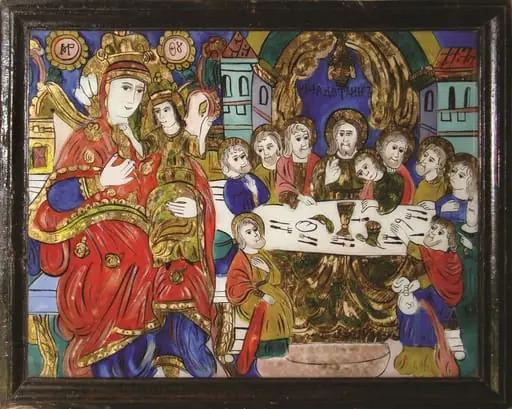 Maica Domnului cu Pruncul și Cina cea de taină
 Cina cea de Taină