Artwork
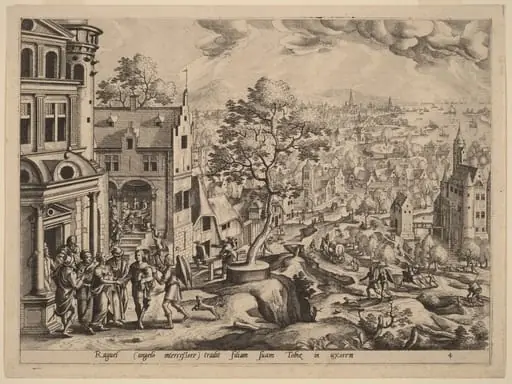
The Departure of the Angel
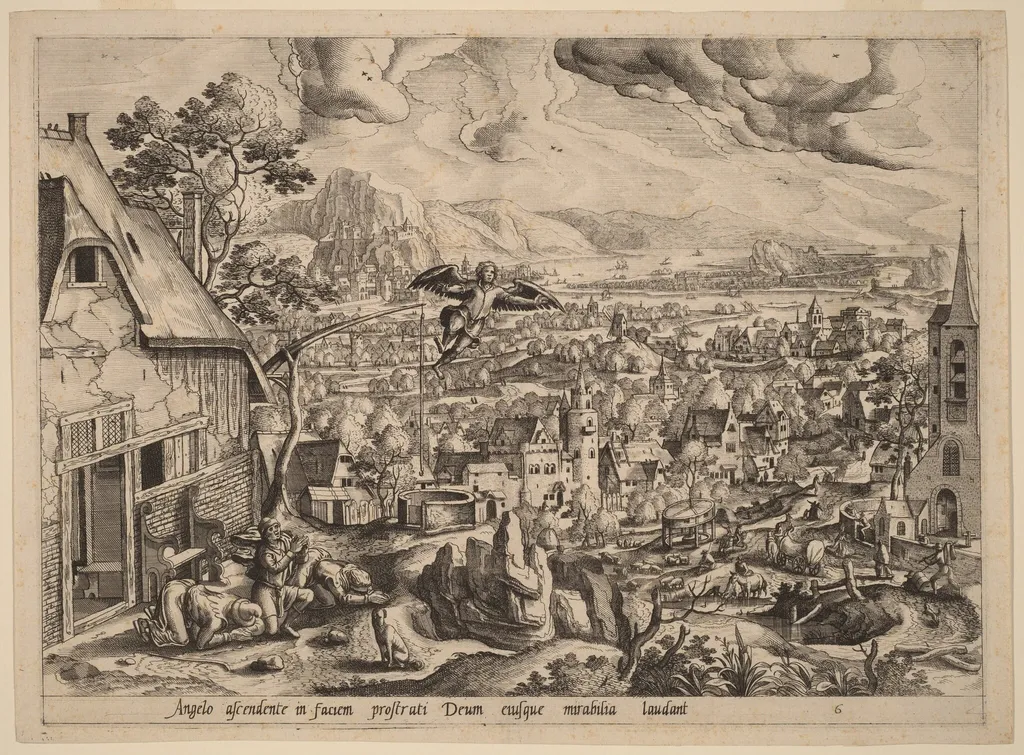
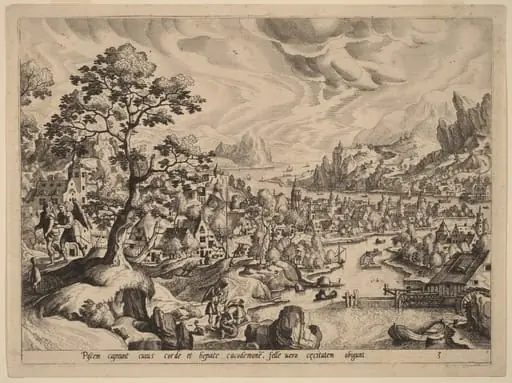
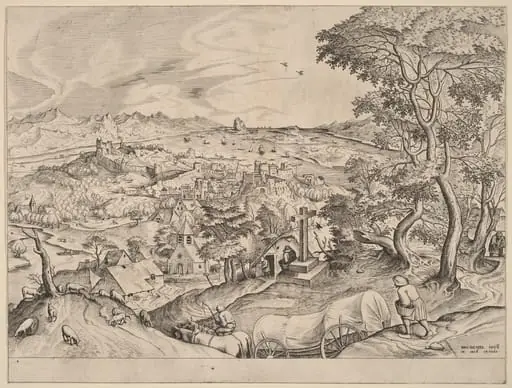
The Departure of the Angel is an ink print by the Renaissance artist Johannes van Doetechum the Elder. It dates from 1565 and is held in the collection of the National Gallery of Art.
About this work
Overview
The work is attributed to Johannes van Doetecum the Elder, a Dutch printmaker known for reproducing the compositions of his contemporaries.
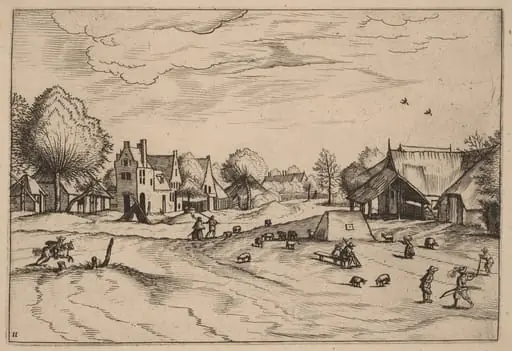
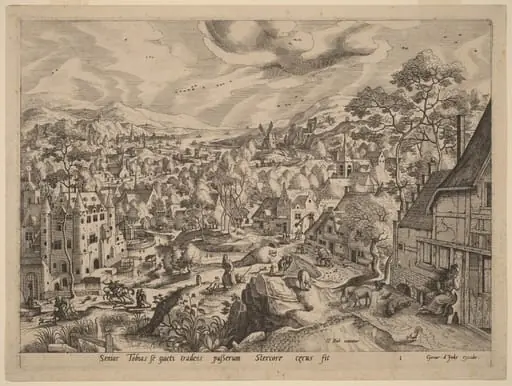
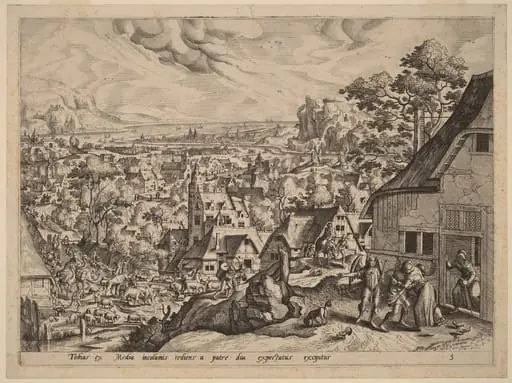
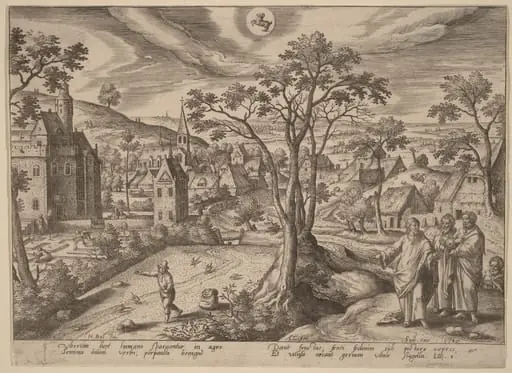
Created circa 1565, *The Departure of the Angel* is an early modern print executed in both etching and engraving on laid paper. The work is attributed to Johannes van Doetecum the Elder, a Dutch printmaker known for reproducing the compositions of his contemporaries. The image presents a bustling landscape that combines a town, a church, a river and a group of figures gathered around a fire, rendered with the fine linear precision typical of mid‑sixteenth‑century Dutch engraving.
Subject & Meaning
The composition portrays a narrative scene, likely derived from a design by Pieter Bruegel the Elder, in which a group of villagers and animals are observed as an angel departs. The inclusion of everyday activity—horsemen, a fire, and a populated foreground—suggests an allegorical reading, inviting contemplation of moral or spiritual transition within a familiar rural setting.
Technique & Style
Doetecum employed a combination of acid‑etched lines and hand‑cut engraving to achieve a rich variety of textures and tonal gradations. The etched areas provide delicate shading, while the engraved lines define architectural forms and figures with crisp clarity. This dual approach creates a sense of depth, allowing the distant town and river to recede behind a densely populated foreground.
History & Provenance
Johannes van Doetecum the Elder worked chiefly in Deventer before moving to Haarlem in 1578, and his prints often served as reproductions of popular genre scenes. *The Departure of the Angel* fits within this reproductive practice, disseminating Bruegel‑inspired imagery to a broader audience. Surviving copies are held in several European print collections, attesting to the work’s circulation in the late Renaissance market.
Context
In the mid‑1500s, Dutch printmakers frequently created engraved copies of paintings to meet the demand for affordable visual culture. Doetecum’s print reflects this commercial environment, as well as the technical advancements that allowed for increasingly intricate line work and tonal effects, positioning the piece within the flourishing print industry of the Low Countries.
Artist & collection

Artist
Johannes van Doetechum the Elder
Joannes van Doetecum the Elder (1530 – 1605) was a Dutch engraver-cartographer known for his etched works after genre scenes by Pieter Bruegel the Elder and maps of various cities in the Netherlands.