Artwork
The Crowned Virgin in a Niche
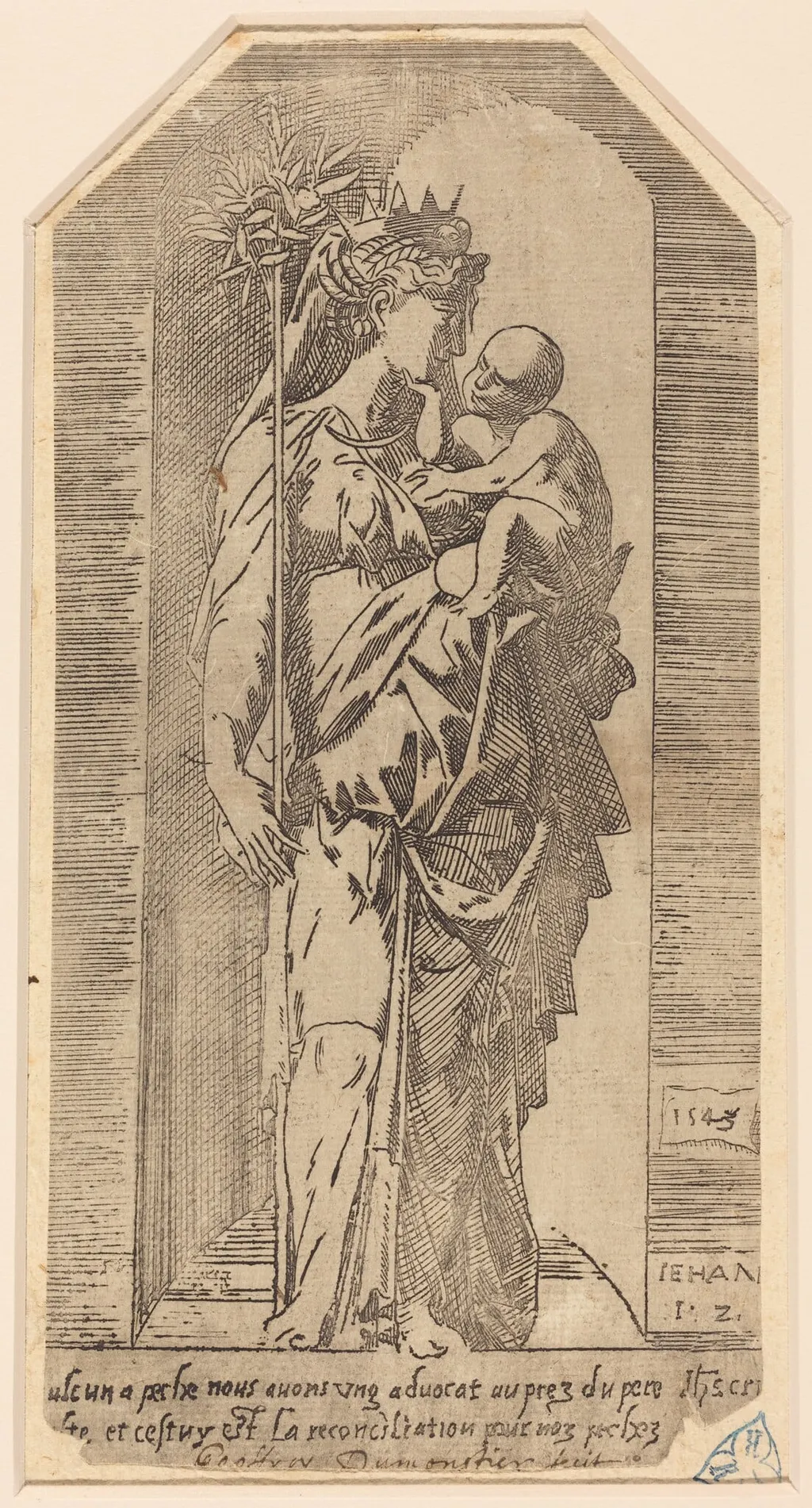
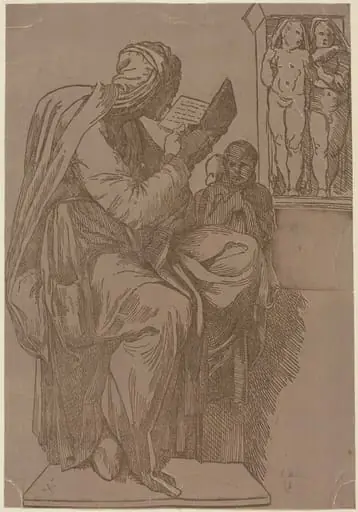
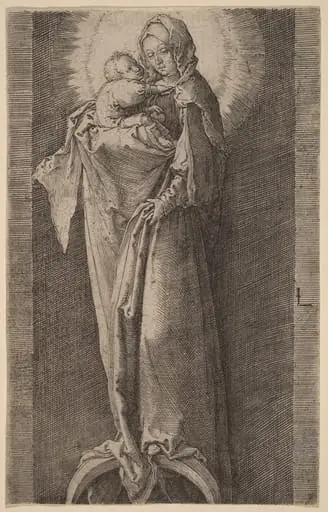
The Crowned Virgin in a Niche is an ink print by the Renaissance artist Geoffroy Dumonstier. It dates from 1543 and is held in the collection of the National Gallery of Art.
About this work
The artist used fine lines to create texture—notice how the folds in her dress look almost three-dimensional.
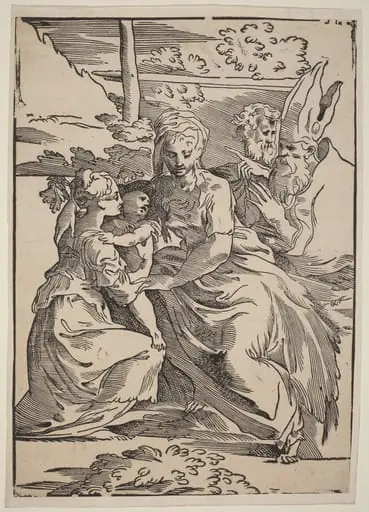
This drawing shows a woman holding a baby, both crowned with thorny halos. She stands in a shallow niche, draped in heavy, flowing robes that look like carved stone. The background is plain except for a few steps behind her.
The artist used fine lines to create texture—notice how the folds in her dress look almost three-dimensional. The date "1543" is scribbled in the corner, matching the year this was made.
Try looking up etching to see how artists use acid and metal plates to make these precise, detailed lines.
Overview
Geoffroy Dumonstier’s etching, dated 1543, presents a devotional scene in which a female figure cradles an infant. Both figures are encircled by thorny crowns, and they occupy a shallow architectural niche that frames the composition. The work is executed on laid paper, which has been mounted on a second sheet for support.
Subject & Meaning
The central figure is identified as the Virgin Mary, her crown of thorns alluding to the suffering associated with Christ’s passion, while the child she holds represents the infant Jesus. The simple backdrop and the presence of a few steps suggest a modest, contemplative space, emphasizing the spiritual bond between mother and son.
Technique & Style
Created through the etching process, Dumonstier incised fine lines into a metal plate, allowing acid to bite the design and produce delicate, precise strokes. The rendering of the drapery demonstrates a keen attention to texture, giving the heavy robes a sculptural quality that appears almost three‑dimensional against the flat paper surface.
History & Provenance
The print bears the artist’s signature and the year 1543 in the lower margin, confirming its early‑mid‑16th‑century origin. It remains an example of Dumonstier’s work in religious printmaking, a medium that circulated devotional images beyond the confines of painted altarpieces.
Artist & collection