Artwork
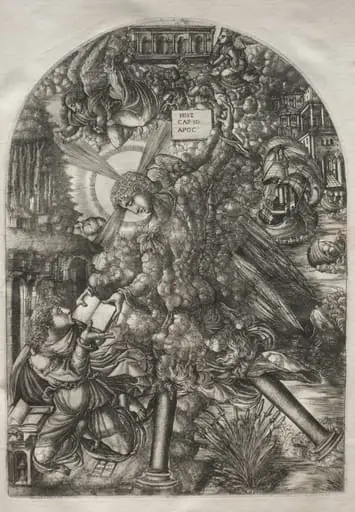
The Angel Gives Saint John the Book to Eat
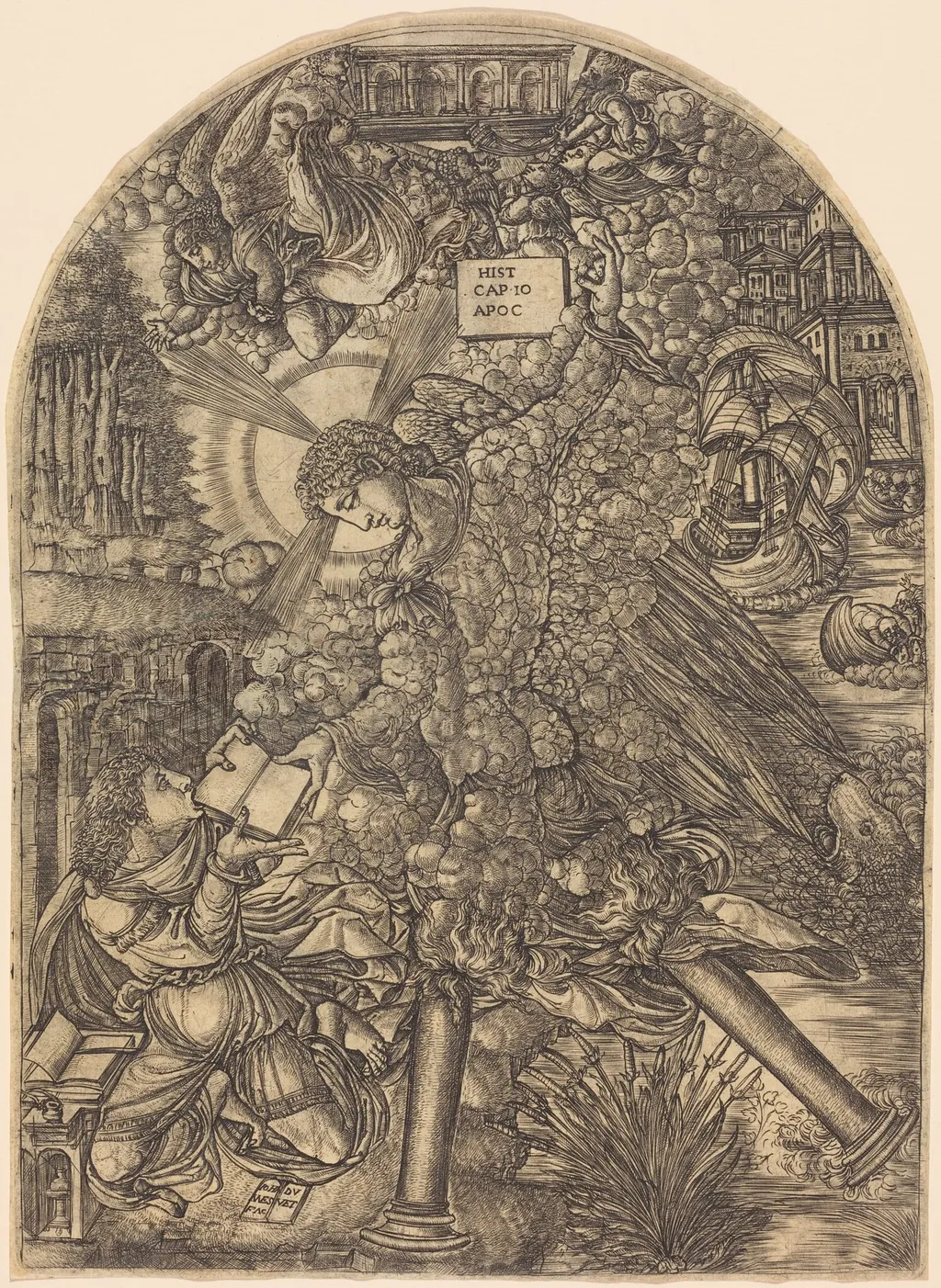
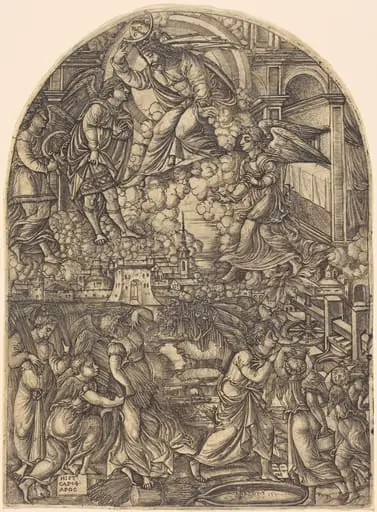
The Angel Gives Saint John the Book to Eat is an ink print by the Renaissance artist Jean Duvet. It dates from 1554 and is held in the collection of the National Gallery of Art.
About this work
Overview
Created in 1554, this engraving by Jean Duvet is one of approximately seventy-three known plates by the French artist, who worked primarily as a goldsmith.
Created in 1554, this engraving by Jean Duvet is one of approximately seventy-three known plates by the French artist, who worked primarily as a goldsmith. Executed on laid paper, the print belongs to a small but influential body of Renaissance printmaking from France. Duvet’s work stands apart for its dense, visionary compositions and its departure from the classical restraint typical of the era.
Subject & Meaning
The scene illustrates Revelation 10:9–10, in which an angel commands the apostle John to consume a scroll, symbolizing the internalization of divine prophecy. A winged figure offers the book to a robed man with curly hair, while airborne figures gesture and hold scrolls. Below, a stylized city and a lone tree anchor the celestial event in a terrestrial space, reinforcing the merging of heavenly vision and earthly reality.
Technique & Style
Duvet employed fine, swirling lines to build complex forms without clear perspective or proportional harmony. The engraving’s energy comes from its unregulated rhythm and overlapping figures, creating a sense of motion and spiritual urgency. Unlike contemporaries who favored clarity, Duvet embraced a raw, almost improvisational mark-making that feels immediate and personal.
History & Provenance
Duvet was active in France from at least 1485 until after 1562, and this print is among his later works. Few of his plates were widely circulated in his lifetime, and most surviving impressions were collected privately. The inscription 'HIST CAP:10 APOC' confirms its biblical source, aligning it with devotional and apocalyptic imagery popular in post-Reformation Europe.
Context
While Italian and Northern Renaissance printmakers pursued idealized forms and linear precision, Duvet’s work emerged from a more localized, artisanal tradition. His background in goldsmithing informed his meticulous line work, yet his compositions rejected academic norms, reflecting a mystical, introspective piety that resonated more with later visionary artists than with his own time.
Legacy
Though largely overlooked during his lifetime, Duvet’s prints gained renewed attention in the 19th century for their emotional intensity and unconventional structure. His use of chaotic composition and symbolic density anticipated the Romantic and Symbolist movements, drawing comparisons to William Blake. Today, his work is studied as a unique voice in early French printmaking.
Artist & collection

Artist
Jean Duvet (1485 – after 1562) was a French Renaissance goldsmith and engraver, now best known for his engravings.

 The Apocalypse: The Angel Gives St. John the Book to Eat
 The Apocalpse: St. John Summoned to Heaven
 The Opening of the Seventh Seal
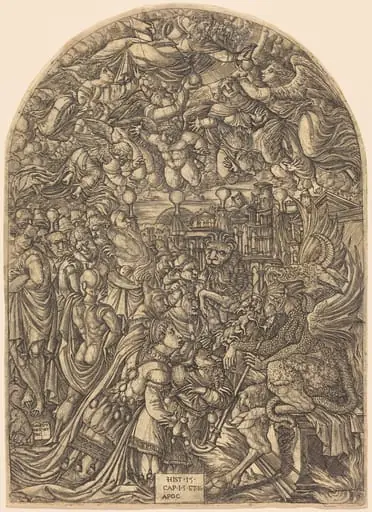 The Dragon and the Beast
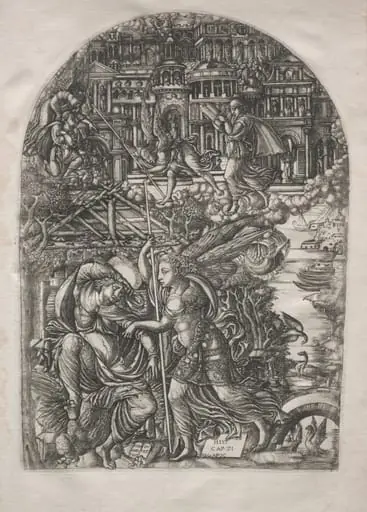 The Apocalypse: The Angel Shows St. John the New Jerusalem
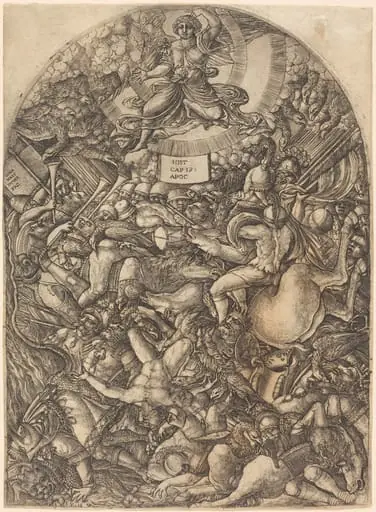 The Angel in the Sun Calling the Birds of Prey
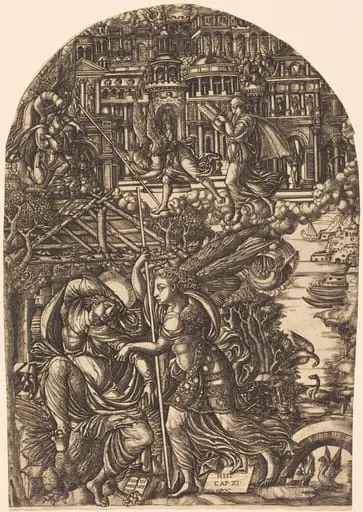 The Angel Shows Saint John the New Jerusalem