Artwork
A Corner of a Meadow with Fountaingrass
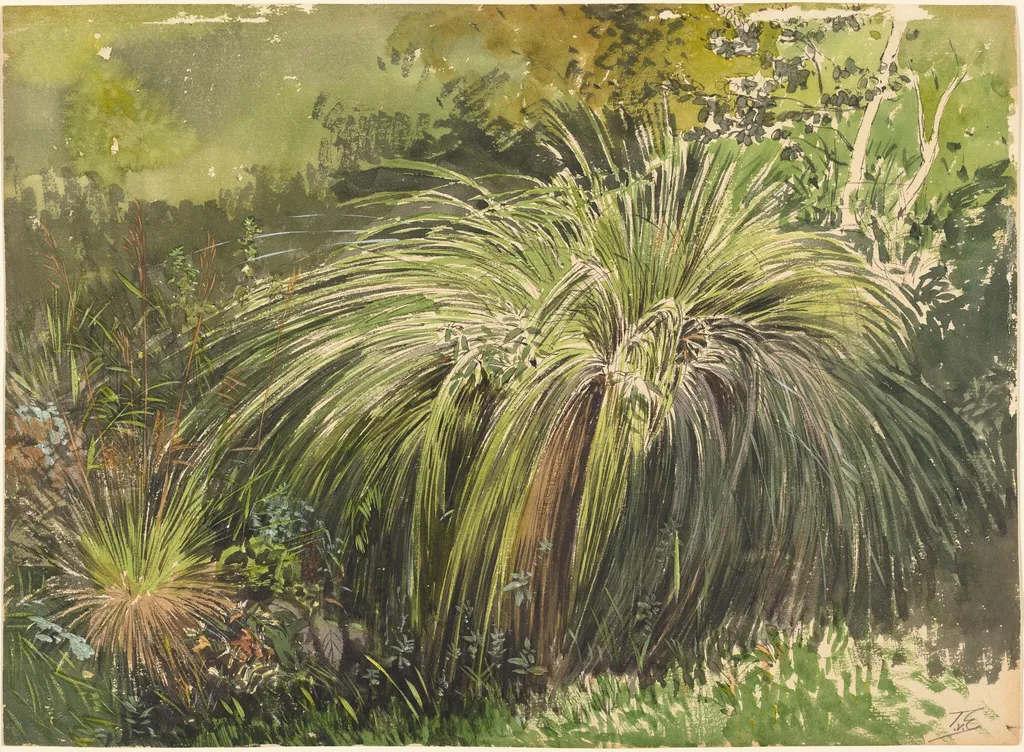
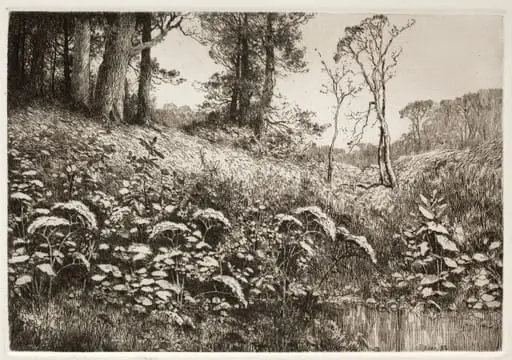
A Corner of a Meadow with Fountaingrass is an ink drawing by the Impressionist artist Themistocles von Eckenbrecher. It dates from 1870 and is held in the collection of the National Gallery of Art.
About this work
Overview
Created around 1870 by German artist Karl Paul Themistokles von Eckenbrecher, this drawing combines pen and black ink with watercolor and gouache on laid paper.
Created around 1870 by German artist Karl Paul Themistokles von Eckenbrecher, this drawing combines pen and black ink with watercolor and gouache on laid paper. It depicts a quiet, intimate section of a meadow dominated by fountaingrass, reflecting the artist’s sustained interest in natural landscapes. The medium allows for both precise linework and soft, layered color, characteristic of late Romantic landscape studies.
Subject & Meaning
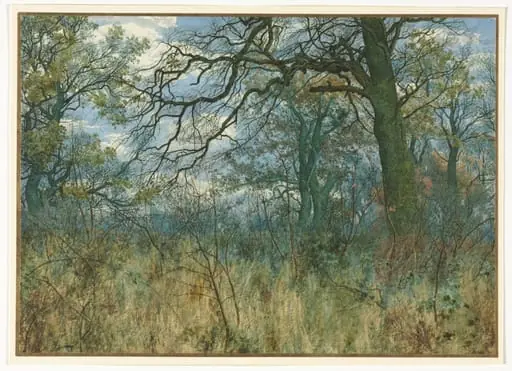
The scene focuses on a dense cluster of tall, swaying grasses, rendered with an emphasis on their organic movement and texture. No figures or human elements appear, reinforcing a contemplative, observational approach to nature. The composition invites quiet attention to the subtle rhythms of the wild meadow, suggesting a reverence for unaltered natural forms rather than idealized or dramatic scenery.
Technique & Style
Eckenbrecher employed loose, fluid brushstrokes to suggest wind moving through the grass, while pen lines define individual stems with delicate precision. Watercolor and gouache were layered to build depth in the foliage, with translucent washes creating the illusion of dappled light. The textured laid paper enhances the tactile quality of the grasses, and soft blurring in the background implies atmospheric distance.
History & Provenance
The work dates from the height of Eckenbrecher’s career, when he was producing numerous landscape and marine studies, often based on direct observation. While specific ownership history is not documented here, such drawings were typically kept as personal studies or preparatory works, circulated among collectors who valued detailed naturalism over finished oil paintings.
Context
In the late 19th century, German artists increasingly turned to intimate natural scenes as a counterpoint to grand historical or mythological subjects. Eckenbrecher’s focus on modest, unpopulated landscapes aligned with broader Romantic tendencies to find meaning in quiet, everyday nature, influenced by both scientific observation and emotional resonance with the environment.
Legacy
This drawing exemplifies a quiet but persistent tradition in 19th-century German art: the study of nature as an end in itself. Though Eckenbrecher is not widely known today, works like this contribute to a broader understanding of how artists engaged with the natural world through direct observation, laying groundwork for later movements that valued authenticity over idealization.
Artist & collection

Artist
Karl Paul Themistokles von Eckenbrecher (17 November 1842, Athens – 4 December 1921, Goslar) was a German landscape and marine painter, in the late Romantic style.

![Tropical Plant [recto], by Jane C. Stanley](https://artifactworldgallery.com/img/jane-c-stanley--tropical-plant-recto--1aa56502d3b9ab34-w320.webp)