Artwork
Views of Rome and Its Environs: Ancient Gate of Alatri
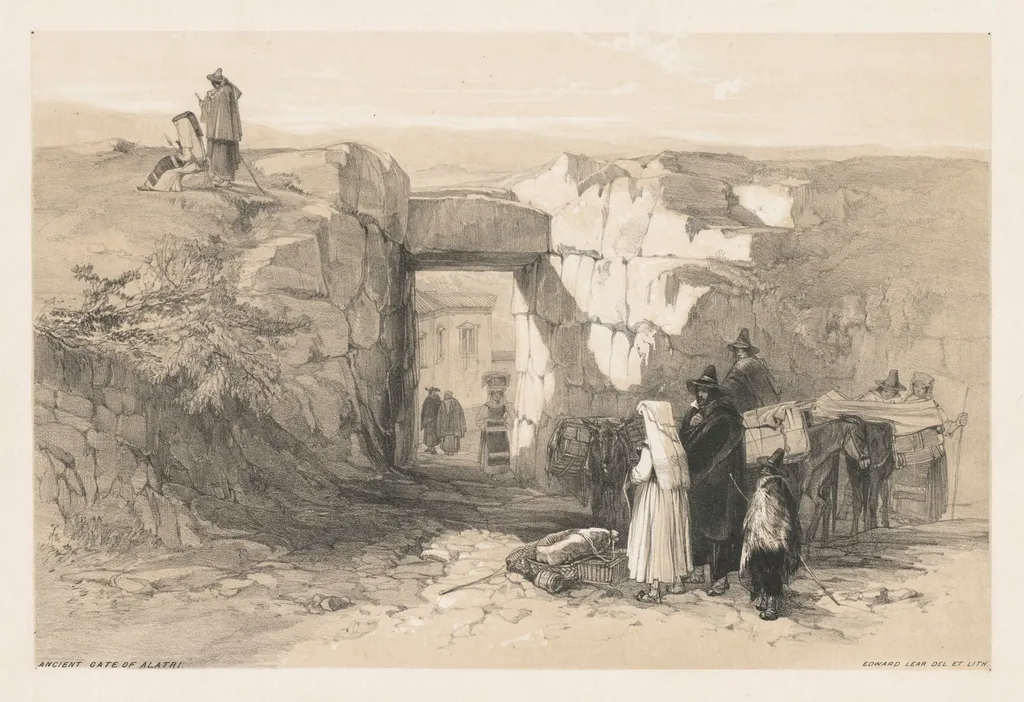
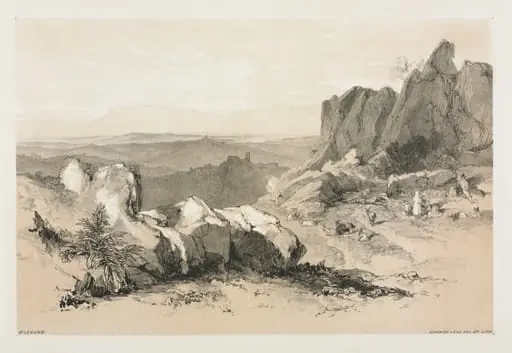
Views of Rome and Its Environs: Ancient Gate of Alatri is a print by the Romanticist artist Edward Lear. It dates from 1841 and is held in the collection of the Cleveland Museum of Art.
About this work
Overview
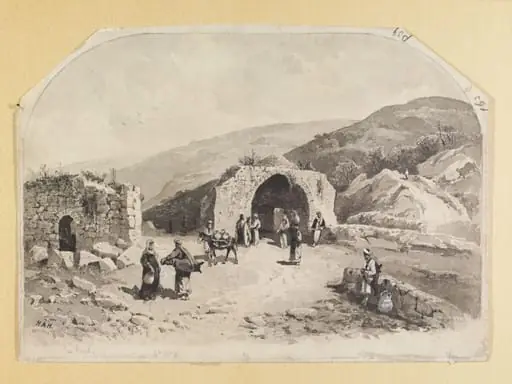
Rendered in pencil and ink, it captures a specific ruin in Alatri, a town southeast of Rome, emphasizing architectural decay and daily life around it.
Edward Lear produced this print in 1841 as part of a series documenting Italian landscapes during his travels. Unlike his later literary works, this piece reflects his early focus on topographical observation. Rendered in pencil and ink, it captures a specific ruin in Alatri, a town southeast of Rome, emphasizing architectural decay and daily life around it. The work was later included in his published travel volumes, serving both documentary and aesthetic purposes.
Subject & Meaning
The image depicts the ancient gate of Alatri, a modest but weathered stone structure, surrounded by quiet human activity. Figures—women, laborers, a dog, a donkey—move through the space without ceremony, suggesting routine rather than spectacle. The lone figure on the hill and the shadowed group within the arch convey solitude and time’s passage. The scene avoids grandeur, instead honoring the unremarkable persistence of life amid ruins.
Technique & Style
Lear employed fine, controlled lines to render the gate’s crumbling masonry and the textures of clothing and animal hides. Shading is minimal, relying on line weight and negative space to suggest depth and age. The composition is deliberately uncluttered, with figures placed to guide the eye through the ruin without dominating it. His draftsmanship prioritizes clarity and observation over dramatic effect, reflecting his training as a scientific illustrator.
History & Provenance
Created during Lear’s first extended journey through Italy, this print was later reproduced in his 1843 publication *Illustrated Excursions in Italy*. It entered The Cleveland Museum of Art’s collection through a 20th-century acquisition of his graphic works. The piece is one of many from his Italian travels that were preserved for their documentary value and refined draftsmanship, distinguishing them from his more whimsical literary illustrations.
Context
In the early 1840s, European artists and travelers increasingly documented classical ruins as cultural heritage. Lear’s work aligned with this trend but differed in its restraint—he avoided romanticizing decay, instead recording structures as they appeared in daily use. His approach reflected a growing interest in empirical observation over idealized classical imagery, influenced by emerging archaeological practices.
Legacy
Though Lear is better known for his nonsense verse, this print exemplifies his disciplined visual record-keeping. His Italian sketches contributed to a broader 19th-century archive of Mediterranean antiquities, valued by scholars and artists alike. The work remains a quiet testament to his ability to capture the dignity of ordinary moments within historical landscapes, influencing later topographical illustrators.
Own this work as a print
Artist & collection
Artist
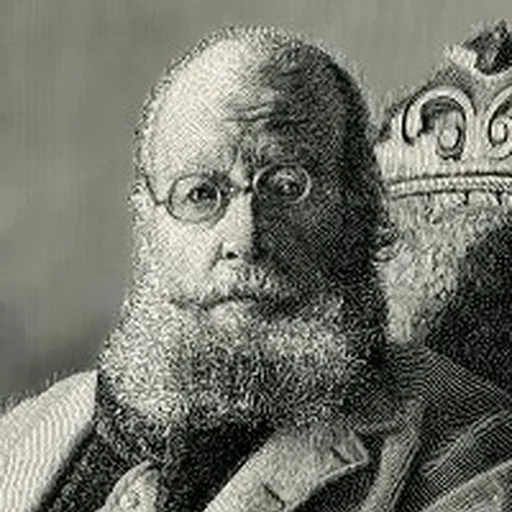
Edward Lear (12 May 1812 – 29 January 1888) was an English artist, illustrator, musician, author and poet, who is known mostly for his literary nonsense in poetry and prose and especially his limericks, a form he popularised but which term…