Artwork
Christ Praying on the Mount of Olives
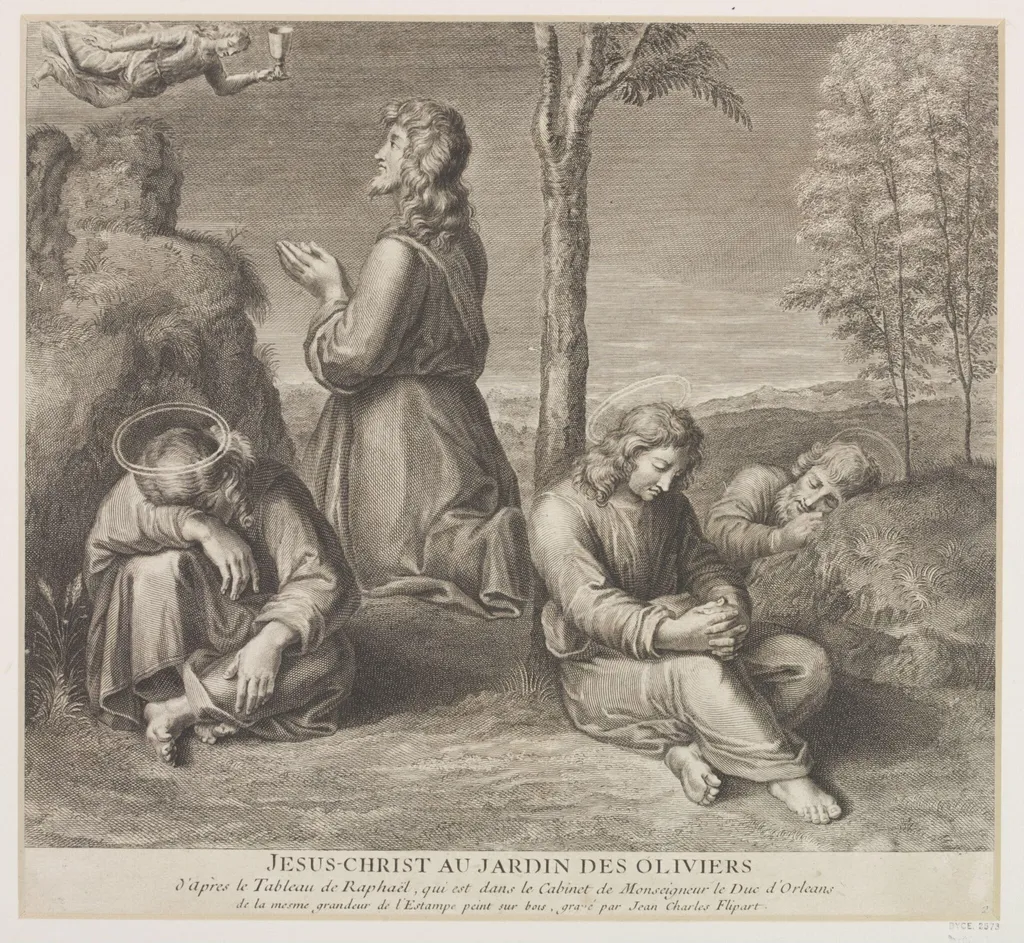
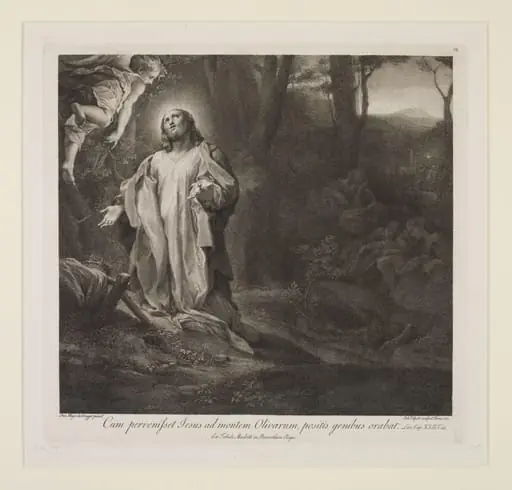
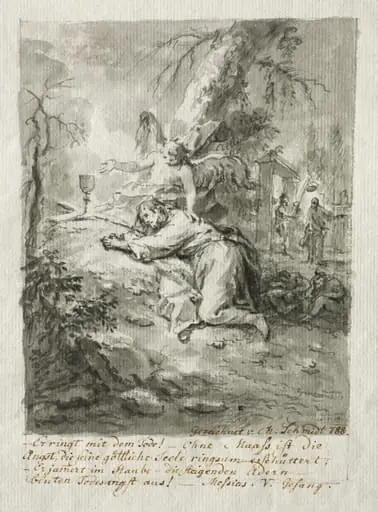
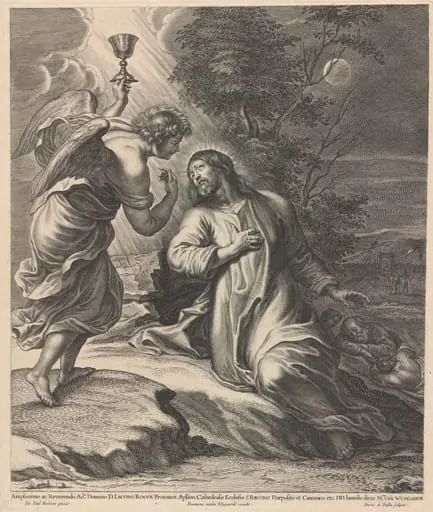
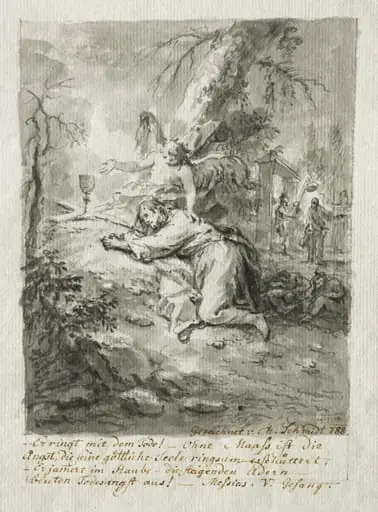
Christ Praying on the Mount of Olives is a print by Jean Charles Flipart. It dates from 1750 and is held in the collection of the Victoria and Albert Museum. This print on paper portrays Christ in prayer on the Mount of Olives, rendered in monochrome ink.
About this work
Overview
This print on paper portrays Christ in prayer on the Mount of Olives, rendered in monochrome ink. It is an engraving by Jean Charles Flipart, based on a composition originally devised by Raphael. The scene captures a moment of spiritual tension, framed by dense foliage and uneven ground, with figures rendered in stark contrasts of black and white to emphasize emotional gravity and spatial depth.
Subject & Meaning
The central figure, Christ, stands with arms raised in supplication, his posture conveying both vulnerability and resolve.
The central figure, Christ, stands with arms raised in supplication, his posture conveying both vulnerability and resolve. Two disciples kneel nearby, their slumped forms suggesting exhaustion and sorrow. The scene references the biblical moment before Christ’s arrest, when he prayed for strength amid impending suffering. The isolation of the figures within the darkened grove underscores their solitude and the weight of divine destiny.
Technique & Style
Flipart employed fine, controlled lines to model form through chiaroscuro, using deep shadows and sharp highlights to define volume and texture. The folds of Christ’s robe are rendered with precision, responding to implied light sources, while the tangled trees and rocky terrain are suggested through dense hatching. The absence of color focuses attention on gesture and contrast, enhancing the emotional intensity of the scene.
History & Provenance
Created in the 18th century, the print derives from Raphael’s early 16th-century design, which was widely disseminated through reproductive engravings. Flipart, a French engraver known for translating Old Master compositions into print, adapted Raphael’s work for a broader audience. The print likely circulated among collectors and religious institutions, preserving Raphael’s composition beyond the original painting’s physical limits.
Context
During the 18th century, reproductive prints served as primary means of accessing renowned artworks for those without access to original paintings. Raphael’s religious scenes remained influential, and engravings like this one reinforced devotional imagery across Europe. Flipart’s version reflects the enduring appeal of High Renaissance compositions, adapted to contemporary printmaking standards and tastes.
Legacy
This print contributed to the continued visibility of Raphael’s compositional ideas in the centuries following his death. By translating his design into a widely reproducible format, Flipart ensured its presence in private collections and educational settings. The work stands as an example of how engraving preserved and transmitted artistic heritage before the age of photography.
Artist & collection
Artist
A printmaker working in late 17th- to mid-18th-century Paris, Jean Charles Flipart carved religious scenes meant for home devotion.