Artwork
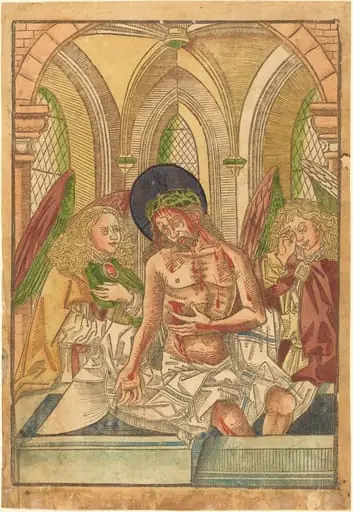
The Man of Sorrows with a Franciscan
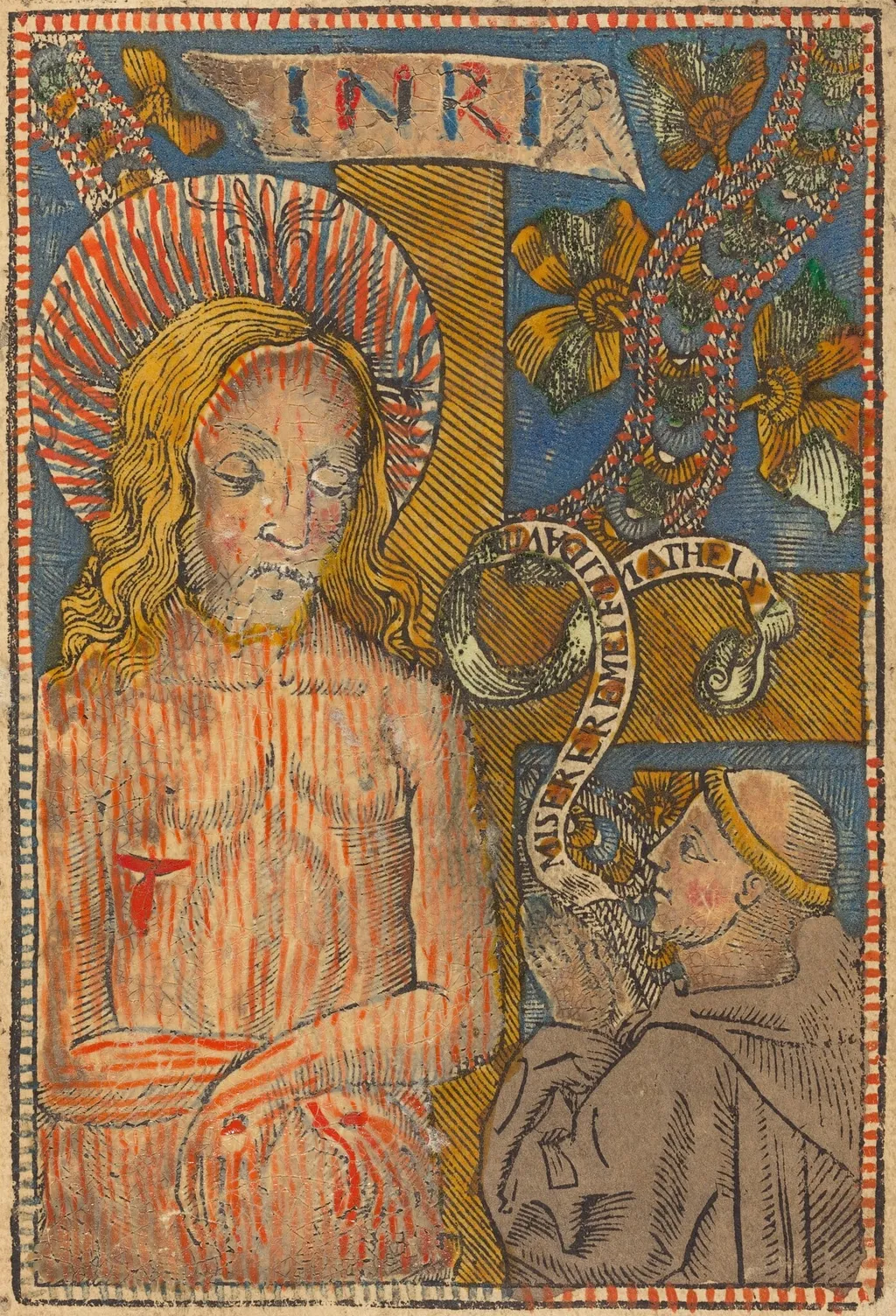
The Man of Sorrows with a Franciscan is an ink print by the Renaissance artist French 15th Century. It dates from 1495 and is held in the collection of the National Gallery of Art.
About this work
This painting is an example of a woodcut from the Renaissance period, and you can learn more about this technique by looking up the artist French 15th Century.
The painting depicts a man with long hair and a beard, wearing a red robe with a red cross on his chest. He is positioned on the left side of the image, with his head tilted slightly to the right. To his right, a figure in a brown robe is shown in profile, facing the man. The background of the painting features a blue sky with yellow and orange flowers.
A banner above the man's head reads "INRI" in red and blue letters. The overall atmosphere of the painting is one of solemnity and reverence.
This painting is an example of a woodcut from the Renaissance period, and you can learn more about this technique by looking up the artist French 15th Century.
Overview
The work, titled *The Man of Sorrows with a Franciscan*, is a hand‑colored woodcut from the Renaissance era. Executed on paper, the print combines black‑line carving with applied pigments in red, blue, green‑yellow, gray and flesh tones, giving the image a modestly vivid appearance while retaining the graphic clarity of the medium.
Subject & Meaning
At the left edge a bearded figure in a red robe bearing a red cross gazes solemnly, his head inclined slightly toward the right. Above him a banner bears the inscription INRI in red and blue lettering, identifying the figure as Christ in his suffering. To the right, a secondary figure in a brown habit appears in profile, suggesting a Franciscan companion or witness, reinforcing the devotional context of the scene.
Technique & Style
The image is produced by carving a design into a wooden block, inking the raised surfaces, and pressing the paper to transfer the line work. After printing, the artist applied watercolor pigments by hand, a common practice for enhancing woodcuts intended for private devotion. The palette—limited yet contrasting—highlights the red robe and the banner while the background sky is rendered in a muted blue, punctuated by stylized yellow‑orange flowers.
History & Provenance
The print belongs to the French tradition of 15th‑century woodcut production, a period when artisans combined religious iconography with emerging print technologies. Although the specific maker is not recorded, the work reflects the workshop practices of the time, where prints were often circulated among clergy and lay patrons for personal contemplation.
Context
During the Renaissance, images of the Man of Sorrows served as focal points for meditation on Christ’s Passion. The inclusion of a Franciscan figure aligns with the order’s emphasis on poverty and empathy with Christ’s suffering, linking the visual narrative to contemporary devotional trends within the Catholic Church.
Artist & collection

Artist
This artist hid their best work inside old travel trunks. They glued vivid woodcuts into the lids of wooden boxes meant to be carried on horseback, like secret postcards from God. If you’ve ever pried open a cracked lid…

![Ecce Homo [verso], by German 15th Century](https://artifactworldgallery.com/img/german-15th-century--ecce-homo-verso--355663726e7bd572-w320.webp)