Artwork
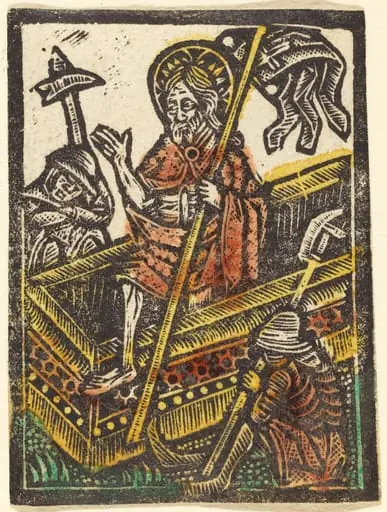
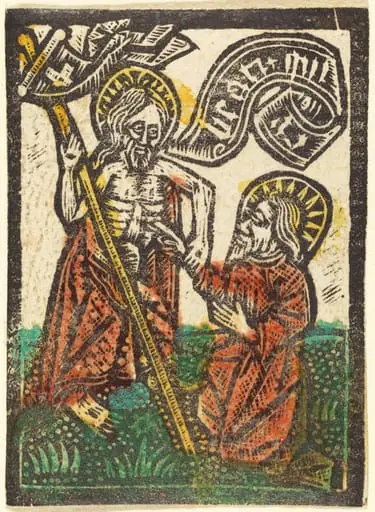
Christ Appearing to Saint Thomas
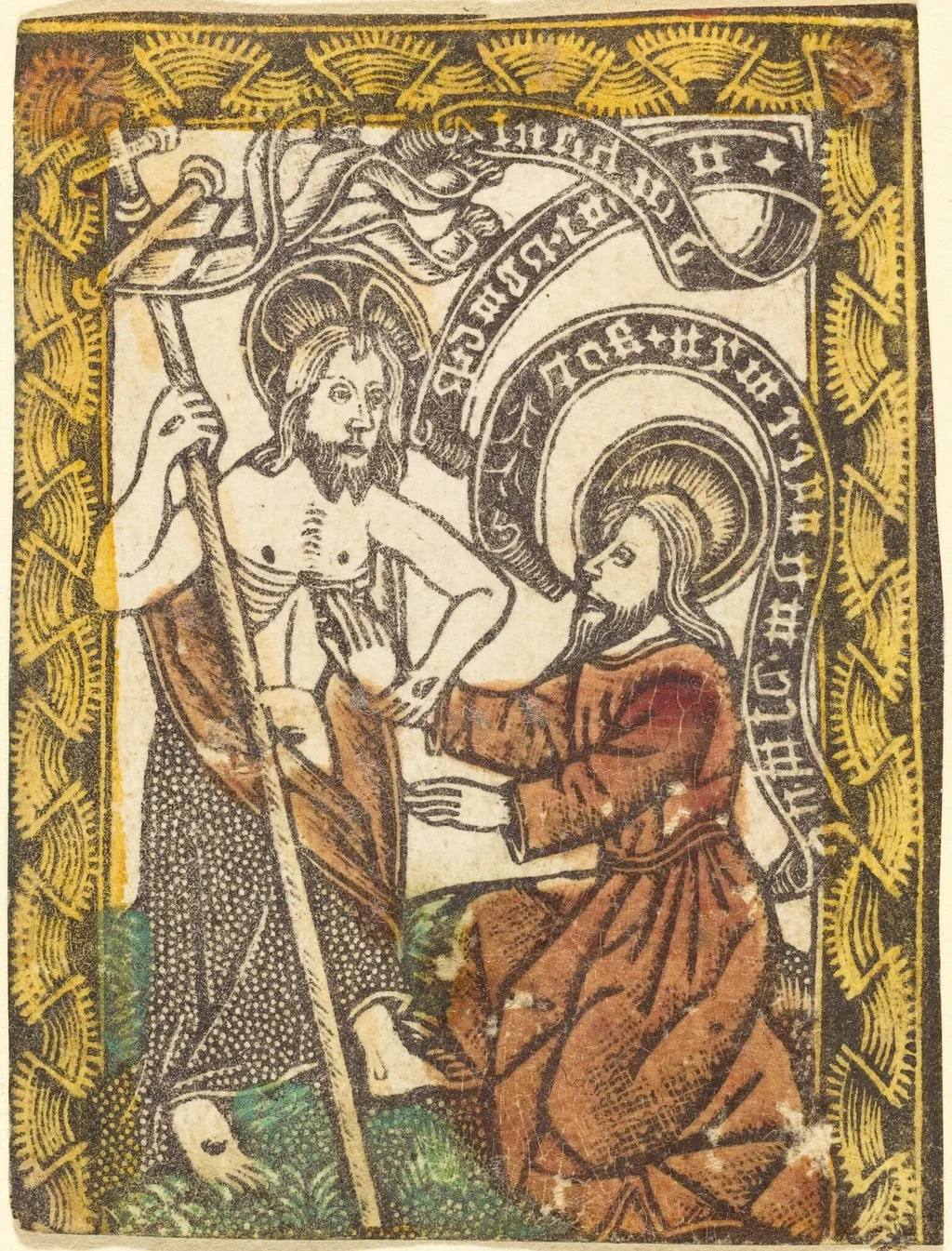
Christ Appearing to Saint Thomas is a paint print by the Renaissance artist German 15th Century. It dates from 1470 and is held in the collection of the National Gallery of Art.
About this work
Overview
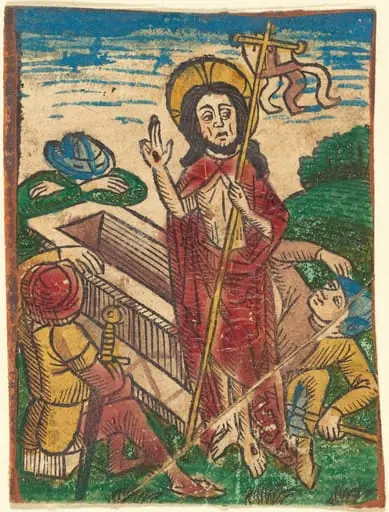
This metalcut print, enhanced with hand‑applied pigments of yellow, red‑brown lake and green, portrays the biblical episode in which the resurrected Christ reveals his side wound to the doubting Saint Thomas. The composition is confined to a modest interior space, framed by a decorative yellow border bearing stylised foliage.
Subject & Meaning
The central figures are the risen Christ, identifiable by his halo and the gesture of extending his wounded side, and Saint Thomas, whose own halo marks his sanctity. Thomas’s hand rests on the wound, embodying the moment of tactile confirmation that resolves his skepticism, a theme recurrent in Christian art as a testament to faith through evidence.
Technique & Style
Executed as a metalcut, the image is defined by crisp, incised lines that produce a stark, graphic quality. The subsequent hand‑coloring adds flat areas of pigment without modelling, preserving the print’s linear emphasis. The use of a yellow ornamental border and leafy motifs reflects decorative conventions of early printmaking.
History & Provenance
The work belongs to the early modern period when metalcut prints were a common medium for disseminating religious imagery. While specific details of its creation and ownership are scarce, such prints were often produced for devotional use and circulated among private collectors and ecclesiastical patrons.
Context
The depiction of the Incredulity of Thomas aligns with Counter‑Reformation concerns, emphasizing the tangible reality of Christ’s resurrection. The straightforward visual language and accessible format of the print made the narrative readily understandable to a broad audience, complementing contemporary painted and sculptural treatments of the same subject.
Legacy
Prints of this type contributed to the spread of standardized iconography for biblical episodes, influencing later engravings and woodcuts. The combination of metalcut precision and hand‑coloring anticipates later developments in color printmaking, marking a transitional moment in the evolution of reproducible religious art.
Artist & collection

Artist
This 15th-century German artist carved vivid religious scenes into metal and wood, then hand-painted them in bright, symbolic colors.

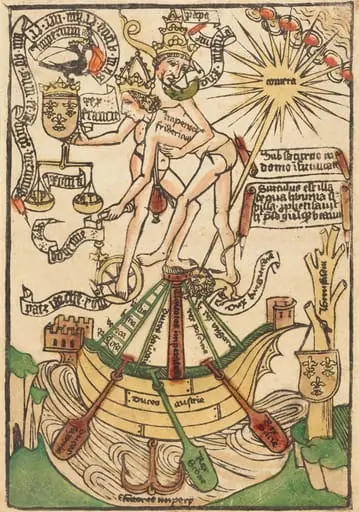 Allegory of the Meeting of Pope Paul II and Emperor Frederick III
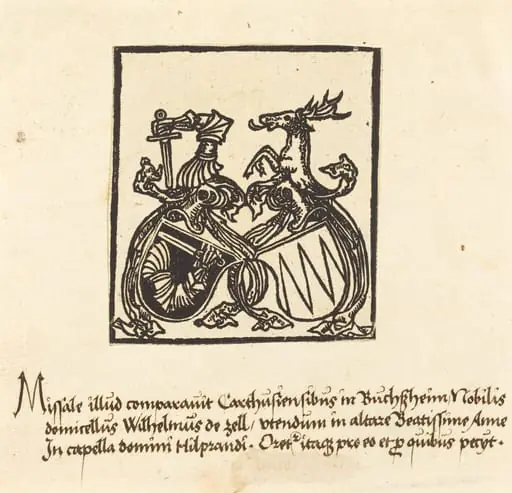 Bookplate of Wilhelm von Zell
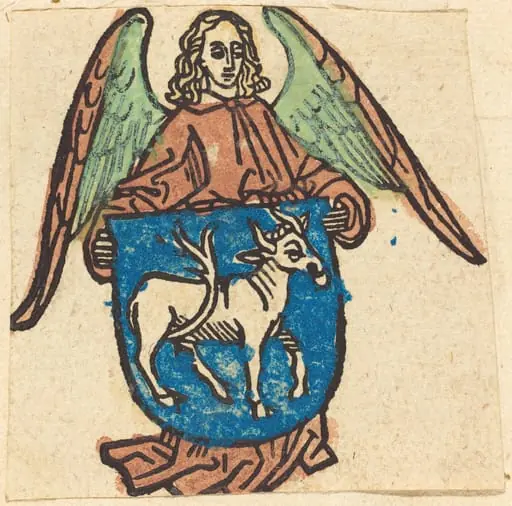 Bookplate of Hilprand Brandenburg of Bibrach
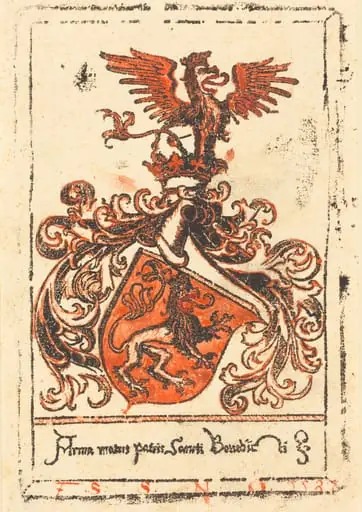 Bookplate of the Abbey of Ottobeuren
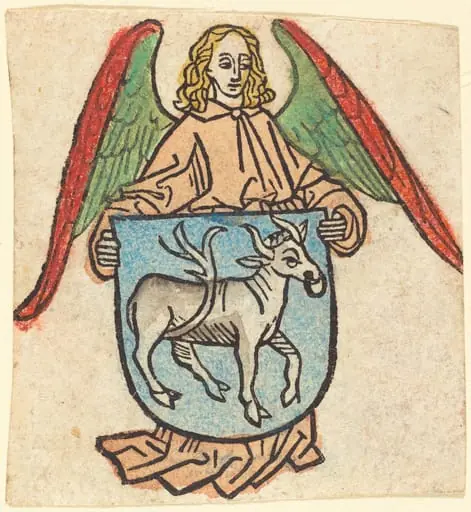 Bookplate of Hilprand Brandenburg of Bibrach
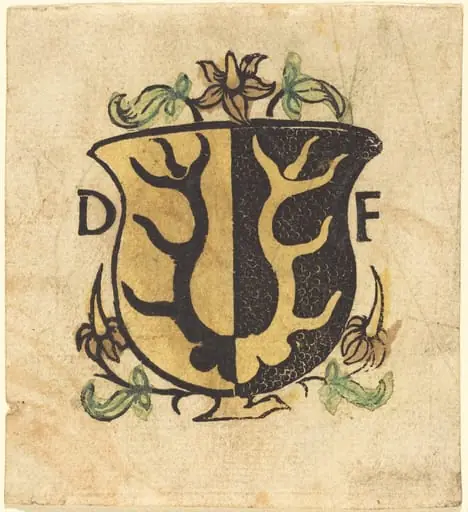 Bookplate of Dominicus Frauenfelder
![Studies for Six Figures (sheet from a model book) [recto], by German 15th Century](https://artifactworldgallery.com/img/german-15th-century--studies-for-six-figures-sheet-from-a-model-book-recto--4837429e0755bc3f-w320.webp) Studies for Six Figures (sheet from a model book) [recto]
Studies for Six Figures (sheet from a model book) [recto] Christ and Mary Interceding with God the Father