Artwork
Shrine of the Holy Sepulchre, Jerusalem
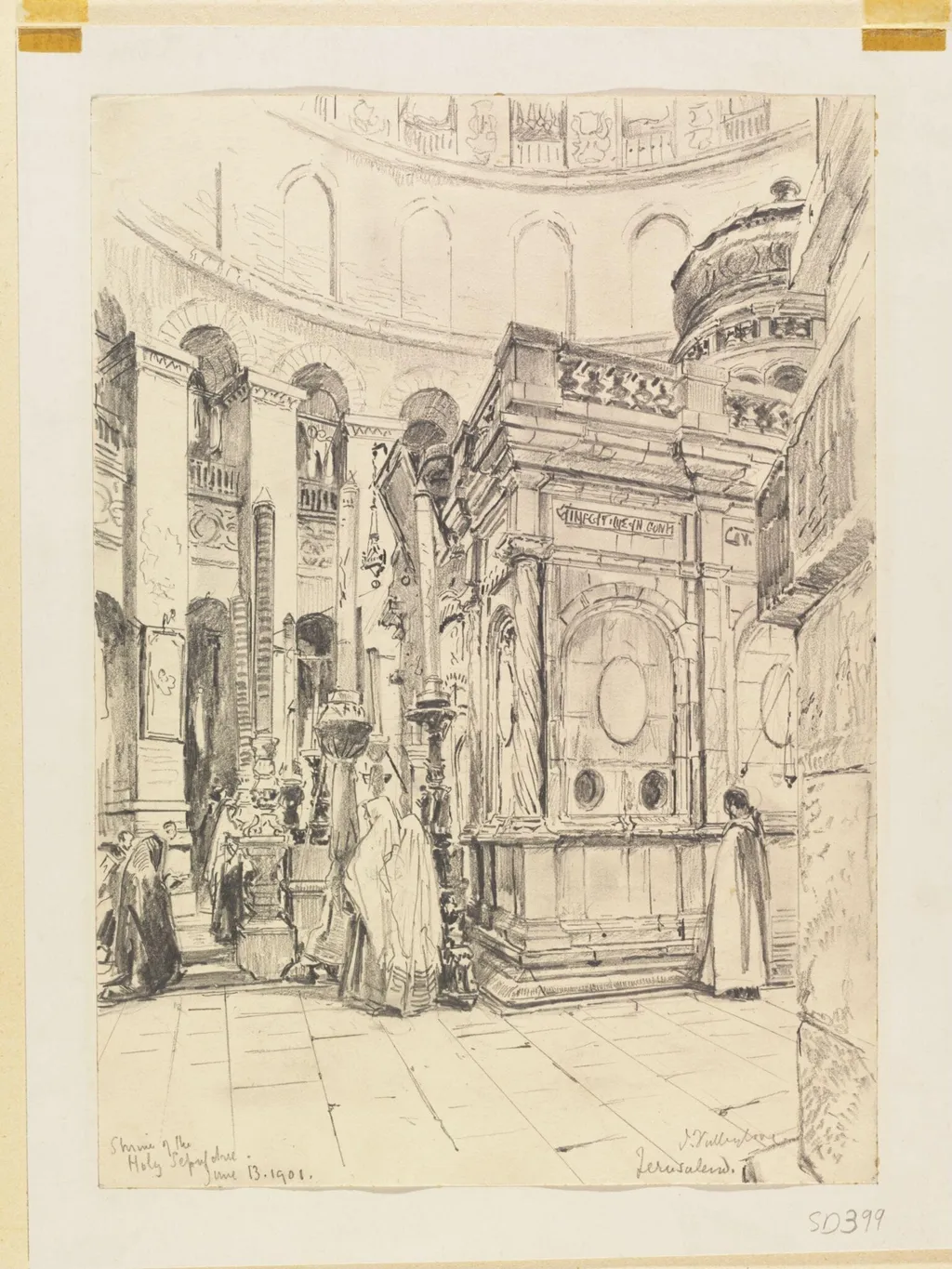
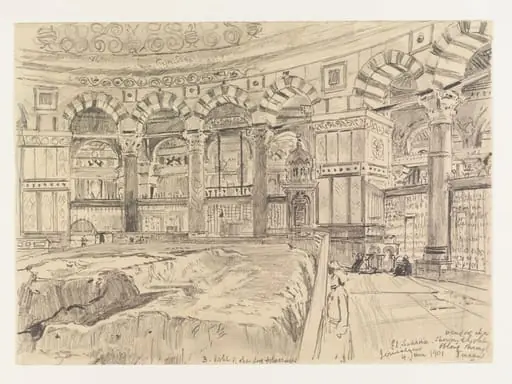
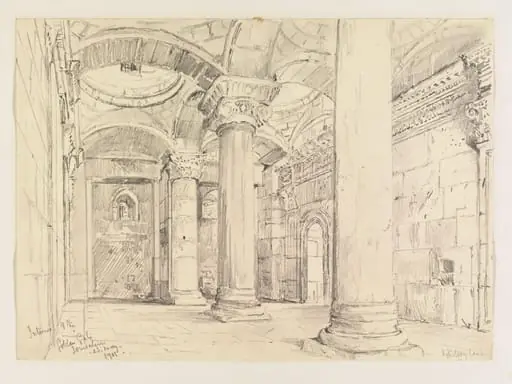
Shrine of the Holy Sepulchre, Jerusalem is a drawing by John Fulleylove. It dates from 1901 and is held in the collection of the Victoria and Albert Museum.
About this work
Overview
This 1901 drawing by John Fulleylove captures the interior of the Shrine of the Holy Sepulchre in Jerusalem. Created as a preparatory study for a watercolor exhibited in 1902, it forms part of a broader project tied to Fulleylove’s 1902 illustrated book on the Holy Land. The work reflects his systematic documentation of sacred sites through careful observation and detailed rendering.
Subject & Meaning
The drawing portrays the central rotunda of the Holy Sepulchre, dominated by the stone structure believed to enclose Christ’s tomb.
The drawing portrays the central rotunda of the Holy Sepulchre, dominated by the stone structure believed to enclose Christ’s tomb. Figures in traditional garments gather around it, suggesting pilgrimage and quiet devotion. The composition emphasizes the architectural weight of the space and the human presence within it, conveying a sense of enduring spiritual practice rather than theatrical spectacle.
Technique & Style
Fulleylove employed fine cross-hatching to model the textured surfaces of the stone walls and floor, building depth through layered pencil strokes. The careful attention to architectural detail and the subtle gradation of light and shadow reflect a topographical precision. Figures are rendered with minimal detail, allowing the architecture to remain the focal point while still suggesting movement and presence.
History & Provenance
The drawing was produced as part of Fulleylove’s research for his 1902 publication, *The Holy Land Painted by John Fulleylove*, with text by John Kelman. It remained in private hands until approximately 1967, when it was acquired by Rodney Searight from the dealer Schidlof. Its trajectory reflects the interest in Orientalist and religious topography among early 20th-century collectors.
Context
Fulleylove’s work emerged during a period of heightened European interest in biblical geography and archaeological documentation. His drawings were not merely artistic but served as visual records aligned with scholarly and devotional pursuits. The emphasis on accurate architectural representation aligned with contemporary efforts to map and preserve sites of religious significance in the Ottoman Empire.
Legacy
Fulleylove’s studies of the Holy Sepulchre contributed to a genre of travel-based topographical art that bridged documentation and reverence. While not widely known today, his work remains a valuable record of the site’s appearance at the turn of the century. Several of his related pieces are held in the Victoria and Albert Museum, preserving his contribution to the visual history of Jerusalem.
Artist & collection